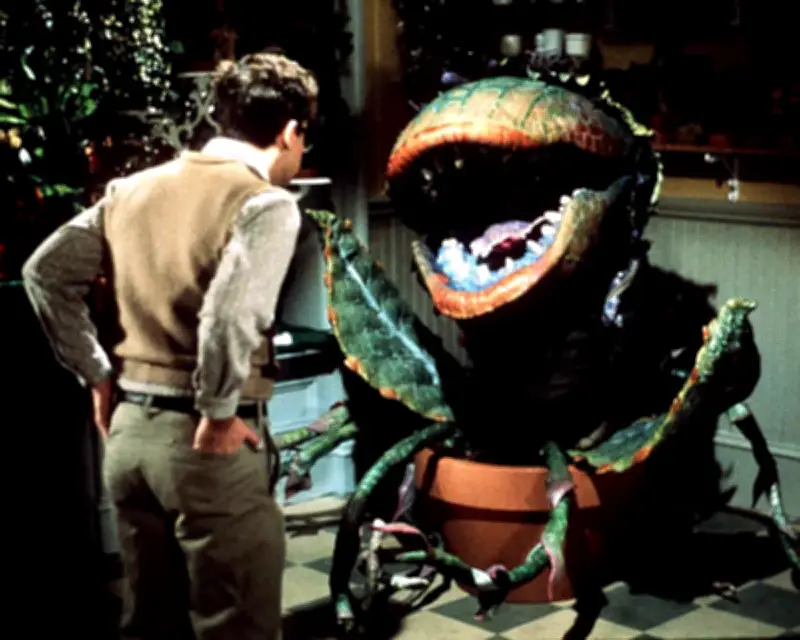
Frank Oz's film adaptation of the cult 1982 musical Little Shop of Horrors stands as a perfectly crafted piece of cinema, a hilarious send-up of B-movies featuring glorious songs by Howard Ashman and Alan Menken, the duo whose music would soon ignite the Disney Renaissance. At just 94 minutes, it avoids the second-act problems that plague many classic movie musicals.
A Miracle of Dumpster Diving
The film is a miracle of dumpster diving, adapting an almost-forgotten 1960 movie by indie legend Roger Corman, who didn't even bother to copyright his low-budget horror comedy. The story begins on Skid Row, a derelict, richly detailed cityscape with a lovingly obvious soundstage feel that most art departments left behind in the 1990s in favor of realism. Oz, the son of puppeteers and the first to perform both Yoda and Miss Piggy, had individuality and scene-setting in his DNA.
There we meet Seymour (Rick Moranis), a perennially orphaned adult who works alongside the ditzy bombshell Audrey (Ellen Greene) at a run-down flower shop owned by the miserly Mushnik (Vincent Gardenia). Their dreams of a better life arrive quickly when a mysterious plant Seymour has been secretly nurturing grows into a national sensation.
A Carnivorous Plant and a Memorable Cast
The trouble is that the plant, named Audrey II due to Seymour's affection for his co-worker, feeds exclusively on human blood. In classic Michigan J Frog fashion, the anthropomorphic Audrey II, voiced by the Four Tops' Levi Stubbs, only voices its carnivorous needs to Seymour, who must decide whether success and human Audrey's love are worth the carnage.
Greene, a holdover from the original stage production, gives an all-time weirdo performance that is massive, intimate and memorable, with pipes to make the celluloid rattle. She is surrounded by heavyweight 80s funnymen, including Steve Martin, Bill Murray and Christopher Guest. A high-concept horror-comedy with an all-star cast, Little Shop is a lot like Clue, released the previous year, which also grew a devoted cult reputation over time.
Anti-Capitalist Themes and Motown Score
Both are intelligent critiques of capitalism disguised as kooky popcorn fare, though "disguised" might not be the right word for Little Shop, which never hides its thematic concerns. Menken's score is a blend of doo-wop and rock'n'roll, but mostly Motown: a genre of romance, struggle and comfort. The original plot's fable-like message is aided by Ashman's cheeky anti-capitalist lyrics and, on film, Oz's remarkable visions.
The movie's first real number, Skid Row (Downtown), is a masterclass in placing its characters' individual desires against the backdrop of communal conflict. Every single shot is framed to acknowledge the individual's involvement in the class struggle, which increases with each foot-stomp and angry face in increasing desperation. Certain frames seem lifted straight out of classic Soviet propaganda.
Little Shop is exceptionally designed, performed and crafted, with no whiff of spotlight-seeking to detract from the greater project. Tapping into that strain of communal excellence is why Oz delivered one of the finest movie musicals of all time, building on what Ashman and Menken fertilized from Corman and screenwriter Charles B Griffith's seed of an idea. Little Shop of Horrors is available on VOD in the US and Australia and on Now TV in the UK.