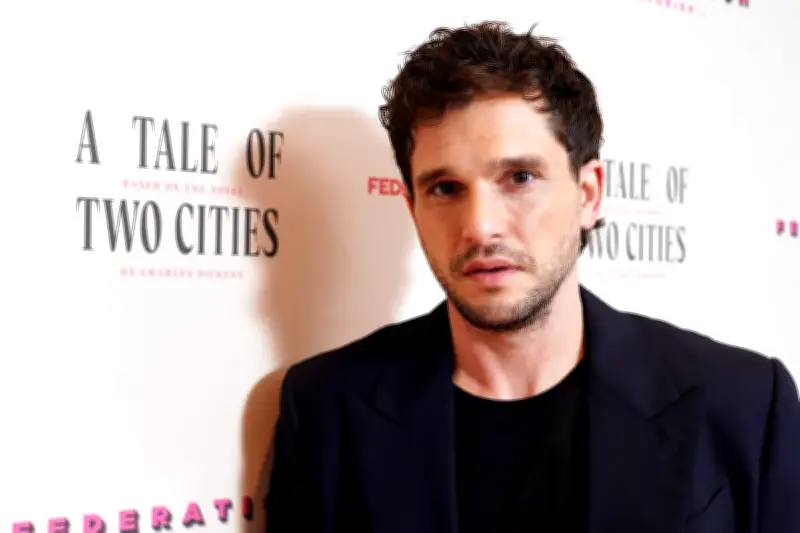
Kit Harington has said his A Tale Of Two Cities adaptation “takes some creative licence”. Published in 1859, Charles Dickens’ novel is set in London and Paris before and during the French Revolution.
It tells the story of French doctor Manette, who spends nearly two decades behind bars in the Bastille in Paris before being released to live in London with his daughter Lucie.
Modernising a classic
Written by Daniel West and directed by Richard Clark, the four-part BBC series stars Harington, Francois Civil and Mirren Mack as Sydney Carton, Charles Darnay and Lucie Manette.
Speaking exclusively to the Press Association at the premiere of the series, Harington said there was a concerted effort made to update the story for a modern audience.
“First and foremost, I hope the fans of this book and lovers of this novel are satisfied with what they see. I hope they will be,” he said.
“With any adaptation, you have to make certain changes. You have to kind of make it your own and have to modernise it. So, we did take some licence and I hope that people enjoy those changes we’ve made. It’s all in the spirit of trying to bring this story up to date.”
He continued: “Adapting it didn’t feel too much pressure in that it hasn’t been done in sort of 40-odd years but myself and Dan and others felt very strongly that this was a story worth telling right now. It has so much modern resonance and relevance.”
Bold and modern adaptation
Harington said that he felt “honoured” to be able to adapt the classic novel. However, West admitted he “wasn’t too worried” about keeping fans of the novel satisfied.
“I think with an adaptation like this, because it’s so well read and so well loved, there’s always going to be a section of the audience who come to it with their own expectations, but we really focused on trying to make a bold and modern adaptation, and an adaptation in the true sense of the word,” he said.
“So, taking the themes and the characters and all the kind of architecture of the book, but giving ourselves the licence to focus in on or amplify certain relationships and characters.”
He added that Dickens’ writing was “extraordinary and resonates down through the ages”.
“But this particular one feels like an incredibly prescient story for right now, at the moment that we’re in, and I’m not sure that that’s necessarily a good thing, but it definitely feels like that sense of social discord and polarised society is very topical,” he added.
Lucie at the heart
Set between London and Paris in 1782, the series takes place at a time where “tensions run high in the war between France and Britain”.
The synopsis for the series has teased: “A young woman, Lucie Manette has her life upended when she receives a message from Paris – her father, assumed dead for almost 20 years, may be alive. The messenger – idealistic French emigre, Charles Darnay – is arrested and charged with treason.
“Lucie enlists the help of a brilliant but erratic young lawyer, Sydney Carton, to free Darnay in the hope he will lead her to Paris to track down her father. Lucie’s collision with Darnay and Carton unleashes a powerful and complex love triangle. Both men fight to be worthy of her love, and Lucie is torn over which one to choose.”
The two men also find themselves “bound together in life and death, through triumphs, tragedies, marriage, and murder”.
West added that one major change from the novel was focusing more on Lucie and giving her more agency.
“One of the biggest changes was making sure Lucie was always the heartbeat of the show, the one driving the action and the agent of change in her own life,” he said.
“The three main characters I wanted to feel contemporary and compelling and three dimensional, and people that the audience wanted to spend time with and were really invested in.”
Harington said Lucie and Charles were characters “lost to time because they’re not so fleshed out and real and rounded” in the novel.
Mack said of her version of the character: “She’s so driven in what she wants out of life. She refuses to accept the parameters that have been set for her as a woman in that time, and she bursts out of them with so much love and curiosity.”
The actress added that the love triangle at the heart of the show had been turned on its head.
“I think this is the first time I’ve seen someone who is genuinely in love with more than one person and can see two whole different lives that they could choose to live. And so, for me, it was really amazing to get to explore that because Lucy was torn from scene to scene on who she loved,” she said.
After previously working on an adaptation of The Three Musketeers in France, Civil said he “knows what it is to try and confront the expectations of the fans”.
“I would say that every time you adapt something, you betray a bit the piece, but it’s part of the trying to get a fresh look on the piece, and I think that passion shows in this production.”
A Tale Of Two Cities will screen on the BBC later this year.