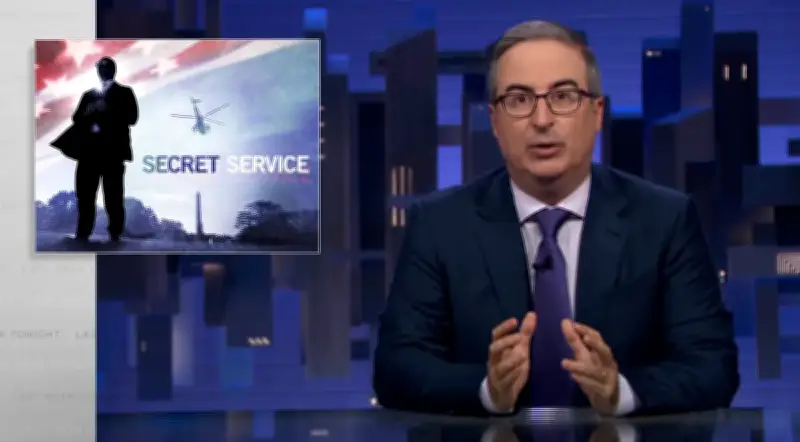
On the latest episode of Last Week Tonight, John Oliver examined the Secret Service, the agency tasked with protecting the US president among other duties. "Agents have a high-stakes job, and that's what makes it so worrisome that by all accounts the Secret Service is heading into what might be one of its most challenging periods yet," the host said, referring to 2028, or what some agents have called "Armageddon," as the service will be responsible for staffing the LA Olympics and Paralympics, the annual United Nations general assembly, and the two presidential candidates and their families during the election.
A recruitment ad with a Butler photo
The Secret Service recruited action movie director Michael Bay to direct a Super Bowl recruitment ad asserting that "protectors are born, not made," including a photo from the July 2024 rally in Butler, Pennsylvania, where Trump was shot in the ear. "That is not exactly a triumphant moment for them, is it?" Oliver noted. "It's a bit odd to choose to self-promote using an image of yourself at your lowest."
Oliver delved into the agency's "inauspicious" origin story: it was formed by Abraham Lincoln, who signed legislation authorizing it mere hours before he was assassinated by John Wilkes Booth while attending a show at Ford's Theatre. Secret Service agents were originally tasked with cracking down on counterfeit paper money. It was only in the early 20th century, after the assassinations of James A Garfield and William McKinley, that they became bodyguards to the president.
Stretched thin with more duties
Modern Secret Service agents now provide presidential protection, though counterfeiting investigations are still an important part of the mandate, and agents from 115 field offices across the country are also tasked with catching credit card skimmers, romance scammers, and other low-level financial crimes. "Which is kind of incredible," said Oliver. "It's like getting in a bad car accident and getting saved by Ryan Seacrest – hold on, this is one of your jobs, too? You're taking a lot on."
"Some agents will insist that those investigations are what keep their minds sharp, and that it can also help establish relationships with local law enforcement," he added. "But that is still a lot to be putting on their plate, especially when that plate is already pretty full."
Agents' protective duty extends not just to the president but their family, the vice-president, former presidents and spouses, visiting heads of foreign states or governments, distinguished foreign visitors, and major presidential and vice-presidential candidates. The job can be very difficult, requiring hours of advance work and punishingly long shifts on top of the psychological burden of being ready to take a bullet for someone, yet with salaries subject to a federal cap, and overtime hours often worked for free.
"For as high as the stakes of their job are, they've consistently been stretched worryingly thin in terms of manpower and resources," said Oliver, manifesting in an unofficial agency slogan "we do more with less." Rather than build a full-scale replica White House for training, agents have been sent to practice on an 80% scale version in Atlanta, built as a TV set by Tyler Perry.
Threats and security breaches
"So the agency is often stretched extremely thin, and that's happened even as their duties have increased," said Oliver. During the last presidential election, Secret Service agents were tasked with protection of 43 individuals around the clock, and the Trump family has taken twelve times more family trips than the Obama family. "And if there's any member of the Trump family watching this right now who's learning for the first time that the rest of your family has been taking over 1,600 trips without you, then I'm truly sorry you had to find out this way whoever you are, Eric," Oliver quipped.
"The point is, the agency is clearly under significant strain, but even that doesn't completely account for the number of inexplicable fuck-ups there have been, which have happened at an accelerating rate ever since the start of the Obama presidency," Oliver continued. "Now that was a moment where admittedly, their job did become much more difficult," as the agency experienced a 400% increase in the number of threats against the president. "And if you do not know why violent threats went up from this guy to this guy," he added next to photos of George W Bush and then Obama, "I've got some interesting news for you: you are a liar."
"And with threats on the rise, you'd think the agency would've been on high alert. Which is what makes it so weird that they had a number of security breaches and scandals" long forgotten, like a man who in 2014 scaled the White House fence with a knife and made it into the building, as the front doors weren't locked. Or, perhaps more humiliating, a scandal involving a sex worker in Colombia in 2011 that compromised information about the president's whereabouts, revealing systemic culture issues within the agency.
Butler and the call for reform
"All of this – an exhausted workforce stretched way too thin, limited resources and some truly poor judgment – all came to a head in Butler, Pennsylvania," Oliver explained. On top of the many errors made that day – among them, not securing the building next door where the shooter went on to the roof, and not drone-proofing the area due to a technical glitch and lack of ethernet cables – a report found that agents had racked up 1.2m overtime hours that year with consecutive shifts and little recuperative rest, contributing to burnout and attrition.
An independent review of the service concluded that the agency "requires fundamental reform to carry out its mission … without that reform, another Butler can and will happen again."
Oliver called for a larger budget spent more wisely, but noted that, as stated in the report, even an unlimited budget would not prevent another Butler. "And that is because when a problem is this persistent and cultural, it needs a much deeper level of intervention," he concluded. "Look, this job ideally requires people who are incredibly brave and incredibly skilled. It's a job that I personally could not and should not do. But the very fact that it's such an important job means that the agency having an insular culture built around doing more with less isn't just exhausting for the agents involved. It can be actively reckless."