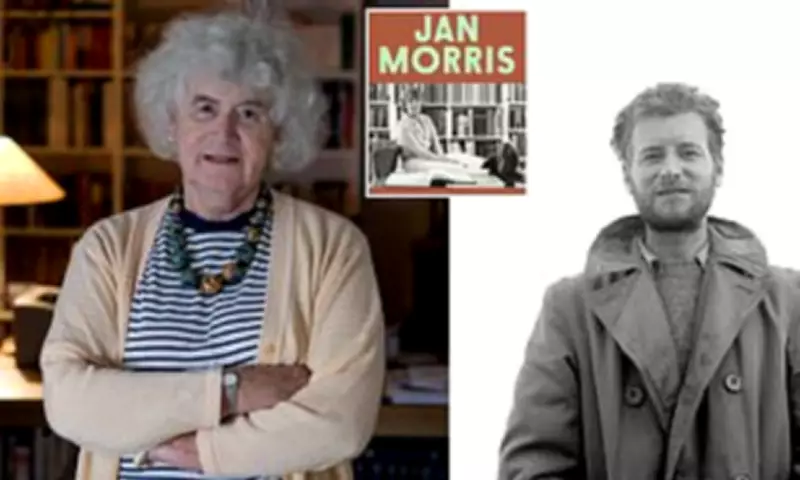
At a Buckingham Palace event in 1999, Jan Morris asked the late Queen if she remembered hearing, on the eve of her coronation, that Everest had been climbed. 'Yes, of course I remember,' replied Her Majesty. 'I was the person,' said Morris, wearing a string of plastic beads, 'who brought the news back.' The Queen's eyes 'went cold'. This white-haired lady had been the bronzed young man described at the time as 'the most famous journalist in the world'.
If this sounds confusing it is because Jan Morris courted confusion throughout 94 years. A staunch Welsh republican who romanticised imperialism and gratefully accepted a CBE, a preacher of kindness accused of unspeakable parental cruelty by her daughter, she lived the first half of her life as a man and the second as a woman. Ultimately, Sara Wheeler picked up an awfully slippery fish when she took on this impressive biography.
Early Life and Career
James Morris was born in 1926 as the youngest of three ferociously intelligent children in a lower middle-class family in Somerset. He was sent to school in Oxford on a full scholarship at the age of 12. From then on success and adventures followed him like a faithful dog. His youthful escapades read like some of the best Tintin comics. After a brief sojourn in the military, with plush Italian post-war postings in Venice and Trieste, he signed up to The Times trainee scheme. Editors noticed his brilliance and fast-tracked him to full-time staff writer.

When, aged 27, he was commissioned to report on Edmund Hillary's 1953 Mount Everest expedition, he ascended the first 22,000 ft with the team before bringing the world the news that the summit had been reached. Other journalistic coups included travelling through the Arabian desert with the Sultan of the Oman and his army of slaves, reporting on the 1961 trial of Adolf Eichmann in the aftermath of the Holocaust, and interviewing Cuban Revolution leader Che Guevara. All while pumping out books like they were going out of fashion.
Personal Life and Marriage
It is a wonder that Morris had any room for a personal life, but just before joining The Times he fell in love with, and married, Elizabeth Tuckniss. They would stay together for the duration of Morris's life. Morris adored Elizabeth, yet his ambitions trumped any impulse to be a good husband and father. A workaholic is often running from something, and Morris was no exception. He first experienced the 'mystic conviction' that he was in the wrong body when, aged four, he was sat playing under his mother's piano.
Morris could describe the spirit of a place better than anyone, but articulating what it felt like to be transgender always eluded her. It was simply a fact like any other, as difficult as describing what it feels like to have blue eyes. James had told Elizabeth that he was transgender when they met, but there is curiously little detail in Wheeler's biography on her reaction to this. But as Wheeler puts it, 'there were three people in the marriage, and two of them were Elizabeth's husband'. Morris's work and 'insoluble yearnings of the internal life left no room for other people'.
Morris had five children, including Virginia, who died at only a month old of meningitis. According to daughter Suki, who has written a scathing article describing Morris as 'a lousy parent' who 'damaged all four living children one way or another', he 'refused to go into the hospital with Elizabeth to see Virginia' when she was dying.
Transition and Later Life
By the 1950s, he was convinced he must 'transition or die'. Morris began to take primitive oestrogen pills in 1959, but the side-effects of bloating and nausea were too awful to bear. However, James's journey to becoming Jan was under way. Jan experimented with all sorts of pills (about 12,000) including hormone tablets made from synthesising the urine from pregnant mares. As the hormones influenced her fat distribution, she developed breast tissue. Through the 1960s she flitted between life as a man and a woman, and was a member of both men's and women's-only London clubs. Friends were confused, but overall supportive. Prejudice was minimal and can be summed up by an anecdote Wheeler shares of a flustered hostess preparing a dinner party complaining that 'James Morris is coming as a woman, and it's thrown the seating plan'.

In 1970 Morris asked her children to call her Jan. Suki, then aged six, recalled that every time she said 'daddy', Jan refused to answer. Jan finally underwent gender-reassignment surgery in 1972 in Casablanca. The operation took only an hour, and she wrote to Elizabeth to thank her for her patience and kindness. The surgery itself, she wrote, 'would make an excellent and not unentertaining piece of memoir!' She was right. Her trans memoir Conundrum was published in 1974, and well received – giving her a second taste of stardom. No longer the bronzed hero of Everest, she now looked like a 'Walmart version of the Queen'.
After her sex change, Elizabeth and Jan got a divorce but remained living together. Morris continued to produce shelf-loads of books. There was a biography of Admiral Fisher (the First Sea Lord), with whom she vowed to have an affair in the afterlife, her marvellous history of the British Empire, and endless travel writing. What she didn't fixate on was her sex change. When asked about it, Morris said nothing, or repeated the lines she had practised when promoting her memoir. Being a woman was an integral part of her life she didn't want to delve too far into it.
Legacy
Morris often joked that her obituaries would be headlined 'Sex change writer dies', which thankfully never came true after her death in 2020. However, transitioning in middle age is hardly something a biographer can ignore. It is the centrepiece in this fascinating book, but Wheeler shows it is far from the only thing for which her subject ought to be remembered. Morris was a complex and extraordinary person, and her books, like Wheeler's biography, will attest to that for many years to come. 'Morris was the 20th century,' says Wheeler. She also remains a conundrum.