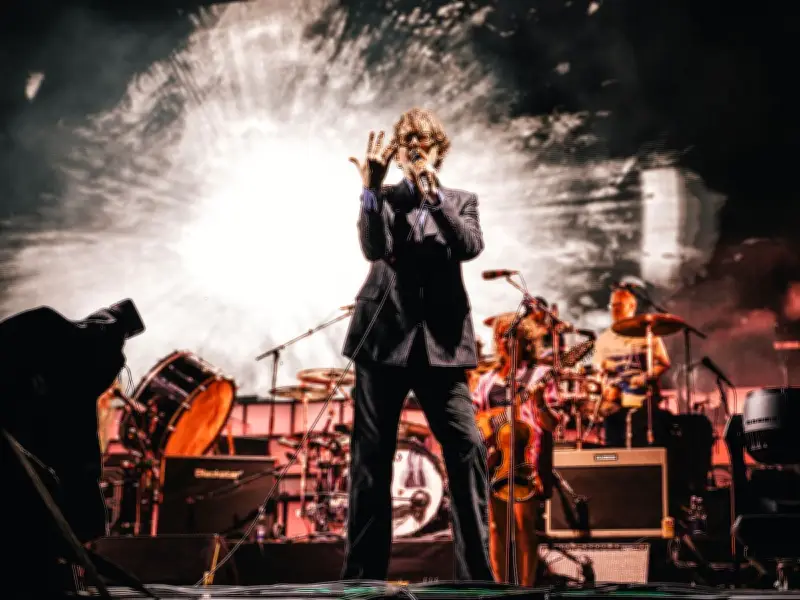
Better known for its steel than its music, over the decades, Sheffield has produced incredible acts, from The Human League to the Arctic Monkeys, Pulp and Def Leppard. A year after one of the city's most iconic venues, The Leadmill, closed its doors, a new book - Groovy, Laidback and Nasty by Daniel Dylan Wray - explains how, despite being torn apart by the Second World War and devastated by the Thatcher government, Sheffield managed to sound so good.
A City of Individuality
Daniel says: "None of the artists who've come out of Sheffield over the years sound alike. Most cities - like Manchester or Liverpool - are usually connected by a sound or a scene or a genre. The thing that connects Sheffield throughout the years is this singularity and individuality. Everyone's a bit wonky, everyone's a bit strange, and nothing really sounds like anywhere else."
Post-War Beginnings
The story starts in the rubble of the war. "It was a rough, tough, working-class city, slow to recover from the devastation of the blitz," says Terry Thornton, who opened Club 60 in a damp beer cellar under the Acorn Inn in 1960. Everything closed at 10pm. If you were out on the streets after dark you were either a burglar or going to start a night shift."

But resourceful Sheffield folk rebuilt their city. "Sheffield subsumed a lot of villages, and all of those villages were places of work - primarily coal mines," says Daniel. "A lot of people would all go to the same place of work, do the same job, earn the same pay. There wasn't a have and have-not attitude between people. It's not cool to brag, it's not cool to crow or be a bighead."
Park Hill flats, the vast brutalist housing estate overlooking the railway station, is another reminder of the city's history, etched into the skyline. Built in 1961 to replace Sheffield's slum housing, it is the largest Grade II listed building in Europe.
Musical Landmarks
Daniel continues: "The second you walk off a train, you turn around and it's there." Many other buildings have a musical connection. Daniel says: "The Hallamshire Hotel is just a pub now, but upstairs was where Pulp used to put on little avant-garde plays. Western Works, a former cutlery factory, was the first place New Order ever recorded anything."
The Human League, formed in 1977, were closely entwined with the venue. Philip Oakey had never sung a note when Martyn Ware gave him the job - on the basis, Ware later admitted, that he had a good haircut and a good record collection. Joe Elliott, of Def Leppard - launched the same year - says: "We literally were the only rock band. We were the bas***d sons of Sheffield."
The band raised £148.50 to record their debut EP in Hull and spent the remaining £1.50 on fish and chips in the car on the way home, while Joe and his mother glued 1,000 sleeves together on the kitchen table. Martin Fry, lead vocalist of ABC, told producer Trevor Horn: "If you produce us, you'll be the most fashionable producer in the world."
But Jarvis Cocker's band Pulp, which he formed in 1978 at school, was going nowhere - arriving at their first Sheffield show in a borrowed greengrocer's van, stinking of cabbage. Jarvis's lucky break came after shoving a demo into a national DJ's hands. "I took my chance," he said. "Five days later the phone rang at my grandmother's house. This was heaven. A dream come true."
Industrial Decline and Musical Escape
When the steel industry collapsed and unemployment rocketed through the 1980s, the city struggled. Daniel says: "There was a huge feeling of despondency and loss. Unemployment was spiking hugely, opportunity was dwindling, everywhere was shut down. For a lot of people growing up during that period, music was their escape."
Meanwhile, Sheffield's socialist council stepped up - putting 45% of its population in council housing - more than anywhere else in Britain. It also kept bus fares at 2p. The founders of the legendary venue, The Leadmill - opened in 1980 and closed in June 2025 after a legal wrangle with landlord - recruited teams of unemployed Sheffield workers to build it.

Jive Turkey and Bleep Techno
From the same rubble came a club night called Jive Turkey, which started importing Chicago house music. At its height, the DJ booth was a windowless broom cupboard, with decks propped up on stolen breeze blocks. "I absolutely loved it in that broom cupboard," says DJ Parrot, one of its residents. "Nights are about dancers, not DJs."
Daniel sees the club and its DJs as the perfect illustration of the city's character. Of the DJs, he says: "They were literally locked away in a windowless broom cupboard, and that was where they were happiest. These sort of quiet, humble pioneers. The focus is on the music. Not on the fanfare."
Blown away by a track by bleep techno duo Sweet Exorcist, club regular Jarvis Cocker asked DJ Parrot what it was, discovering it was his own record. Using equipment from his Central Saint Martins art course, Jarvis ended up directing the music video for it. "No one would really associate Pulp with bleep techno," says Daniel. "But there was this little overlap. It captures the cross-pollination that's always existed in the city."
The 1990s Recovery and Arctic Monkeys
By the 1990s, Sheffield was recovering and the council created a Cultural Industries Quarter, drawing galleries, a cinema and recording studios into spaces the steel industry had vacated. The city's first new nightclub in 12 years, The Republic, opened in a former steelworks in 1995. Gatecrasher moved in a year later and became one of the biggest clubs in the world. And in 2005, music bible the NME wrote: "Forget LA, New York or London … Yorkshire is the best new band scene in Britain."
In the early 2000s, four childhood friends from High Green, a north Sheffield suburb near Barnsley, formed Arctic Monkeys. Drummer Matt Heiders said: "Instead of deciding which house to go and egg that night, we were like, why don't we start a band." Their first gig was in 2003 in the upstairs room of The Grapes, a cash-only pub in the city centre.
When they won the Mercury Prize in 2006, Arctic Monkeys star Alex Turner shuffled to the microphone and said: "Someone call 999, Richard Hawley's been robbed." HMV reported a 336% increase in Hawley's sales in the days that followed. Singer-songwriter Hawley, who grew up in Sheffield and first found wider fame as a touring guitarist for Pulp, went on to become one of the city's most beloved figures.
His 2005 album Coles Corner - named after a meeting place for young lovers outside a Sheffield department store - is now regarded as a classic. Even Meadowhall Shopping Centre was referenced by Rebecca Lucy Taylor, aka Self Esteem, who headlined Glastonbury in 2022 wearing bra cups cast from 3D-printed replicas of the centre's domes.
A Humble Legacy
Daniel says: "I think one of the reasons why it's so beautiful how much amazing stuff has come out of Sheffield is that it was in spite of that bleakness. The city has produced great - and unique - artists."
Sheffield and its stars refused to become big headed. Daniel said: "Last time I saw Phil Oakey I was driving past and saw him - this guy synonymous with androgynous synth pop - and he was putting his bins out. It's quite charming - this guy doing something as boring as that. And that's what this city is about. It doesn't make people saints. It's all about the music."
*Groovy, Laidback and Nasty by Daniel Dylan Wray is published by White Rabbit priced £25