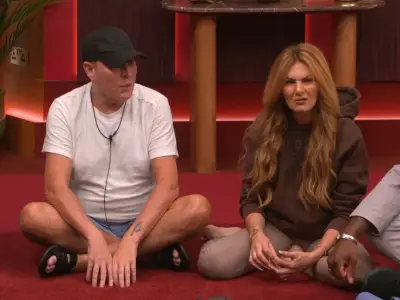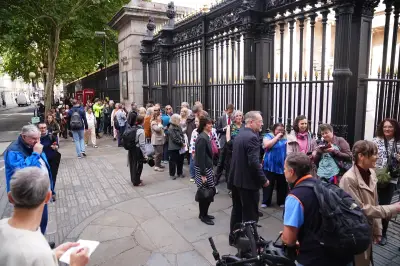
Gillian Anderson asked a group of women to stop repeatedly sitting in the front row of her West End show, and was subsequently accused of being rude, ungrateful and annoyed that her fans are 'supporting her too much'.
In a video filmed at the stage door of Who's Afraid of Virginia Woolf?, Anderson tells the group: 'You guys cannot sit in the front row. I don't care; you cannot sit in the front row. It's so distracting.'
'You can't come 20 times and sit in the front row, it'll drive me mad.'
Divided reactions and clarification
The video quickly went viral, and the response was divided. 'Imagine telling a fan they're supporting you too much,' one person argued, while others pointed out that the women had bought tickets and therefore had every right to sit wherever they wanted.
Anderson subsequently clarified on social media that these weren't random strangers she was addressing, but women she 'go[es] back over 20 years with', asking people not to attack them and explaining that @sohoplace is so intimate that performers 'can all see you' in the front row.
This has prompted its own slightly hysterical online debate about exactly who these women are. We don't know, but if they're really attending the play that often and waiting at the stage door afterwards, it seems safe to say they aren't casual fans.
Theatre etiquette and the nature of fandom
We can probably assume they're devoted members of Anderson's 'fandom,' a term used to describe people who aren't just fans of a celebrity or piece of media, but devoted, deeply invested members of a group who connect over their shared love of the subject of their fascination. Which is what makes 'they paid for their tickets' such a strange defence.
There is an obvious theatre-etiquette argument here. Who's Afraid of Virginia Woolf? is an emotionally gruelling, three-hour play performed in the round, with the front row reportedly about a foot from the actors at points. You don't need to behave badly to become distracting from that distance; even trying to catch an actor's eye could easily throw them off.
And live theatre depends on the relationship between actor and audience: one crowd laughs where another stays silent, tension shifts, and performers respond to the room. The audience isn't simply consuming the performance; it helps create it.
The parasocial dynamic
But I think the reaction to Anderson's stage door comments reveals something more interesting about modern fandom than just a lack of etiquette. The internet is often blamed for making fans believe they know celebrities personally, but it's important to identify that parasocial fandom can also have the opposite effect: it can dehumanise them.
A celebrity you adore becomes something to consume and collect. You collect shows, selfies, stage-door meetings, autographs, acknowledgements, moments of eye contact. Devotion becomes measurable: how many times you went, how close you got, whether they recognised you. And somewhere in that accumulation, the actual human being at the centre of the fandom can become secondary to what they provide: access, experiences, proof of proximity — all of it social currency within a community where devotion itself can become competitive.
Because if these fans love Anderson enough to spend the considerable time and money required to watch the same three-hour play from the front row more than 20 times, surely her feelings about their presence should matter to them.
Boundaries and reciprocity
I think that is precisely what made this exchange uncomfortable for some people: For a moment, a parasocial relationship became two-sided. Anderson noticed them, she recognised them, and then she expressed a preference of her own. Effectively, she said: 'If you are going to repeatedly place yourself a few feet from me while I work, wait for me afterwards and return often enough that I know who you are, then I also get to exist in this relationship. I get to tell you when something you do affects me. I get to say no.'
That is what closeness to an actual person involves. Other people can disappoint you, disagree with you, and set boundaries you don't like. You cannot be close to someone while retaining complete control over the terms of that closeness. A parasocial relationship offers an escape from that reciprocity because the celebrity in your head cannot reject you. Why? Because they aren't actually participating in the relationship.
Except, on this occasion, Anderson did. And suddenly, the argument online from people who thought Anderson was out of line became that there was no relationship at all. These women were simply customers who had purchased seats and could do whatever they wanted with them; Anderson is a product they are entitled to.
But you cannot claim the emotional significance of extraordinary closeness to another person the way devoted fans do and then, the moment that person expresses a need of her own, retreat into the language of a commercial transaction. Anderson wasn't asking these women to stop supporting her, or even to stop coming to see her play. She asked people who had apparently seen her perform more than 20 times to sit somewhere she couldn't see them quite so clearly, to give others a chance to sit in those particular seats.
If you really love watching somebody perform, and want them to do so to the absolute best of their ability, allowing them to forget you exist for three hours seems a remarkably small thing to ask. Because the moment their personhood becomes inconvenient to your enjoyment of them — the moment their discomfort matters less than your right to access them — the parasocial relationship has swallowed the person whole.