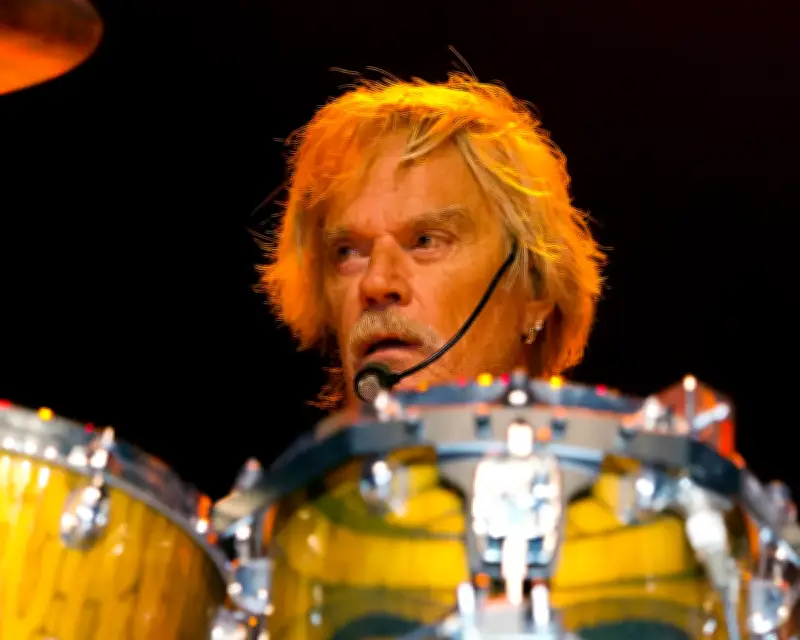
Frank Beard, the drummer for the Texan trio ZZ Top for more than five decades, has died aged 77. He was renowned for being the only member of the band not to wear an outlandishly luxuriant beard, despite his surname, and spent over 55 years as the band's drummer, appearing on all their albums from ZZ Top's First Album in 1971 to La Futura in 2012. He was also an indispensable fixture in their live performances, apart from brief interludes caused by illness in 2002 and 2005. Earlier this month, he was forced to miss further shows on ZZ Top's The Big One! Tour, including a date at the Hollywood Bowl.
Master of the 'Texas shuffle'
ZZ Top carved a singular niche for themselves with their unique blend of stripped-down blues and gutsy rock'n'roll, played with economy and focus. Beard was a master of the 'Texas shuffle' beat, of which the critic David Sinclair noted that 'it required looseness and absolute precision at the same time. ZZ Top's grooves swing hard, but they never drift.'
As a result, ZZ Top could claim to be prime exponents of 'chooglin'', a term coined by John Fogerty, the lead singer of Creedence Clearwater Revival, to describe music that was both punchy and muscular, yet laid-back and easy-rolling. The band demonstrated this impeccably time and again, on songs such as La Grange, Cheap Sunglasses or their superb version of the Sam & Dave classic, I Thank You. It sounds simple, but very few bands can pull it off.

Early life and formation of ZZ Top
Beard was born in Frankston, Texas, and grew up in Irving, part of the Dallas-Fort Worth conurbation, where he attended Irving high school. Taking inspiration from the arrival of the Beatles and also the blues, he began playing the drums in his teens and recalled how, 'I discovered all the blues joints in Dallas where you could hear a lot of great players like [the guitarist] Freddie King.'
It was around this time he first met ZZ Top's future bass player, Dusty Hill, a Dallas native who had started his musical career playing in the Starliners, alongside his brother Rocky, a guitarist. From 1966 to 1968, the Hill brothers and Beard played together in a string of bands including the Warlocks, the Cellar Dwellers and American Blues.
In 1968 Beard, now married and with a young child, moved to Houston, where Billy Gibbons had been playing in a psychedelic band, the Moving Sidewalks. In 1969 Gibbons formed the first version of ZZ Top, with Dan Mitchell on drums and Lanier Greig on bass and keyboards, but after they released a debut single, Salt Lick, Beard was brought in to replace Mitchell. The first time Gibbons and Beard played together, Beard was cranked up on amphetamines and 'I made him jam for about eight hours 'til his tongue just fell out,' as he recalled in the 2019 documentary ZZ Top: That Little Ol' Band from Texas.
For his part, Gibbons described how he realised he and Beard were, musically speaking, made for each other. 'It didn't take 30 minutes, it didn't take 30 seconds – I knew that Frank Beard had the kind of chops that I was looking for. He played fiercely. He played with determination.' Beard was thus inducted into the band, and on his recommendation Dusty Hill was brought in on bass in late 1969.
Career and legacy
The new ZZ Top lineup played a debut show at the Knights of Columbus Hall in Beaumont, Texas, on 10 February 1970. Their debut album, ZZ Top's First Album, was released in January 1971. It was their third album, Tres Hombres (1973), which gave the band their major breakthrough, reaching No 8 in the US and featuring several of their most enduring and definitive songs, including Waitin' for the Bus, Jesus Just Left Chicago and La Grange.
Success had its pitfalls for Beard. After the Tejas album, the band took a three-year hiatus, partly because Beard had to enter rehab after a period of debilitating drug addiction. He recalled how most of his $72,000 earnings from touring in 1976 had been devoured by his drug habit. 'I knew that I needed to kick heroin, I needed to stop doing cocaine,' he reflected. 'I had done it all and I couldn't go any further.'

Despite the band's stripped-down earthiness, they made astute use of advances in studio technology. Eliminator (1983) exploited the potential of synthesisers and drum machines to create not only a US No 9 album and a UK No 3, but also the huge hit singles Legs, Gimme All Your Lovin' and Sharp Dressed Man, which brought them a vast new audience. Their hot streak continued with the Top 10 albums Afterburner (1985), Recycler (1990) and Antenna (1994). Their final studio album, La Futura (2012), reached No 6 in the US and cracked the UK Top 30.
Gibbons described Beard as 'one of the most naturally innovative drummers, and a great and true son of Texas. His signature backbeat was key to keeping ZZ on top. The band of which he was part for six decades is going to keep on keeping on as he had wished.' Beard is survived by his second wife, Debbie (nee Meredith), whom he married in 1982, and their twin sons, Rory and Nico, and by a daughter from his earlier marriage.