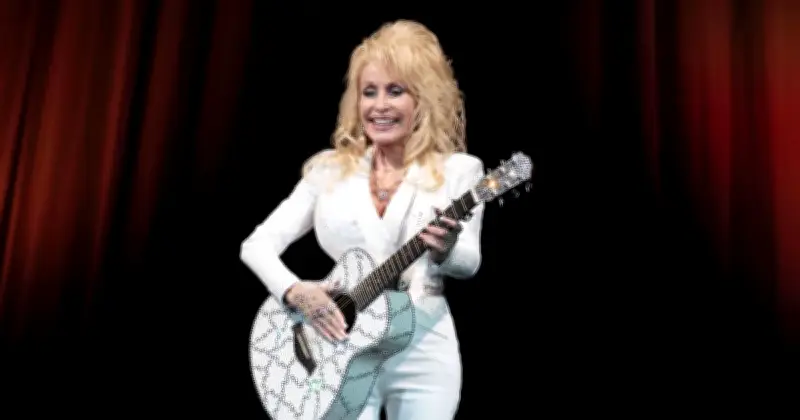
When Taylor Swift paid tribute to Dolly Parton yesterday, it cemented how the late country icon’s influence continues to resonate among today’s music superstars. In her statement, Swift wrote: “A world without Dolly doesn’t feel possible, real, or right. But because of the eternally generous way she spent her time on this earth and the countless lives she changed for the better, her legacy will be an everlasting one.”
The singer, who began her career in country music, continued: “Dolly possessed the softest heart when it came to the struggles of others, and a backbone of steel to defend her own self-worth as an artist.” Swift also thanked Parton “for the tightropes she walked so that young girls like me could grow up dreaming of joining the circus too”.
A Trendsetter in a Sexist Industry
From a singer famed for her own resolute determination in taking on established music industry standards, Swift’s sentiment perfectly summarised how Parton was a trendsetter both in her music and for standing strong in the face of an entertainment industry beset by sexism when Parton first became a star.

Beyonce, Sabrina Carpenter, Billie Eilish and Parton’s goddaughter Miley Cyrus are among other new singers who have hailed Parton as a role model, being all too aware of how hard Parton had to fight for female artists to be taken seriously. Some of the behaviour from powerful music industry executives would be instantly disgraced now, yet it was the norm in the 1970s.
Helped in no small part by Swift’s transformation from a promising Nashville balladeer into a pop superstar, country music has become bigger than ever over the past decade, with a new generation of artists such as Luke Combs, Ella Langley and Morgan Wallen headlining stadiums in Britain as well as the States. But, even when rhinestones were out of fashion, Parton’s music transcended trends.
Musical Legacy and Covers
Generations of stars recognised the universal appeal of Parton’s classics, with Whitney Houston turning I Will Always Love You into a soul ballad that topped the chart here for 10 weeks, and 14 weeks in the US, in 1992. One of the biggest bands of the Noughties, The White Stripes’ early fame was in part thanks to turning Jolene into a fearsome rock anthem.
And Parton was hailed yet again when Beyonce asked her to provide a cheeky voiceover on Beyonce’s own move into country music, when she reworked Jolene into the fiddle-laden powerful ballad Tyrant on the country-themed album Cowboy Carter in 2024. Beyonce said of Parton: “You taught so many lessons on how to be uniquely oneself. I’m honoured for the privilege to work with you. I will treasure that forever.”
Career Battles and Personal Strength
In addition to her musical versatility, tales of Parton’s courage have proved just as durable. She faced hardship from the start of her career, when her musical partner Porter Wagoner turned Parton from a cult newcomer into a country smash when he invited Parton to star on his TV series The Porter Wagoner Show in 1967. They scored 14 Top 10 hits in the US country chart together – but Wagoner was mistaken when he thought their duets were for keeps.
Parton, whose solo career had started to blossom, worked with Wagoner for seven years, having initially wanted their partnership to last for only five. She famously wrote I Will Always Love You as a kiss-off to Wagoner in 1974, when he had pleaded with Parton to stay. She later said: “I wasn’t trying to hog Porter’s show, but I just carved out a little place for myself. I think he had a real hard time when I started getting pretty popular. And there was no way I wasn’t going to do what I was going to do.”
Once she was solo, Parton had her own successful TV show – and she made a point of inviting as many fellow female country singers onto Dolly! as possible, to give them the spotlight. Sure enough, Dolly! helped launch the careers of country leading lights such as Emmylou Harris and Linda Ronstadt.
Wagoner tried getting his revenge, suing Parton for $3m in 1979 for breach of contract – it was settled out of court for $1m. Typical of Parton’s generosity, she later reconciled with Wagoner, performing I Will Always Love You at a tribute concert for Wagoner five months before his death in 2007.

Only 5ft, Parton’s usual way of ensuring men would pay attention in record company meetings was to announce: “I have something that I think we can all make some money off of. Get over the fact I’m a girl here, because my mind is on something else.”
She married her teenage sweetheart Carl Dean in 1964. The couple stayed together until the construction boss’ death in 2025. Their inseparable love didn’t prevent industry figures and musicians from trying to force themselves on Parton, but she’d grown up tough in part thanks to being surrounded by her uncles and seven brothers. She said: “I’m as strong as a boy. I know how to push you off and get the hell away from you.”
Of course, Parton’s busty figure made her the target of no end of jokes. But, typical of her way of disarming any critics, the first one making the gags was usually Parton herself. As she said: “When all else fails, I just tell a boob joke.” That image led to some early self-preservation. Parton was in awe when she saw a woman known as “The town’s tramp” for the first time: low-cut top, short skirt, high heels. “I just thought she was beautiful,” Parton recalled. “People would tell me: ‘She ain’t nothing but trash’ and I’d reply: ‘Yeah? Well, that’s what I’m going to be when I grow up.’”
That rebellious attitude saw Parton’s father and grandfather both hit her, disapproving of her appearance. She addressed their punishment in her 2011 song The Sacrifice, in which Parton stated that the abuse was ultimately worth it, for helping to ensure she really did want to dress that way.
Parton’s most famous quip about her style was: “It cost a lot to look this cheap.” All the time that she leant into the gags, Parton was quietly brushing off the stereotypes behind the scenes: she was one of the first singers – male or female – to retain control of their songwriting publishing rights.
Philanthropy and Lasting Positivity
The juxtaposition of making a point with a big grin was epitomised by Parton starring with Jane Fonda and Lily Tomlin in 9 To 5 in 1980, as three harassed office workers out to overthrow their sexist boss. Dismissed at the time by some critics as cartoonish, the film is now regarded as a feminist classic – and of course, its theme tune is one of the all-time greats.
There’s Parton’s famed philanthropy to contend with too. Her farmer father Robert’s illiteracy inspired the singer to launch her Dollywood Foundation in 1988. It’s since given literally millions of books to children, while a $500 gift to every high school graduate in Parton’s hometown of Sevier County saw the high school dropout rate plummet from 35% to 6% in the early 1990s.
Yet perhaps Parton’s greatest skill was her unstinting positivity. In an age when almost every celebrity is viewed as divisive by some cultural commentators, Parton remained universally popular, respected not just for her immense talent, but also for steering her career with such a light touch. If it cost a lot to look that cheap, it also took a lot of effort to make it all look so effortless. As Parton’s spiritual successor Taylor Swift put it: “Somehow, Dolly was able to give us her lessons about the world gently and honestly simultaneously, and oftentimes hilariously.” Dolly Parton was smiling to the end, and having a blast with her music too. Just ask Beyonce.