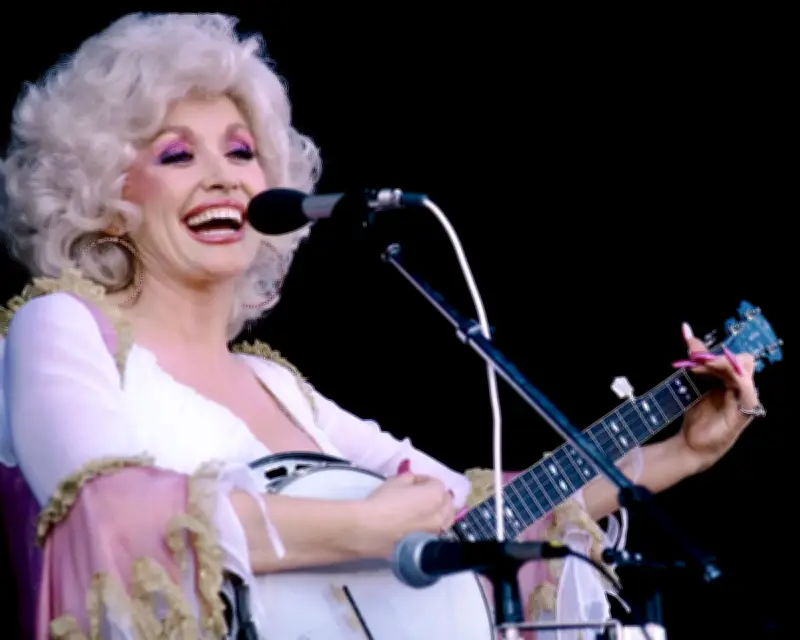
Dolly Parton, the queen of country and crossover pop, was beloved by so many communities – many antagonistic to each other – but it was perhaps her gay fans who claimed her most vociferously and publicly. Her death on Tuesday prompted an outpouring of tributes that underscored her unique ability to cross every barrier of age, sexuality, race, and politics.
A Night at the Theatre
I was at the National Theatre in London on Tuesday night, at a production of Pride, which tells the story of the unlikely alliance between gay activists and Welsh miners during the 1984 miners’ strike, when news broke of Parton’s death. Against the sadness, one couldn’t help smiling. At a very gay production, attended by a majority gay audience, I half expected them to stop the show or call out a team from St John Ambulance bearing stretchers.
In the script for Pride, references to Judy Garland and Ethel Merman serve as shorthand for gay sensibilities, but it could just as easily have been Parton. When we got home my friends and I danced around to 9 to 5, and on Wednesday morning it was Here You Come, Again (“looking better than a body has a right to” – oh, Dolly) on a loop, along with her 1971 hit Coat of Many Colors.

An Unlikely Icon
Parton was, in some ways, an unlikely gay icon. She was studiously neutral on a great many subjects, including politics, and while she could be funny and waspish, the person she most often poked fun at was herself. In my colleague Alexis Petridis’s lovely tribute, he mentions Parton’s 1977 encounter with Barbara Walters – a woman so rich in spite and Chanel suits as to win her her own following in corners of the gay community. She asked Parton: “Do you ever feel that you’re a joke?” One was struck by Parton’s smiling response – “I’m sure of myself as a person. I’m sure of my talent” – relative to how Katharine Hepburn, a gay icon with a more traditional way of handling things, responded to similar nastiness from Walters. When the journalist asked her, “Do you ever wear a skirt?”, Hepburn clapped back: “I have one. I’ll wear it to your funeral.” In a million years, Parton wouldn’t have been rude like that.
All of which, you might think – and despite the bouffant hair and rhinestone wardrobe – might have lessened her appeal to gay audiences. But Parton had something else. The voice, of course, but to me it was also a question of sincerity. She meant it: every rhinestone, every teased, backcombed strand of hair in the blowout. She could joke about her image with the best of them, but we all knew that when it came down to it, Parton was deadly serious about the way she looked. There is a hard, gleaming gemstone at the core of camp culture that isn’t funny at all. It exists in absolute earnest, a private space of joy and pain and beauty undiluted by judgment. It’s hard to say precisely how one knows the difference between the endless fake, gay-baiting uses to which this tone is put and the real thing, but one does. Gay rights was one of the few issues on which Parton didn’t stay neutral – she threw the Bible at homophobes, asking them who they thought they were to pass judgment – but it wasn’t that. You just knew.
Crossing Every Barrier
And yet if there’s another thing we knew about Parton, it was her genius to cross every barrier of age, sexuality, race, and politics. In a recent poll conducted by the University of Massachusetts Lowell, Parton was the only person in the survey to win higher than a 50% approval rating from Democrats, Republicans, and independents. She crossed class barriers, too. While the Democratic Socialists of America praised Parton for being “a hero of the working class”, the now-billionaire president, Donald Trump, issued possibly the most positive statement he has ever made about another human being, saying of Parton: “There has never been anyone like her, and never will.”

Eminem posted a tribute. Straight women loved her, including one of my aunts, who when she went platinum blond in her 60s was fond of quoting Parton’s famous line – “It costs a lot of money to look this cheap” – by way of justification. Parton owned it all, and was god-level smart and as kind as they come, which may have been at the root of how she pulled off the seemingly impossible feat of being genuinely adored by all. When Trump ordered the nation’s flags to be lowered, one marvelled again at her unique status as someone as beloved in rural Kentucky as she was in Hell’s Kitchen.
Tributes and Memories
On Wednesday morning, my friends and I only had eyes for the gay stuff, including a statement released by Jane Fonda, with whom she starred, alongside Lily Tomlin – what a triumvirate – in the 1980 film 9 to 5. Fonda said: “To her gay and trans fans, I want you to know that she loved you.” Meanwhile Parton’s nephew, Bryan Seaver, who was her head of security, as was his father, Larry, before him, issued a video statement on behalf of the family. “Dolly has lived in the light,” he said, movingly. When Bryan said: “May god bless you all, she will always love you,” I had my biggest wobble.
To quote another gay icon, Barbra Streisand: it’s the laughter we’ll remember. At the production of Pride on Tuesday night, my friend told me his Dolly story. I hope it’s alright to mention this; I can’t help but think Dolly would’ve enjoyed it. He was at a (gay) wedding deep in rural Tennessee a few years ago and thought he’d take a quick look at Grindr, the gay hook-up app. As expected, in that grimly traditional part of the US, it was an absolute gay desert, except for a bizarre cluster in a single spot about 40 miles down the road. Surprised, my friend glanced at the map and burst out laughing. Of course: Dollywood. What a gift she was to all of us – but to some of us, perhaps, more than others. Thank you, Dolly, for everything. God, we’ll miss you.