Vernon Katz: A Life of Resilience and Scholarly Pursuit
Vernon Katz, who has passed away at the age of 98, led a remarkable life that spanned continents and cultures. A childhood refugee from Nazi Germany, he escaped the horrors of the Holocaust through the Kindertransport program and later flourished as a distinguished Oxford scholar. His journey from persecution to academic prominence is a testament to human resilience and intellectual curiosity.
Early Life and Escape from Germany
Born in Herford, Germany, Vernon was the son of Emmy and Hermann Katz, members of an affluent Jewish family that owned a brushwork factory. His comfortable childhood was shattered by the rise of the Nazis in the 1930s. In March 1939, he boarded a Kindertransport train to Britain, a decision that would save his life. He later reflected on this experience with deep gratitude, stating, "I thought the people there were angels, they were such good people. I love this country, because it saved my life." Both his parents, who had been imprisoned, managed to join him in the UK before World War II erupted, where they established a successful knitwear business in London.
Academic Journey at Oxford
In 1947, Vernon began his studies in philosophy, politics, and economics at University College, Oxford. His undergraduate tutor was Harold Wilson, who would later become Prime Minister of the United Kingdom. This foundation sparked a lifelong passion for learning. He pursued postgraduate studies in Indian philosophy, guided by Sir Sarvepalli Radhakrishnan, a scholar who would go on to serve as President of India. This academic path ignited a strong desire in Vernon to experience firsthand the philosophies he studied in literature.

Meeting Maharishi Mahesh Yogi and Translational Work
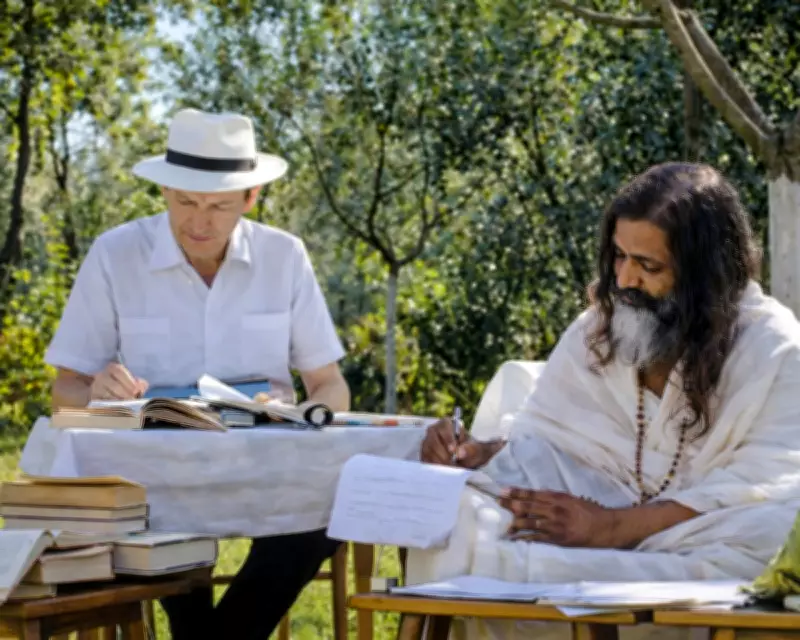
In 1960, in London, Vernon's wish was fulfilled when he met Maharishi Mahesh Yogi, who taught him transcendental meditation. This encounter marked the beginning of a profound collaboration. The Maharishi invited Vernon to assist with the translation and commentary on the Bhagavad-Gītā, published in 1967. This work sold over a million copies and played a crucial role in reviving Vedic knowledge globally. Vernon fondly recalled, "The Gītā was translated and discussed on land, sea, and in the air, in townhouses and country houses, by the Thames and by the Ganges, in the Alps, and on the canals of Venice. I had never known such happiness as this work with Maharishi."
Later, he helped Maharishi translate the Brahma Sutra, another foundational text of Indian philosophy. By reviewing recordings from their sessions, Vernon compiled two volumes of Conversations with Maharishi, published in 2011 and 2018. Additionally, he co-authored The Upanishads: A New Translation with Thomas Egenes in 2015, further cementing his legacy in Sanskrit literature.
Personal and Professional Life
For many years, Vernon lived in London, where he managed a thriving knitwear business. A supportive business partner enabled him to travel and dedicate time to his scholarly endeavors. In 2014, he settled in Suffolk, enjoying a quieter life. He also served as a trustee and visiting professor at Maharishi International University in Fairfield, Iowa, for decades, lecturing on Sanskrit literature. Fluent in English, German, and Italian, he took great pleasure in translating ancient Sanskrit texts into English.
In 2008, Vernon published a memoir, The Blue Salon and Other Follies: A Jewish Boyhood in 1930s Rural Germany, offering a poignant account of his early years. He is survived by seven cousins: Yvonne, Anita, and Ralph in the UK, and Stephen, Ralph, Terry, and Pam in the US.
Vernon Katz's life story is one of triumph over adversity, blending academic rigor with spiritual exploration. His contributions to Indian philosophy and his role in preserving Vedic knowledge through translation have left an indelible mark on scholarly and spiritual communities worldwide.