May 2026 Books: Cornwell Memoir, Weimar History, and Age-Gap Novel
May 2026 Books: Cornwell Memoir, Weimar History, Age-Gap Novel

Books of the Month: What to Read in May 2026

Martin Chilton selects his top new book releases for May, ranging from Patricia Cornwell's candid memoir to a dysfunctional age-gap love story and a historian's look at Weimar Germany.

Dr Kate Lister's Flick: A History of Female Pleasure (Bantam) opens with a memorable dedication: “For all the men who didn’t make me cum.” Lister's eye-opening account of how women’s pleasure has been controlled throughout history is thought-provoking and intrepid. To discover why she writes that “nobody should ever have to learn about w***ing from a middle-aged piano tuner,” readers must pick up this excellent, spiky book.

Lister's study is one of several valuable books this month from female historians. Nandini Das's This Little World: A New History of Tudor and Stuart England (Bloomsbury) tells Britain's story through migrants, merchants, pilgrims, and exiles often omitted from accounts. Emma Southon's Servus: How Slavery Made the Roman Empire (Hodder) discusses how Roman elites normalized brutality to control enslaved people, noting that “random violence against enslaved people remains a point of hilarity for the whole of Roman history.”

Wide Pickt banner — collaborative shopping lists app for Telegram, phone mockup with grocery list

Though much has been written about the Cambridge spies, Piers Blofeld draws on fresh research and newly released documents in Master of Lies: How Anthony Blunt’s Treachery Shaped Our World (Quercus). Blofeld dissects the horrifying consequences of Blunt's espionage for the Soviets and targets the moral failings and cover-ups of the British establishment.

Two life stories stand out for May. Deborah Lutz's discerning This Dark Night: The Life of Emily Brontë is the first biography of the Wuthering Heights author in two decades. David Scott's tribute to comedian Caroline Aherne, Caroline Aherne: Rebel in Disguise (Manchester University Press), includes her finest TV moments, such as when, as Mrs Merton, she undercut bigoted comedian Bernard Manning by asking: “Bernard, who do you vote for now Hitler is dead?”

Douglas Stuart, author of the Booker-winning Shuggie Bain, sets his new novel John of John (Picador) on the Hebrides, delivering an unflinching yet tender tale of a corrosive father-son relationship. Séamas O'Reilly's rollicking novel Prestige Drama (Fleet) follows the mysterious disappearance of a famous actor traveling to Derry to star in a TV drama about the Troubles. It is caustic, withering, and genuinely funny, with original put-downs and a simile describing a character's lazy eye “buffering in its socket like a boiling egg.”

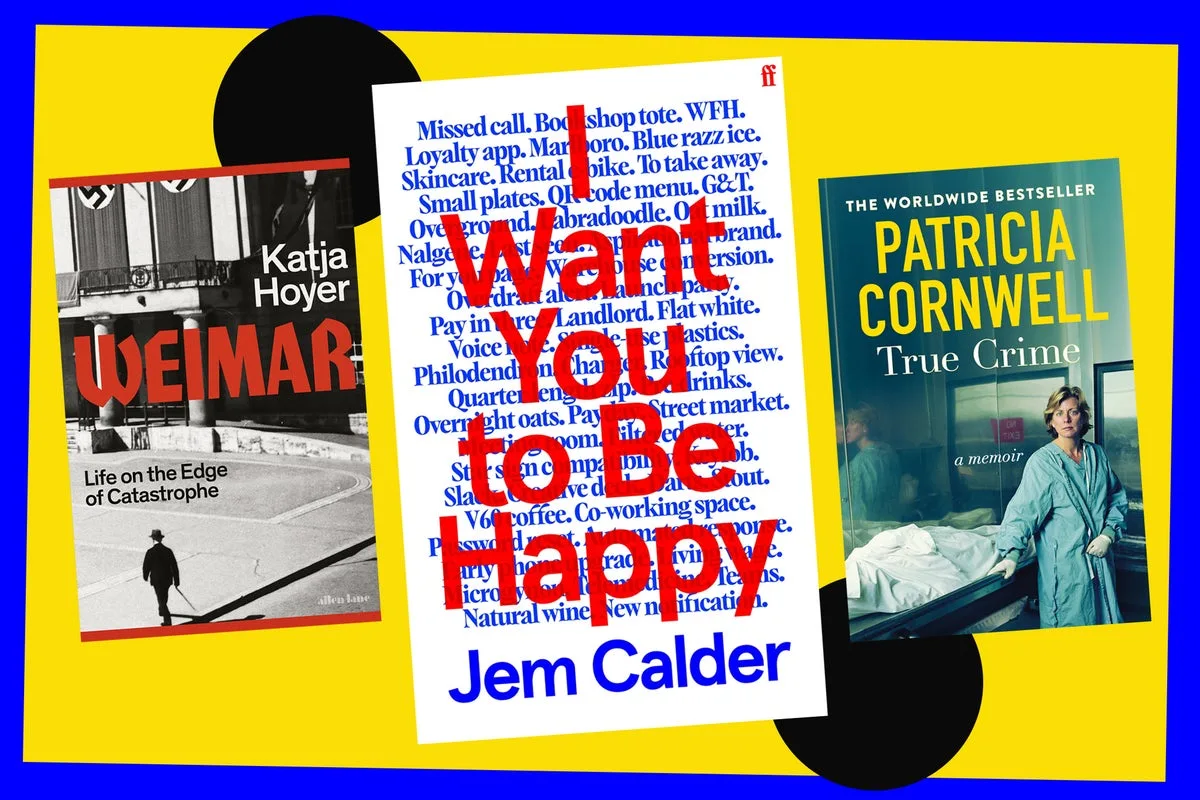
Memoir of the Month: True Crime by Patricia Cornwell

Crime fiction's gain was journalism's loss, as Patricia Cornwell admits in her autobiography True Crime. The creator of forensic pathologist Dr Kay Scarpetta (played by Nicole Kidman in the new Amazon Prime series) is self-deprecating about her early days at The Charlotte Observer in the 1980s. She cheerfully recounts mixing up NFL teams and kick-off times, printing the typo “Daffy F***” for Daffy Duck, covering a fashion show without noting designers' names, and writing an obituary for the wrong person. “The next day he called me to say he wasn't,” she writes.

Born in Florida on 9 June 1956, Cornwell tells her story in a simple, staccato style. Her parents were dysfunctional, leaving her to fend for herself (eating raw hamburgers from the freezer). She describes her early life as “a string of failures,” admitting she was bad at spelling, ballet, sewing, arithmetic, and cheerleading.

Cornwell is candid about her parents' mental health struggles and her own. Her father left the family on Christmas morning in 1961, running off “with a cheap-looking woman I'll call Shirley.” She notes that “absenting himself and ghosting were his special weapons.” She adds, “At an early age, I had no misconceptions about human nature. I knew people could be cruel to all living things, including each other.”

Pickt after-article banner — collaborative shopping lists app with family illustration

Sexual predators feature prominently: a security officer who tried to assault her at age seven, a leering psychiatrist, and later a Miami detective who drugged and raped her. She even faced unwelcome attention from George H.W. Bush (witnessed by Barbara Bush, who called him “a dirty old man”). Larry King is depicted as a complete sleazebag.

The book covers her hysterectomy, bisexuality, a horrific car crash on the Pacific Coast Highway, pilot training, eating disorders, and addiction to chocolate laxatives. Encounters with the famous include OJ Simpson, but the most affecting moments describe how she overcame obstacles to sell 120 million books and “create the forensic thriller genre.” She attributes her success to working in morgues and a natural inclination for snooping. A good amateur tennis player, she lists five rules for winning, including “Hate your opposition” and “Never Say Sorry.”

True Crime: A Memoir by Patricia Cornwell is published by Sphere on 5 May, £25.

Non-fiction Book of the Month: Weimar by Katja Hoyer

The Nazi Sieg Heil salute apparently originated in Weimar, a city Adolf Hitler visited over 40 times. He often stayed at the Hotel Hohenzollern, run by Jewish hotelier Rosa Schmidt. In the mid-1920s, he gave a speech blaming “n****r and jazz music” for being “soul poisoners of the German people.”

In Weimar: Life on the Edge of Catastrophe, historian and journalist Katja Hoyer tells the chronological story of Weimar's role in Hitler's rise. She analyses how far-right ideologies took hold in a city whose citizens were fatalistic about politics. Anecdotes include actor Emmy Sonnemann, who dated Hermann Göring. Sent to present flowers to Hitler in 1933, she was baffled as he “fell into one of his monologues.” Hoyer notes she “slowly walked out as Hitler continued to mumble to himself.” She married Göring two years later, enjoying wealth from “lucrative military contracts, which opened doors to embezzlement, bribery and corruption.”

The book includes photographs, notably one of Hitler staring jealously at a bust of philosopher Friedrich Nietzsche. It also tells the story of Kurt Nehrling, a young social democrat who paid a heavy price for resisting Nazism. Hoyer shows how far-right leaders used propaganda and culture, not just terror, to control the population. Weimar was a microcosm of Germany, where people looked the other way as the Nazi regime murdered at nearby concentration camps.

Weimar: Life on the Edge of Catastrophe by Katja Hoyer is published by Allen Lane on 7 May, £30.

Novel of the Month: I Want You to Be Happy by Jem Calder

During a family Christmas, 23-year-old barista Joey tells her grandmother she has met someone “very nice.” The wise old gran replies, “Let's just hope he stays nice.” Over Jem Calder's splendid debut novel I Want You to Be Happy, readers side with naive Joey as her relationship with Chuck, a 35-year-old copywriter on the rebound, frays. “I was interested in the idea of a romantic comedy where, in the margins of the text, one of the characters is basically having a complete nervous breakdown,” says Calder, referring to Chuck's drinking and insecurity.

Calder delivers a sharp portrait of our diminished age of WhatsApp, Wordle, climate anxiety, commitment phobia, AI, ghosting, online stalking, and wasting “non-refundable life minutes” on phones. Chuck and Joey are well-drawn protagonists, with sharp humour (Joey's friend Laurel tells her after a boozy night: “Babe, you look like Beetlejuice”) and shrewd dissection of modern phoniness, as when a woman says she loves the blues but only listens to “Spotify playlists.”

Set-pieces include a disastrous romantic weekend in the country and a disconsolate Christmas with Chuck's elderly parents. He endures “drinkies” at a neighbour's, where “stout, thyroid-disorder-eyes Graham Bradshaw answered the door.” Chuck's alcoholism causes his work to implode, while Joey deals with her vulnerabilities and the grind of making ends meet. “There was no other way of living in the city,” she says, a statement that will ring true for many twentysomethings. Both panic about their life trajectories, with Joey reflecting on the daily toll “of simply trying to be undepressed.”

The novel explores ambition to write (Chuck fiction, Joey poetry) and deftly shows who has talent. It left me musing on whether we all choose a way to lose, suggesting that not ending up where you want is a guaranteed condition of life. All fiction lovers will gain something from spending non-refundable life minutes engrossed in this stirring novel.

I Want You to Be Happy by Jem Calder is published by Faber on 21 May, £16.99.