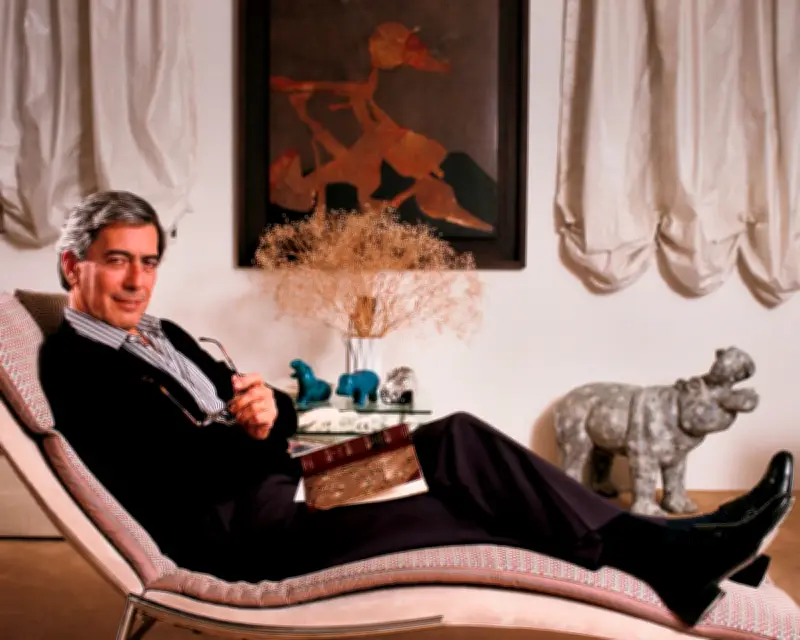
Mario Vargas Llosa, the Nobel-winning author, began his career dissecting oligarchy with surgical precision and ended it dining happily among its ranks, according to a new biography by Gerald Martin. The book traces one of literary history's most spectacular political migrations, from hard left to hard right over half a century.
Early Politics and the Break with the Left
Martin argues that Vargas Llosa never truly belonged to the left. His brief flirtation was not with socialism so much as with a socialist: the dazzling Lea Barba, whom he met at San Marcos University. Beneath the guerrilla chic, Martin finds an old patrician confidence in hierarchy. A university contemporary called him a "Lima posh boy."
Vargas Llosa's break with the left came in 1971 with the "Padilla affair," when Cuban poet Heberto Padilla was forced into a public confession. Vargas Llosa led an international campaign against Castro's treatment of writers. Martin is unsentimental about this moment, arguing that Vargas Llosa's comparison of Castro with Stalin was overdrawn and helped isolate the regime when the Latin American left needed support.
Personal Life and Marriages
Martin restores the women Vargas Llosa reduced to literary raw material. His scandalous marriage at 19 to his aunt-by-marriage Julia Urquidi became the novel Aunt Julia and the Scriptwriter. Her memoir, What Varguitas Didn't Say, exposed the less charming reality of adultery and abandonment. Julia was later discarded for his first cousin Patricia Llosa, who bore him three children and was told to take babies away when he needed to work.
Half a century later, Patricia was replaced by Spanish society doyenne Isabel Preysler, mother of singer Enrique Iglesias, with whom the octogenarian exchanged the republic of letters for the pages of ¡Hola!.
Move to England and Thatcher Adoration
Vargas Llosa settled in Cricklewood, London, suiting his taste for suburban conservatism. Historian Hugh Thomas, another émigré from the left, introduced him to Tory circles and eventually Margaret Thatcher. Vargas Llosa wrote of the encounter with fanboy adoration in a piece titled "The Lady Among the Wild Beasts."
After Peru rejected his presidential ambitions on a neoliberal ticket in 1990, he increasingly revelled in circles where power congratulates itself upon its realism. Utopias became pathologies in his later fictions.
Later Right-Wing Politics and the Punch
After the 2010 Nobel prize, Vargas Llosa backed Peru's unelected ruler Dina Boluarte and Chile's anti-gay, anti-abortion crusader José Antonio Kast, denounced feminism as literature's "staunchest enemy," and treated leftward electoral twitches as a "return to caudillismo."
The most famous incident in literary history occurred in 1976 when Vargas Llosa floored Gabriel García Márquez with a punch over allegations that García Márquez had overstepped by comforting Patricia during their marital collapse. García Márquez later remarked there were only "two soups on the menu": capitalism and socialism. Vargas Llosa turned up his nose at one and gorged on the other.