The Gruffalo Returns: Axel Scheffler's Monster Becomes a Generational Icon
Julia Donaldson and Axel Scheffler are set to captivate a fresh generation of young readers this autumn with the highly anticipated release of a third Gruffalo book. Robert McCrum recently met with Scheffler, the artistic genius behind the green-warted, purple-prickled monster that has become a cornerstone of children's literature.
A Monster for the Millennials
Twenty-five years ago, The Gruffalo lumbered into the cherished bestiary of literary creatures, joining the ranks of the Lion and the Unicorn, the Jabberwock, and the Wild Things. Overnight, this fearsome yet endearing beast transformed into a millennial classic, rivaling the phenomenal success of Harry Potter in children's publishing.
A generation of bedtime storytelling has thrilled to Julia Donaldson's tale of impending dread in a deep, dark wood. Now, a new Gruffalo story, Gruffalo Granny, has been announced, with a worldwide book launch scheduled for September. Meeting Axel Scheffler, the illustrator whose prime has been devoted to this iconic creature, offered insights into the creation of a multi-million pound superstar.

The Birth of an Icon
The Gruffalo, with his "terrible tusks and terrible claws," first clumped into children's consciousness in the spring of 1999. Donaldson's tale of a little brown mouse who outwits fearsome predators with plucky cunning has become an integral part of every child's imaginative landscape. Inspired by a Chinese fable, "The Fox that Borrows the Terror of a Tiger," the story has achieved contemporary classic status, with many parents confessing a mild obsession with this fabulous creature.
Scheffler, an easy-going and reticent man, acknowledges the story's immense success, which would have astonished his father—a teenage soldier who manned an ack-ack searchlight in Berlin during the Third Reich's final days. Through post-war Germany's "Wirtschaftswunder" years, his father became the managing director of a food factory, while Axel pursued a different path.
From Hamburg to British Landscapes
Born in Hamburg in 1957, Axel Scheffler grew up in a society rebuilding itself through hard work. His childhood reading included Mickey Mouse and Danish classics about "Petzi," a naughty little bear. The Scheffler family, middle-of-the-road Anglophiles, loved English holidays, with an idyllic visit to Devon in the summer of 1976 becoming a turning point for Axel, fostering a lifelong love for the British landscape.
As a solitary boy, he lost himself in drawing. In 1982, after completing social work instead of military service, the young conscientious objector packed his art supplies and headed to the Bath Academy of Art in Corsham. It was there that he discovered his vocation and the simple ambition of becoming an illustrator.
Collaboration with Julia Donaldson
Scheffler's early years in England were not marked by starving in garrets. From a flat in Streatham, he shopped his work to magazines like Time Out and The Listener, as well as to emerging children's book publishers. Walker Books provided some work, followed by Faber commissioning a book cover and illustrations for Helen Cresswell's The Pie-Makers and The Bottle-Rabbit.
By the early 1990s, Scheffler began collaborating with up-and-coming children's book writer Julia Donaldson, illustrating her poem "A Squash and A Squeeze." Unbeknownst to him, Donaldson was completing a children's poem about a little brown mouse who outwits a monster. She had already submitted "The Gruffalo" to a publisher, who let it gather dust in the mid-90s. In frustration, she recovered the manuscript and sent it to Scheffler, asking if he might consider illustrating it.
Creating the Monster
Donaldson's seductive mix of Chinese folk-tale and nursery rhyme, touched with genius, immediately captivated Scheffler. As luck would have it, he was about to have dinner with a children's book publisher who recognized the poem's timeless brilliance and made an immediate offer. Suddenly, it became Scheffler's responsibility to put flesh and bones on Donaldson's sublime creation.

Inevitably, there was trial-and-error in the birth pangs of the terrible Gruffalo. Initially, Donaldson pictured a rougher beast, confessing a penchant for Gustave Dore's art. Their publisher worried that Scheffler's first sketches might alarm juvenile audiences—the Gruffalo's eyes were too small, and there was a problem with his teeth. Could he make him less scary?
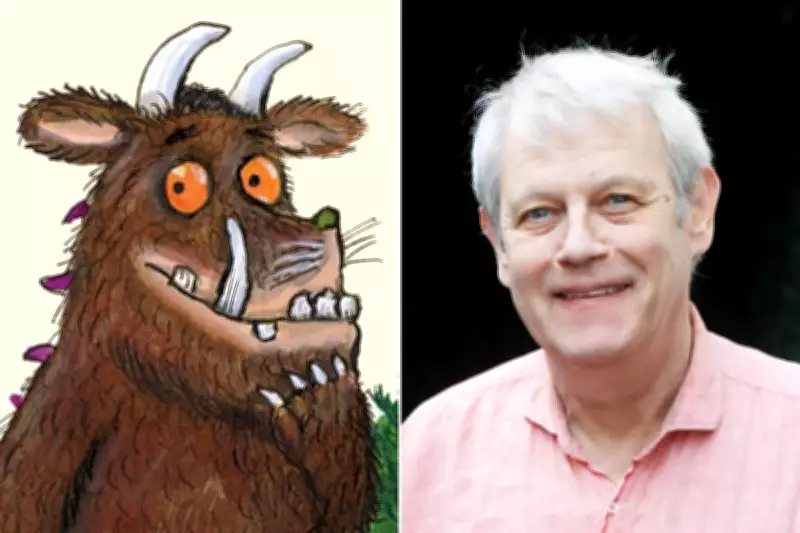
Scheffler was unfazed by these typical publisher-illustrator exchanges. In the end, "my monster," as he calls him, became that classic: the monster who's not a monster. Afflicted with "purple prickles" and "a poisonous wart at the end of his nose," he is, underneath, a big softy. For all his "terrible teeth," he'll scarper at the first hint of trouble.
The Power of Illustration
The Gruffalo possesses the ageless charm of the perfect tale, with Scheffler's visualisation integral to its success. The artist carefully repeats his admiration for Donaldson's "genius," but, like Carroll's John Tenniel, Milne's E.H. Shepherd, and Dahl's Quentin Blake, he knows his illustrations supercharged her words toward posterity, contributing to a fictional universe.
A true classic about the power of a good narrative, The Gruffalo achieves a bewitching marriage of wonder and dread. The cool terror of the words is softened by the innocence, clarity, and warmth of Scheffler's art. "I see myself as a humorous illustrator," he says, conceding that his artwork subtly complements Donaldson's style. There is, he confides, "something in the Gruffalo books that reflects our personal history."
Life Beyond the Monster
Is it too fanciful to find Scheffler tapping into a rich vein of mittel-European fairy-tale imagery? His natural reticence resists this line of inquiry. "Let's leave that to the psychoanalysts," he replies with a laugh. Now, as he returns to drawing—for the umpteenth time—a portrait of the Gruffalo, he reflects on his brush with fame, remarking, "I am lucky not to be recognised."
Home is Richmond Hill, where he lives with his partner Clementine and their teenage daughter, surrounded by paints, brushes, and pencils. In a momentary flash of Teutonic steel, the shy anglophile shakes his head over Brexit. "A very sad day. Such a terrible mistake. What were you thinking?" Politics aside, he's perfectly content. "There's nothing else I want to do. I have no dream project." Sometimes, possibly tongue-in-cheek, he wishes he could paint like Caspar David Friedrich, but otherwise, he's happy.
Looking Ahead to Gruffalo Granny
Gruffalo Granny will be launched in September 2026, but Scheffler notes it's not entirely new. "The Gruffalo hasn't changed after all these years," he says, embellishing his drawing. Like Prospero, he seems to cherish his power over an imaginary kingdom.
It's already been a generation. "Julia always said, No sequel for twenty-five years." As the conversation closes, Scheffler's sketch is almost complete. Does he converse with the Gruffalo in his head? Scheffler seems puzzled. "Why would he talk to me? He's a monster…." A beat. "My monster."