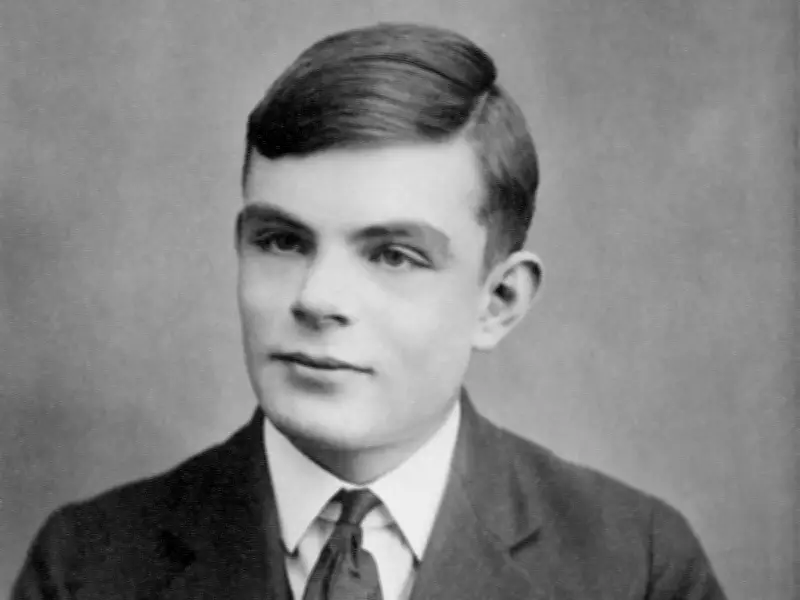
An analysis of an unpublished short story by Alan Turing, the father of modern computing, reveals a man who was "fun, cheeky" and boldly embraced his homosexuality, according to Cambridge Professor of Literature Sarah Dillon.
The risqué tale, believed to have been written in late 1952 or early 1953, shatters Turing's reputation as an isolated mathematician. Instead, it paints a picture of a playful man overcoming trauma while "defiantly embracing his homosexuality," Dillon said.
The story, titled Pryce's Buoy, is a six-page handwritten fragment preserved at King's College Cambridge. It has been transcribed and examined for the first time by Dillon, whose findings are published in The Review of English Studies.
What the story reveals
Dillon said: "We've distilled a version of Turing that is a two-dimensional stereotype. He's come to be seen as socially unaware, entirely concerned with logic and numbers, and pretty isolated. His short story reveals a very different man: playful, funny, cheeky, literary, and someone who really liked sex."
The story centres on Ron Miller, a working-class rent boy, and Alec Pryce, a homosexual scientist famed for an invention called 'Pryce's buoy'. Dillon says Alec is "clearly auto-fictional" and represents Turing himself. She has no doubt that Pryce's Buoy is a direct fictionalisation of the late 1951 sexual encounter that led to Turing's arrest.
The story abruptly cuts off mid-sentence with the words "Ron wouldn't." Dillon said: "There was clearly more and that's so frustrating. We don't know where the rest of it went. We don't know if Turing's mum censored it. Did it get more sexually explicit? How did it end? That's frustrating but everything else is so exciting."
Influence of Angus Wilson
Dillon has identified Angus Wilson, a fellow Bletchley Park veteran, as the inspiration behind Turing's story. In July 1952, Wilson published Hemlock and After, a pioneering gay novel that had a profound impact on Turing. On close reading, Dillon discovered that Turing "copied" one section of Wilson's book "in many explicit ways, including replicating the order of events in the plot, reproducing the same (or very similar) phrases and diction, and adopting the narrative technique of shifting focalisation."
Dillon said: "When you start trying your hand as a creative writer, you copy what inspires you. It's a kind of scaffolding because writing creatively is scary. It's completely normal that Turing copied Wilson." Wilson showed that homosexuality was normal and an integrated part of many people's lives. "He also made the law against it look increasingly outlandish," Dillon added. "Imagine being Turing. You're a homosexual man, you've been prosecuted, you've been forced to take hormone treatment. And then just months later, you read this novel. It must have been such a powerful moment for Turing amid so much trauma."
Turing's legacy
Turing died in 1954 at age 41. Dillon is currently writing two books about Turing and hopes his love of literature will help challenge the polarization of STEM subjects over the humanities. She said: "We need to stop thinking that the literary and the scientific are binary opposites. They're not. Lots of scientists read and write literature, and lots of literary people are very skilled at science. If you polarise or aggrandise one over the other, you lose the mix we need to function as individuals and communities."