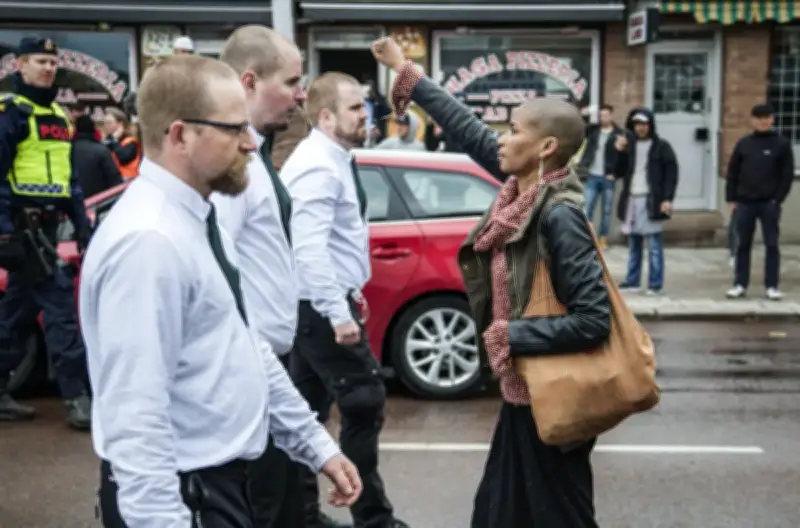
Tess Asplund, the woman captured in a 2016 photograph raising her fist against a neo-Nazi parade in Borlänge, now sees the image as a sign of Sweden's dramatic political change. Ten years on, as Sweden prepares for elections where the far right is expected to become the second-largest party, Asplund expresses bewilderment at the country's transformation.
"Ten years ago, people would say, 'Oh we dislike the far right, the Sweden Democrats, we despise Nazis,'" said Asplund, 52. "And now, they've become normalised. It's like, what happened?"
A Decade of Political Change
Asplund's comments reflect a reshaping of Swedish politics, where the far right has moved from pariah to power. "I'm sad, afraid and ashamed of Swedish citizens," she said in an interview at a cafe in central Stockholm. "It's pure racism."

Ahead of a general election on 13 September, polls suggest the centre-left opposition leads the ruling rightwing coalition, potentially signaling a change of government. However, the Sweden Democrats, a party with neo-Nazi roots, are expected to secure the second-most votes, as they did in 2022, when they played a supporting role in a minority coalition.
The 2016 Protest and Its Aftermath
On 1 May 2016, Asplund traveled to Borlänge to rally against a march by the Nordic Resistance Movement, one of Sweden's largest neo-Nazi groups. Photographer David Lagerlöf of Expo, an anti-racism foundation, captured her defiance, which went viral and drew global media attention.
The photo drew comparisons to a 1985 image by Hans Runesson, showing a woman attacking a skinhead with her handbag in Växjö. Asplund faced online harassment and death threats, but also received thanks from Swedes on the streets.
Far-Right Influence and Migration Policies
The Sweden Democrats have used their government influence to target migrants and Muslims, implementing ultra-restrictive migration policies. Earlier this year, Prime Minister Ulf Kristersson suggested the far right could enter government if his coalition won, a watershed moment for Swedish politics.
Asplund noted that the Nordic Resistance Movement, designated a terror group by the US in 2024, has faded, but "the Nazis are in the shadows" as the Sweden Democrats grow. She pointed to deportations of young people who failed to meet increased earnings thresholds for migrants as evidence of a hardened Sweden.
"Thirty years ago, we would be on the street fighting against this. Now it's like, 'That's sad for him or her.' It's a shift that really scares me," she said, adding that assassinated former Prime Minister Olof Palme "would turn over in his grave."
Despite her disappointment, Asplund stressed that many Swedes still fight for human rights. "We are many, many people here fighting for human rights and against racism," she said, though she fears the far right may have won the battle for Sweden's soul.