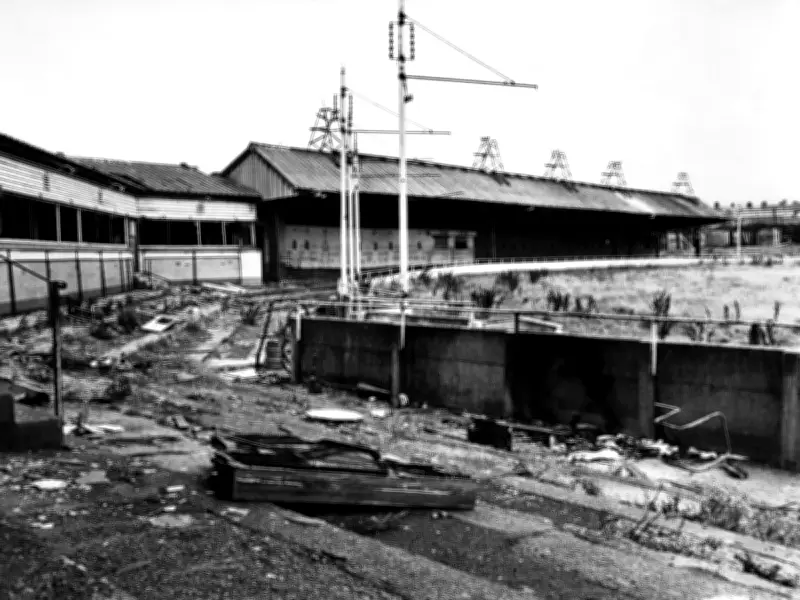
Seven lost Tyneside football grounds in Newcastle, Gateshead, North Shields, and South Shields are revisited, stepping back to a very different football world where crowds, big and small, once gathered to watch matches in the early, pre-commercialised days of the game.
South Shields and Horsley Hill Stadium
South Shields FC currently play in the National League N/S and lifted the FA Vase in 2017. Their home games are at the 3,500-capacity Mariners Park near the border of South Shields and Jarrow. But between 1919 and 1930, a former incarnation, South Shields AFC, played at the 25,000-capacity Horsley Hill Stadium, competing in Division Two against the likes of Manchester United, Manchester City, and Chelsea, while fielding a full England international.
On September 22, 1923, South Shields beat Manchester United 1-0 at Horsley Hill and finished above United in the league that season. In another season, they beat Chelsea 5-1 and won 2-1 at Manchester City. Home gates during the 1920s averaged around 15,000, with a record attendance of 25,641. Player Warney Cresswell won the first of his seven full England caps while playing for the club. But money was tight, and caught between Newcastle United and Sunderland, South Shields were forced to sell their best players, with Cresswell sold to Sunderland. In 1930, the club folded and moved to Gateshead. Today, Horsley Hill Stadium is long-gone and a housing estate is built on the site.
Redheugh Park and Gateshead FC
Redheugh Park, in the Teams area of Gateshead, hosted one-time football league club Gateshead for over 40 years. With Newcastle United's shadow looming large, Gateshead's time there was marked by ups and downs and ever-present financial problems. The club's first season was in 1930 when cash-strapped South Shields FC moved up-river and formed Gateshead FC. The first game in the old Third Division North attracted a crowd of 17,000, while a record 20,752 fans watched them play Lincoln in 1937.
The club's finest hour saw them reach the FA Cup quarter-finals in 1953, losing narrowly to Bolton Wanderers and Nat Lofthouse at Redheugh Park. In 1960, they failed to gain re-election to the league, and the last six decades have seen the club competing in various Northern non-league divisions. In 2014, Gateshead missed out on a return to the Football League when they lost to Cambridge in the Skrill play-off final at Wembley. Today the club competes in the National League and plays at Gateshead International Stadium. The last football was kicked at Redheugh Park in 1971, before the ground was bulldozed the following year. The area was flattened for the 1990 Gateshead Garden Festival, and there is still a football pitch and a five-a-side soccer centre on the site today.
Appleby Park and North Shields FC
In 1969, the season Newcastle United lifted the Inter-Cities Fairs Cup, North Shields won the FA Amateur Cup at Wembley, with 74,000 present to witness them come from a goal down to defeat Sutton United 2-1. They boasted manager Frank Brennan, who had twice captured the FA Cup playing as Newcastle United's centre-half in the 1950s. North Shields, formed in 1896, went into administration after failing to repay creditors £98,000, and their home at Appleby Park was sold off for housing, relegating them down the pyramid system. That was in 1992, and the club were saved by supporters including Lindisfarne's Alan Hull and drummer Ray Laidlaw joining the board.
The club rose again, and in 2015 North Shields repeated their Wembley success, lifting the FA Vase by beating Glossop North End. Today the Robins, who boast former Newcastle United star Malcolm Macdonald as club president, play at Daren Persson Stadium at Ralph Gardner Park in Northern League Division One.
Newcastle East End's Four Grounds
The four football grounds in Newcastle's East End were where the forerunners of Newcastle United played before the club set up home at St James' Park in 1892. The sites in Byker and Heaton were discovered by football writer Paul Brown while writing his book All With Smiling Faces. Newcastle United was founded in 1881 as Stanley FC, named after Stanley Street in South Byker. Stanley Street no longer exists but was part of what is now Walker Road. The team played on open ground near where St Peter's Social Club now stands.
As the club grew, it changed its name to East End and moved to a new ground behind St Michael's Vicarage, near Bothal Street, inside what is now the Byker Wall estate. Within a couple of years, the club moved again to a pitch next to the railway line at Dalton Street. After moving to Heaton in 1886, the new ground at Heaton Junction, just off Chillingham Road, was regarded as one of the best in the country, with a good pitch, a large wooden pavilion, and one of football's first press boxes. East End played many big matches there, including derbies against Sunderland and cross-town rivals West End, attracting boisterous crowds of up to 5,000 fans.