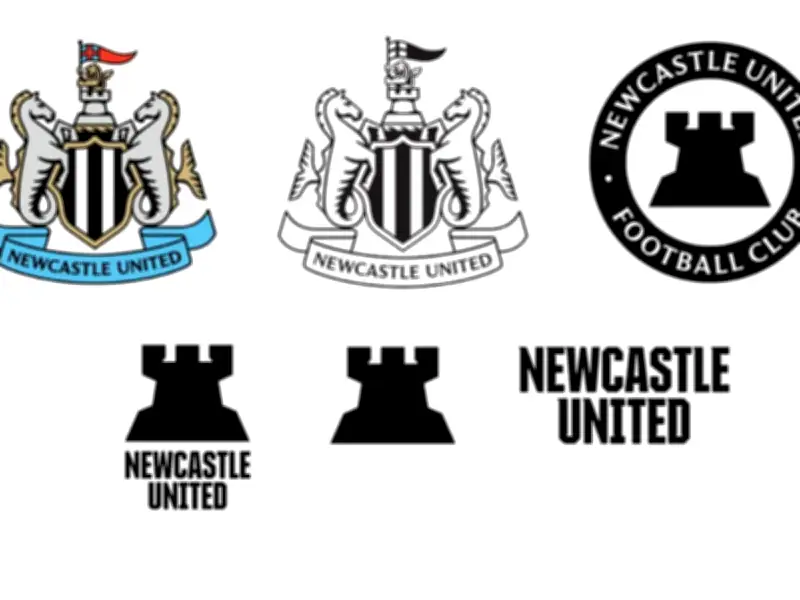
Newcastle United's marketing chief Steven Taylor has explained that the club's rollout of "secondary" club signage and crests reflects feedback from fans.
After the club released a new enhanced badge to take the Magpies forward into a new era, one that CEO David Hopkinson hopes will see Newcastle be in a challenging position for the Premier League title by 2030, a series of other fonts were also introduced. One of them was a circular crest with a castle in the middle, and during a presentation, it was displayed emblazoned on a beer bottle lid as an example of how it may be used around the club in the future.
Castle chosen as 'most sacred' part of crest
Speaking to BBC Newcastle, Taylor said: "We're not just announcing a new crest, we are announcing a new brand identity for the club."
"It includes a secondary market that includes a castle, and we selected the castle because in the fan survey, it came across loud and clear that we should treat the castle as the most sacred and important part of the crest."
"But it has attributes that signify values that we want to carry forward into the future."
Stadium changes and rolling implementation
Newcastle have also attached a new logo on the walls of St James' Park on Barrack Road. This icon represents the club as a venue and replaces an older version that had been used for the last 10 years. Fans will now start to see plenty of changes around St James' Park with an abundance of crests set to be removed.
These include signs on doors and crests on each individual executive box, as well as in and around the dressing room. Taylor said: "There is a rolling implementation where across the stadium we have 100s if not 1000s of the crest that will gradually be replaced."
"This will show up immediately across all of our digital channels."
Part of 2030 ambition
Taylor also made it clear that the series of changes were the start of an ambitious drive towards the 2030 goal of challenging for both the Premier League and WSL titles in the years to come. He said: "What we are announcing actually goes way beyond the crest."
"It's a rich form of storytelling that will drive fan engagement and fan growth that globally that will drive the ambition of the club."