Former Baillie Gifford winner Patrick Radden Keefe is among the authors shortlisted for the 2026 prize, this time with his book on London’s criminal underbelly.
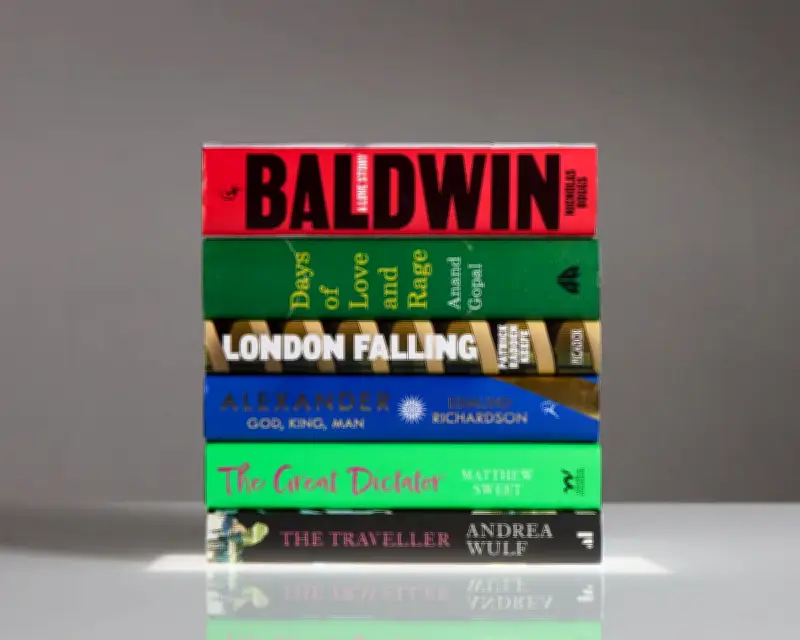
The six-strong shortlist spans literary biography, ancient history, true crime and international reportage, with James Baldwin, Barbara Cartland and Alexander the Great among its subjects.
Keefe’s London Falling
Keefe, who won the prize in 2021 for his book Empire of Pain, is this time selected for London Falling. This book tells the story of the death of Zac Brettler, a British teenager who fell from a luxury London apartment after pretending to be the son of a wealthy Russian oligarch, described as “a scrupulously researched work of narrative nonfiction” and “grimly absorbing from start to finish” in Ian Thomson’s Guardian review.
Keefe is joined by Andrea Wulf – who was previously longlisted in 2008 – along with Nicholas Boggs, Matthew Sweet, Edmund Richardson and Anand Gopal. The winner, announced on 4 November, will receive £50,000.
Other shortlisted titles
Wulf has been recognised for a second time with The Traveller, which traces the life of George Forster, an 18th-century naturalist and explorer who joined Captain Cook’s second voyage around the world as a teenager.
Matthew Sweet’s The Great Dictator explores the life of the prolific romance novelist Barbara Cartland, who famously dictated the 723 novels she authored, against the backdrop of the changing sexual and social politics of her era. In a Guardian review, Kathryn Hughes wrote: “Sweet pays his subject the compliment of absolute seriousness, regarding her as a cultural phenomenon whose extraordinary life, stretching the entire 20th century, deserves deep study.”
Edmund Richardson made the shortlist for his book Alexander, which charts the life of Alexander the Great. Meanwhile, Nicholas Boggs’ biography, Baldwin, reflects on the friendships, romances and creative relationships that influenced the writer’s work. Ralf Webb praised Boggs’s “exhaustive” research in his Guardian review, enabling the author to “meticulously re-stage Baldwin’s life in something like biographic ultra-high-definition”.
The final book on the shortlist, Anand Gopal’s Days of Love and Rage, examines the Syrian civil war through the experiences of residents of Manbij, a city in the country’s north.
Judges and context
Chair of judges Kirsty Lang said the books offer “something for everyone”. “It is an eclectic list united by stories of people navigating a world full of conflict as well as hope,” she said. “At a time when many of us are trying to make sense of a complex and frightening world, nonfiction can help us find our way through.”
The shortlist was drawn from a longlist of 13 books, including Murder in Paris ’68 by Edward Chisholm, The Nord Stream Conspiracy by Bojan Pancevski, Ukrainian Lessons by Charlotte Higgins, Redwood by Ben Macintyre, Hotel Exile by Jane Rogoyska, Never Say War by Åsne Seierstad and Stay Alive by Ian Buruma. The books were selected from more than 350 eligible titles published between 1 November 2025 and 31 October 2026.
Alongside Lang, the judges include novelist Elif Shafak, Waterstones head of books Bea Carvalho, writer and cultural historian Tiffany Jenkins, Spectator literary editor Sam Leith, and editor and reporter Ravi Mattu.
The prize was founded in 1999 as the Samuel Johnson prize, and has been sponsored by investment management firm Baillie Gifford since 2016. The firm has faced criticism over its investments in fossil fuels and companies with links to Israel. In 2024, campaign group Fossil Free Books organised boycotts of literary festivals sponsored by Baillie Gifford.
Last year’s prize was won by Australian writer Helen Garner for her collected diaries, How to End a Story. To explore the shortlisted titles for the Baillie Gifford prize 2026, visit guardianbookshop.com.