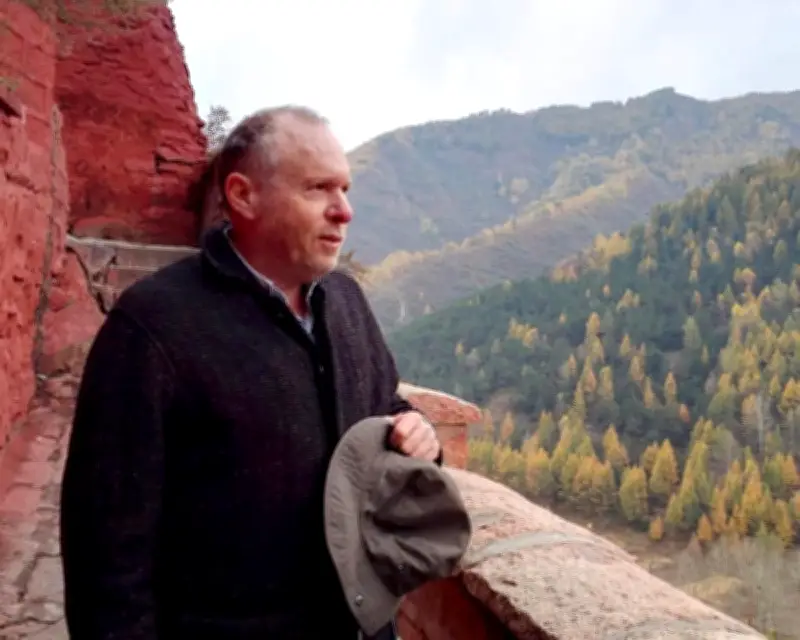
Francis Markus, the former BBC Shanghai correspondent, has died aged 65 of cancer, according to a friend. He was a talented journalist whose compassion for those he reported on led him to spend the last two decades of his life working for humanitarian organisations throughout Asia.
Career at the BBC
After being posted to Shanghai in 2002, Markus demonstrated not just an unerring news sense, covering protests in Hong Kong and social change in China, but a deep interest in human stories. He reported on the suicide-watchers patrolling one of China’s highest bridges over the Yangtze River and the lives of those dealing with HIV. He was always prepared to go the extra mile for a story, whether dodging government minders to interview North Korean refugees or, for a TV report on why residents of Shanghai’s old neighbourhoods often went out to the shops in their pyjamas, venturing out on to the street in his own pyjamas to interview them.
Early life and education
Born in Southgate, north London, he was the son of Peter Markus, an electrical engineer, and Anna (née Somogyi), an artist and puppeteer. After Highgate school he went to New College, Oxford, to study French and German, but soon switched to Chinese and Japanese. After graduation in 1983 he spent a year on a British Council scholarship in Shanghai, where he picked up the notoriously difficult Shanghainese dialect – one of some 10 languages, including his parents’ native Hungarian, that he spoke fluently.
Journalism and humanitarian work
He then worked as a subeditor for Agence France Presse in Paris for two years, during which time he discovered that the BBC World Service had no vacancies for Mandarin speakers but needed a Vietnamese speaker. He enrolled on a Vietnamese course, and subsequently spent about 15 years at the World Service as a producer and presenter covering east and south-east Asia. He made many memorable reporting trips to the region, including an epic journey through the Russian far east into northern China, before moving to Shanghai.
After leaving the BBC in 2005, Markus joined the International Federation of Red Cross and Red Crescent Societies in Beijing as a communications delegate, raising awareness of its work in some of China’s poorest regions, and of famine in North Korea. He also went back to Oxford to take a course on forced migration, one of his primary concerns. From 2014-16 he worked for the UNHCR and the ICRC in Geneva, before relocating to Nepal and then Thailand, promoting coverage of issues such as the Rohingya refugee crisis on the Myanmar-Bangladesh border. From 2021 on, he worked for the UN Food and Agriculture Organisation.
Personal life and legacy
His commitment to humanitarian issues never diminished his irreverent sense of fun. A fantastic mimic, he could compose impromptu limericks in almost any circumstances, one of many attributes – along with his kindness and generosity of spirit – that made him much loved by colleagues and friends around the world. Meeting Wang Yuehua, a university teacher, made him very happy, and in 2006 they had a civil partnership, eventually settling in Chiang Mai, northern Thailand. Yuehua survives him.