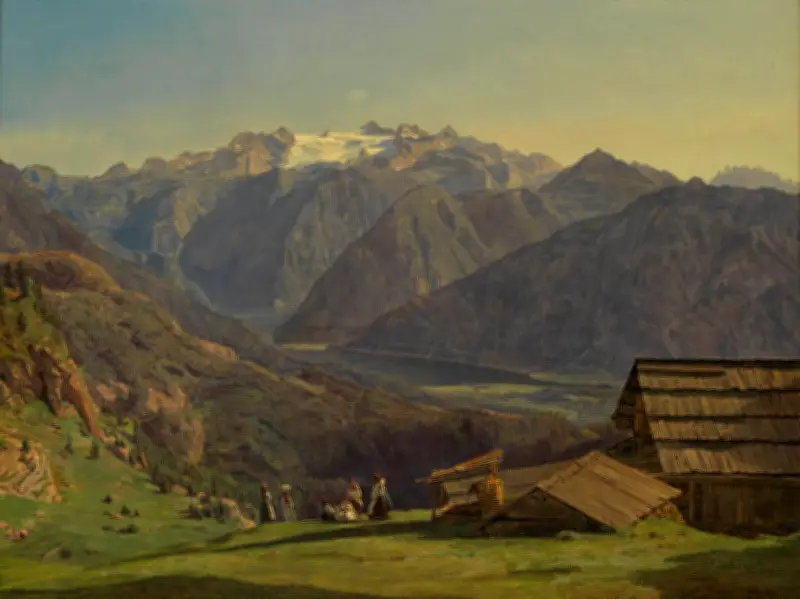
The National Gallery's exhibition Waldmüller: Landscapes presents the meticulous and radical work of Ferdinand Georg Waldmüller (1793-1865), a key figure in 19th-century Austrian art. Known for his unflinching accuracy, Waldmüller rejected the sentimentalizing tendencies of his Biedermeier contemporaries, instead focusing on precise depictions of nature. The exhibition runs from 2 July to 20 September.
Waldmüller's Radical Approach
Waldmüller was an influential teacher and a vocal critic of the Viennese Academy, eventually calling for the abolition of all academies in 1857. His landscapes, such as View of the Dachstein with Lake Hallstättersee (1838) and The Ruins of the Temple of Juno Lacinia near Agrigento (1846), are characterized by a tightly controlled composition and a focus on topographical accuracy. Captions in the exhibition systematically list notable details and offer technical analysis, such as noting distinct changes in tonality from soft green to blue-grey.
Technique and Influence
Waldmüller initially taught himself by copying 17th-century Dutch artists like Jacob van Ruisdael but later abandoned this in favor of studying directly from nature. Unlike Ruisdael's expressive landscapes, Waldmüller strips his work of dramatic impact, applying leaves, bark, and grass with the precision of a chef using tweezers. He used a white ground for his oil paintings, a technique also adopted by the Pre-Raphaelites, which allowed for brilliant colors. However, his commitment to accuracy results in muted, natural tones compared to the Pre-Raphaelites' intense hues.

Context and Significance
The exhibition includes only one portrait, Self Portrait as a Young Man (1828), which dwarfs the landscapes in scale. The caption notes his 'delicate fingers proclaiming his sensitivity and talent.' A single genre scene, Early Spring in the Vienna Woods (1861), features smiling children gathering violets, offering a glimpse into the saccharine Biedermeier trend that Waldmüller rejected. This contrast highlights his desire for 'unflinching honesty' in depicting the actual world.
The National Gallery's collaboration with the Belvedere in Vienna, which loaned most of the paintings, aims to fill gaps in its collection of German, Swiss, and Austrian 19th-century Romantic works. The gallery currently holds only one Caspar David Friedrich. This exhibition continues the gallery's effort to showcase underrepresented artists, providing a broader geographic and historical perspective. While not as thrilling as a Van Gogh blockbuster, the Waldmüller showcase is described as the 'art historical equivalent of eating your greens'—a healthy exercise for a balanced palate.