The Turner prize show at Middlesbrough Institute of Modern Art (Mima) is most exciting when you passionately support one of the artists and want to convince everyone she’s a genius. This year, that thrill is so strong that the reviewer wants to get a T-shirt made to support the artist, like the Boro scarves and banners seen around the town.
Freije’s apocalyptic humanoids
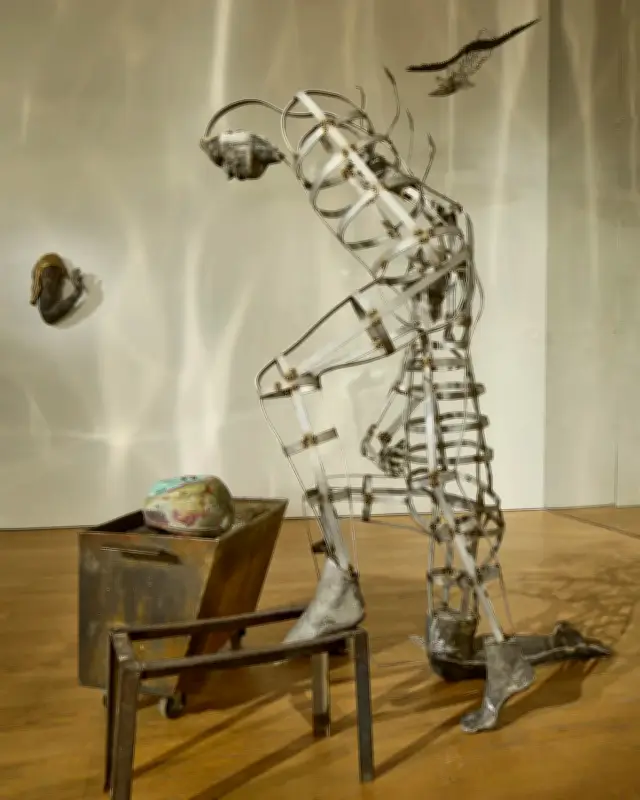
Kira Freije has her own floor, separated by a tall flight of stairs from the three other shortlisted artists, because the fine watery mist in her installation could damage their fragile materials. Yet setting her apart seems like a statement, and it is justified. She shows 33 lifesize statues of tragicomic steampunk cyborgs, individual works but gathered in a vaporous apocalyptic wasteland, with an impact and resonance that is on a level of its own.
Our faces and hands, Freije understands, are what make us human: these are the only fully human thing left about her figures, as if a rogue AI has replaced the rest. They have hollow frames for bodies, hard metal replacements for flesh, bone and soul but with life-cast faces soliciting empathy. You walk among them, come close to gaze into an anguished visage or at a fallen figure desperately clutching at another’s steel ankle. This is a pathetic world where humanity is holding on as a ghost in the machine.
It’s coarse, passionate stuff, with rusty buckets of fetid liquid and a mangy sofa in the bronze steamy glow undercutting any sense of shiny futurism. This is not the future. It’s the way we live now. Freije’s cyborgs touch one another tenderly, offer support, cuddle steel-framed pets. The only surviving things that matter, says this stunning installation, are love and compassion.
Barclay’s haunting tableau
Simeon Barclay’s room is a dramatic tableau, reminiscent of immersive theatre company Punchdrunk, that leads you past giant photographs of a man reading a tabloid newspaper – “Leave ’em to die” blares the headline – and a glowing melancholy landscape, then through a labyrinth beneath a neon sign into a central space suggesting a living room. Barclay’s recorded voice declaims poetry denouncing a northern, working-class man – his father? – who lost his way in hardened, selfish masculinity. It’s visceral and haunting but a little disparate, the connection between elements loose. What exactly has the father figure done wrong, what is the specific loss Barclay laments? Maybe he should work it up into a more precise memoir or novel.
Humeau’s baroque forms
Marguerite Humeau is all baroque form and zero content. Beneath her wacky creations there’s probably something about nature, ecology, the planet. But what you experience is a self-conscious cocktail of eccentricity and brittle originality as she mixes substances you wouldn’t guess in a million years in the kind of art publicists call “alchemical”. Her sprawling sculpture The Holder of Wasp Venom, for instance, contains “Natural beeswax, microcrystalline wax, pigments, 150-year-old walnut (cause of death: unknown), handblown glass and wasp venom.” Amazing. But it still looks like a stack of giant biscuits. There is no feel of the materials, none of that intense presence of felt or fat you get in the genuinely alchemical art of Joseph Beuys.
Yet there’s another dimension to Humeau’s art – a soundscape of high-pitched warbles, heartbeat pulses and elephantine bellows which uncannily follow you around her two rooms. This psychedelic soundtrack doesn’t need to be understood: you go with the flow. Her sculptures too are best if you just enjoy their weirdness, drink in the wasp venom and let your mind nibble at a giant hallucinogenic Hobnob.
Sasraku’s oil protest
Tanoa Sasraku’s room features a big, brown abstract agglomeration of textures hanging at one end. A roomful might have been sublime. Instead Sasraku also shows a table top covered with little glass paperweights. These all hold tiny bulbous bottles and bubbles containing a dark viscous liquid – more alchemy, but this time it’s about the oil industry. You can only get close enough to make sense of objects at the edges of the space-hogging installation and their tininess precludes emotional or intellectual impact beyond an “a-ha!”. Once you get that Sasraku is protesting against big oil you’ve got all the satisfaction her work offers. She is by far the least giving artist here.
But the truth is the reviewer is prejudiced. The moment Freije’s room was seen, the wish was for her to win. Her gathering of lost souls could be in Dante’s Inferno: you want to speak to these tormented figures, ask them how they came to be here. And if there’s an echo of Dante, there’s also an affinity for Rodin whose Gates of Hell the medieval author inspired. Dante, Rodin. Bacon, Giacometti and Kienholz could be thrown in, which is just another way of saying that Freije makes art about the desperate nature of being human. A sceptic might accuse her of apocalyptic overkill, steamy sensationalism, but it’s tempered by humour – look at the cute pets. As for apocalyptic overkill, read the papers.
What a blistering artist and what a classy year for the Turner. Barclay and Humeau have been treated harshly, but their rooms are full of personality and verve and they make it a truly competitive shortlist, with a sense of occasion. This feels like an event, like it matters – which the Turner prize has often failed to achieve in recent years. It is hoped it will inspire wild and eloquent disagreements. Humeau will certainly have her fans but, win or lose, Freije is a great modern artist. If you want to see the future of art, get yourself to Middlesbrough. Turner prize 2026 is at Mima, Middlesbrough, 26 September to 29 March.