Sir Stanley Wells, the eminent Shakespeare scholar and author who brought together the worlds of academia and the theatre, has died aged 96.
In 1978, Oxford University Press made Wells director of a Shakespeare department specially created so that he could produce a new edition of the complete works. Starting from scratch, he went back to the early printed copies, the quartos and folios, and thought through every editorial and textual decision, including how to modernise spelling and punctuation, and edit stage directions and speakers' names, while giving the rationales for emendations.
Groundbreaking edition
The single-volume Complete Shakespeare appeared in 1986, edited by Wells with Gary Taylor, John Jowett and William Montgomery. It proved to be groundbreaking, startling and controversial. Shakespeare was presented as a man of the theatre, one who revised his work in the light of performances. Unconsidered collaborative elements of his works were identified, attributions to him of little-known works were reconsidered, and some new attributions were made.
From 1982, Wells was also general editor of OUP's individual play series, starting with Henry V and completed in 2011 with Richard II. He thus became the first person solely to shape, supervise and complete an entire Shakespeare series.
Career at the Shakespeare Institute
From 1988 to 1997, he was the University of Birmingham's professor of Shakespeare studies and director of the Shakespeare Institute, based in Stratford-upon-Avon. There he presided over the International Shakespeare Conference, the International Shakespeare Association and the Royal Shakespeare theatre's summer school; he also served as vice-chair of the theatre's governors from 1991 to 2003.
His many projects ranged from editing 19 volumes of Cambridge University Press's annual Shakespeare Survey, and Shakespeare in the Theatre: An Anthology of Criticism (1997), to being a special adviser on Shakespeare: The Animated Tales (1992-94) for BBC Two and S4C. Deeply committed to Shakespeare on the stage, he brought together the worlds of academia and the theatre through discussion, teaching and publication. Nonetheless, he was a keen critic, approaching directorial conceits with humour, and sometimes bewilderment. Actors admired and consulted him.
His vast knowledge of the plays and theatre history is evident in Shakespeare: A Dramatic Life (1994) and Great Shakespeare Actors: From Burbage to Branagh (2015). Shakespeare for All Time (2002) is a comprehensive overview of the playwright's wide influences on culture; Shakespeare & Co (2007) considers him alongside his fellow dramatists; and Shakespeare: Sex and Love (2010) discusses his personal life, and his use of sex and romance in the plays.
Early life and education
Born in Hull, Wells was the eldest of four children of Doris and Stanley Sr. His father ran a bus company, and one day brought home a complete set of Dickens from the editor of the Hull Daily Mail. Stanley, aged 12, hid behind the sofa and was heard laughing out loud at The Pickwick Papers. Later he saw touring productions of Shakespeare to Hull featuring the actor-manager Donald Wolfit.
At Kingston high school, the English teacher who encouraged his interest in Shakespeare was a Mr Large. He introduced his class to Sonnet 29, "When in disgrace with fortune and men's eyes", which spoke to Stanley's teenage angst. In 1948 he went to University College London, and gained a degree in English. Then he was, as John Aubrey described Shakespeare, "a schoolmaster in the country" – at Hilsea college, near Basingstoke, Hampshire.
In 1957 he wrote to Allardyce Nicoll, the then director of the Shakespeare Institute, asking for a summer job in Stratford-upon-Avon. This led to Nicoll offering him a PhD scholarship, with which he produced an edition of Robert Greene's novel Pandosto, or The Triumph of Time, Shakespeare's main source material for The Winter's Tale.
Later career and legacy
As a fellow of the institute from 1962, Wells developed popular short residential courses for international undergraduates, and got to know the actors and personnel of the RSC. Judi Dench became a friend, and she and her husband, Michael Williams, made him godfather to their daughter, Finty. For the New Penguin Shakespeare, he edited A Midsummer Night's Dream, Richard II and The Comedy of Errors (1967-72). He went on to become associate editor of the series, and later its general editor.
In 1975, he married the novelist Susan Hill. They had three daughters, though the second, Imogen, died soon after birth. He was knighted in 2016. One of the most generous of scholars, he always encouraged colleagues and students, supervised around 90 PhD theses, and lectured extensively at home and overseas.
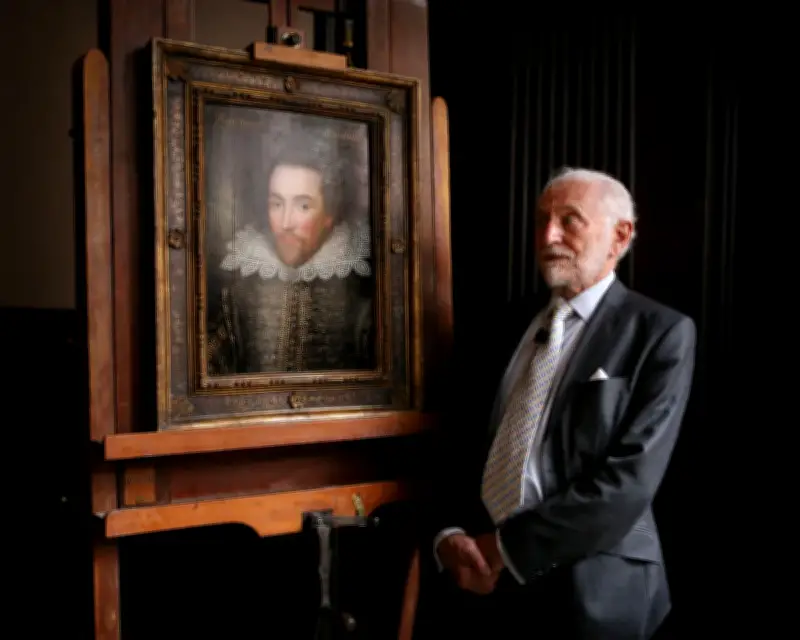
Over the course of a quarter century, a collaborator worked with Wells on a range of publications, talks and projects, including the updating of the Penguin Shakespeare, the unveiling and championing in 2009 of the Cobbe portrait of Shakespeare, perhaps painted from life around 1610 and held by the family of that name, and the excavation of New Place, Shakespeare's home in Stratford-upon-Avon (2011-2016). There were books: Shakespeare Beyond Doubt: Evidence, Argument, Controversy (2013), The Shakespeare Circle: An Alternative Biography (2015) and All the Sonnets of Shakespeare (2020). They travelled extensively, giving many talks for the Stratford festival in Ontario and the Craiova Shakespeare festival in Romania, and also at conferences and special events throughout north America and Europe.
In Stratford-upon-Avon, Wells was chairman of the Shakespeare Birthplace Trust (1991-2011), and later its honorary president. To mark his 90th birthday, he gave four new public lectures for it: What Was Shakespeare Really Like? They are still available online, and were revised and published by Cambridge University Press (2023).
Wells is survived by Susan, his daughters Jessica and Clemency, and his grandchildren, Lila and Zephyr. Stanley William Wells, Shakespeare scholar, was born 21 May 1930 and died 23 November 2026.