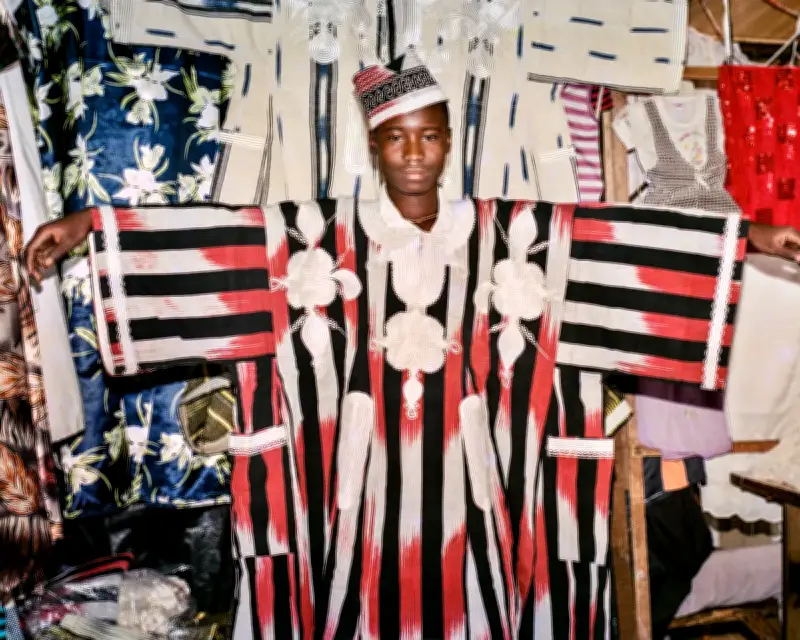
Sanlé Sory, one of West Africa's most prolific photographers, took an estimated one million photographs over six decades, documenting the profound social and political changes in Burkina Faso. A new exhibition, Colour Years, captures a lesser-known chapter of his career, focusing on his transition to colour photography in the mid-1980s.
The exhibition, Sanlé Sory: Colour Years, is at the Photographers' Gallery, London until 21 February 2027. All portraits were taken in Sory's Volta Photo Studio in Burkina Faso. The photographs are by Sanlé Sory, 2026, courtesy of Tezeta.
A Shift to Colour
Sory's colour prints, meticulously restored from the negatives in his archive, will be on show alongside Volta Jazz album covers featuring his portraits of influential bands that flourished after Burkina Faso's independence in 1960. Better known for his black-and-white studio photography of the 1960s and 70s, Sory started producing colour portraits in his Volta Photo studio in the mid-1980s.
When asked why he moved to colour, Sory said: 'When you are in a place where everybody dances, you have to try to dance like everyone else!' His clients wanted a new way to see and show themselves, and he gave it to them.
Capturing a Society in Transition
Sory first came to photography when he needed an identity photograph. After several years learning his trade as an apprentice, he set up his own studio in 1960 when he was 17. He kitted his studio out with props and hand-painted backdrops to attract clients in his hometown of Bobo-Dioulasso. His clients chose their clothes, hairstyles, props and poses with great care. However, his portraits are about more than fashion and style. They tell a story of everyday life after the huge changes brought by the country's independence from France.
From studio portraits of families, couples and friends, to identity photographs and portraits of traders and shopkeepers in the local market, Sory's photographs are a vivid portrait of a country in transition and a community ready to embrace change.
Curator's Perspective and Legacy
Taos Dahmani, curator at the Photographers' Gallery, says: 'The shift from black-and-white to colour is about far more than technology; it mirrors a changing Burkina Faso. Sanlé Sory embraced colour in the mid-1980s, as the country moved through the revolutionary years of Thomas Sankara and into an increasingly globalised era. His photographs don't just record changing fashions; they capture a society reimagining itself and expressing new ideas of identity, aspiration and modernity.'
A book, Volta Colour by Sanlé Sory, is also available through GOST. Director Stuart Smith writes: 'Sory is one of West Africa's most prolific photographers. It has been enriching and enlightening to look through his archive and select and sequence some of the most poignant colour images he made for our book.'
As a teenager, Sory photographed automobile accidents around Bobo-Dioulasso, which he would race to document on his motorcycle. Following the opening of his Volta studio in the 60s, he developed a reputation as a photographer of the Burkinabe club scene in the 1960s and 70s. In 2021, fashion designer Grace Wales Bonner released Volta Jazz, a line of clothing inspired by Sory's photographs, which included a film of the same name created by Joshua Woods.