Film-maker Bob Connolly still harbours misgivings about Rats in the Ranks, his celebrated fly-on-the-wall documentary about skulduggery at inner-Sydney’s Leichhardt council, even on its 30th anniversary.
“I have huge regrets about the film, huge regrets,” Connolly, 81, said this month, marking three decades since the 1996 release of the film he made with his late partner, Robin Anderson.
“The entire press coverage was basically: ‘we loved the film but we hated the councillors who are all low lives’. And it’s rankled with me for 30 years.” Some on the left were furious at what they saw as a film sending up a progressive council.
A duty of care for subjects
Anderson, his professional and life partner, died in 2002 aged 51 after co-producing five award-winning feature-length documentaries. Her last film was Facing the Music, about a campaign to save the music department at the University of Sydney.
“When we make five 90, 95-minute films, you live through a period of someone’s life which is very often stressful, which is lonely, which has high stakes,” Connolly said. “And you really do develop a duty of care for the subjects.”
Connolly and Anderson’s subjects were the incumbent mayor of an inner-western Sydney council, independent Larry Hand, and 11 disparate councillors, including four Labor party representatives whose dysfunction is the heart of the drama. The duo spent 10 months following these characters around, using up 60,000 feet of 16mm film.
The idea that an observational documentary about local government could sustain a feature-length film was not immediately clear to commissioning executives. If it hadn’t been for the couple’s solid record of producing consistently brilliant documentaries it may never have been approved.
From the highlands to urban politics
The couple’s first film, Franklin River Journey (1980), was followed by what became known as the Highland trilogy: First Contact (1983), which was nominated for an Oscar, Joe Leahy’s Neighbours (1988) and Black Harvest (1992).
Shifting their focus to an urban landscape was serendipitous. In 1993 Connolly met Hand when he asked for help to fight a development in Glebe. He was impressed by Hand’s ability to handle conflict.
“Larry was smart, he was well educated, he obviously was a good politician, he was respectful,” Connolly said. “I think he quickly formed an opinion about the rights and wrongs of disputes, but never let that be shown.”
Meanwhile, a project they had planned in Fiji fell through and they needed a new idea for a film.
“I was putting out the garbage one day, and I remembered Larry had said to me ‘what you’ve got to remember about councils is that they’re a clearinghouse for conflict’,” Connolly said.
“So we thought that’s a good idea for a film: the spreading suburbia and a lot of the decisions being made by the council.”
Connolly approached Film Australia. “My gut feeling was that something interesting would very likely happen, but I couldn’t guarantee it,” he said.
Chris Oliver, who was an executive producer at Film Australia when they pitched their project, remembers telling them: “Please tell me you’re joking.” Oliver said when he was shown footage of Hand in action he thought he had a “classic laconic larrikin feel about him” and approved the project. Funding was approved under Film Australia’s National Interest program.
Finding the narrative
When filming started in December 1993 the mayoral election was 10 months away, and they had no plans to feature the political manoeuvrings in the run-up. It simply hadn’t occurred to them.
“We went to a whole lot of site inspections and got some great stuff and then Robin looked at me and said ‘I’m getting worried’,” Connolly said. “We’d been at it six weeks and we were realising that everything was mosaic. There were a whole lot of small conflicts but no overarching narrative.”
A conversation in a pub in Balmain after a site inspection changed everything. “We heard there’s going to be a shit fight this year because [ALP councillor] Evan Jones wants Larry out,” Connolly said.
Suddenly they had a dramatic narrative: it wasn’t the councillors’ relationship with the ratepayers, it was the councillors’ relationships with each other.
The opening scene of the film is a caucus meeting at which the ALP members do not hide their dislike for each other. Connolly still marvels at the access they had to a Labor caucus meeting, which he believes had never been filmed before.
“We shot that scene three weeks before the mayoral election, and everything in the film was shot after that sequence. We shot 50,000 or 60,000 feet of film and we used virtually none of it.”
Connolly said none of the extraordinarily candid scenes in the film would have been possible had they not spent months quietly observing the action until the councillors forgot they were there while they engaged in the universal practice of number crunching.
“The classic example of that was in the early weeks we camped in Larry’s office and every now and again there’d be a very sensitive phone call coming in, some sort of politically ticklish thing, and he’d say, ‘look, I’m really sorry, but would you mind just going out for this?’. Well, about six or seven, eight weeks later, that had all gone.”
Hand allowed the couple to film him as he made calls and tried to drum up support to serve as mayor for a fourth year. Adopting a conspiratorial tone Hand would look into the camera and say things no one would want to be heard saying publicly, such as: “She’s a dirty rotten traitor”; “She’ll vote for Kath [Hacking] on the basis that she’s hopeless” and “I find it so unethical”.
Connolly said Hand became so comfortable with the camera in his office that “it was all totally natural”. He added: “Events are unfolding in this office, and we’re capturing them without having to do anything but point the camera. And the reason is that he has become comfortable with us being there. We became a sounding board for Larry. And it was all totally natural.”
Legacy and lasting impact
The film screened at more than 40 international film festivals and won multiple awards. At the now defunct Valhalla Cinema in Glebe, Rats in the Ranks played for five months and box office takings were more than $120,000, which according to Oliver, was a record for a feature documentary at the time. It has cemented its place as a critical masterpiece and is still available to rent on streaming services and the National Film and Sound Archive.
Oliver said it “was the first real insiders’ fly-on-the-wall treatment of political trading” and it resonated across cultures. In the New York Times, Janet Maslin wrote that Rats in the Ranks appreciates “the dauntless energy and sheer Shakespearean conniving it takes to stay afloat” in the “shark-infested waters” of local politics.
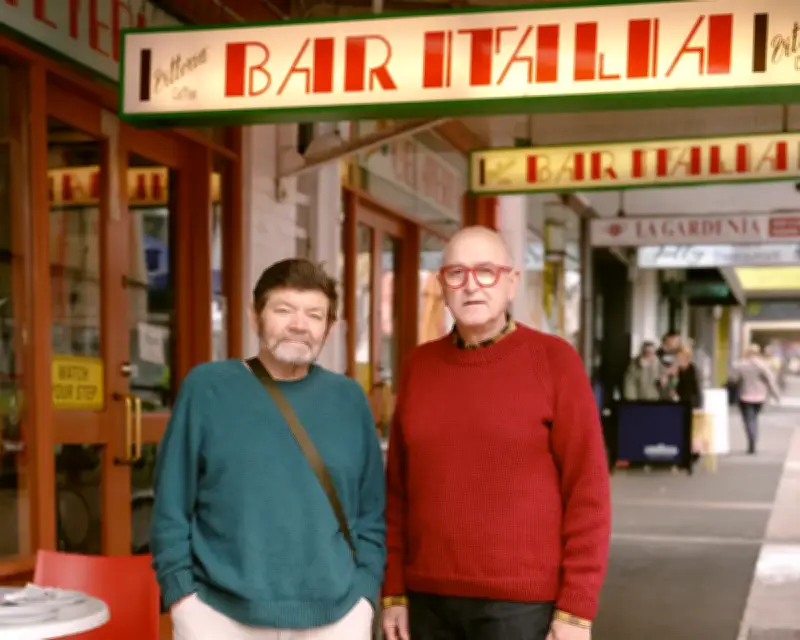
One of the best known scenes in the film is one in which Anthony Albanese, then assistant general secretary of the ALP in NSW, refused to appear on camera at a meeting of the Labor caucus at Bar Italia. Unable to agree among them on who should be the mayoral candidate, Albanese famously advised them to pull a name out of a hat.
“I got presented with a trophy for the best non-appearance in a feature film,” Albanese told Guardian Australia in 2019. “I dunno where it is now, but I’ve still got it somewhere”.
Coincidentally, in the days before speaking to Connolly and Hand, the Sydney Morning Herald published a headline which rankled both men: Rats in the ranks: ICAC hears double-crosses, blackmail and broken promises. It was accompanied by a large photograph of the famous movie poster of Larry Hand grinning like a Cheshire cat in his red mayoral robes and chain.
Connolly was furious the Herald had linked Hand with blackmail and corruption and drafted an angry letter to the editor. The article opened old wounds about some of the negative reaction to the film’s subjects from the media and sections of the left.
Hand, who has been the secretary of the Balmain branch of the Labor party for a decade, was not impressed his photograph had been used alongside the word blackmail. “What sort of dimwit fucking editor would put the word blackmail next to a photograph of me,” he said.
Connolly and Hand have remained friends, which drives Connolly’s regrets about the film. He said “the mayoral contest was a wonderful piece of drama. It was almost too wonderful.”
Almost all the scenes of the councillors doing their duty in the electorate hit the cutting room floor. All that was left was the raw fight for power, and he feels bad because he got to know the characters. “They haven’t got a high status,” he said. “They’re part-time. They get paid peanuts. They’re often elderly. What I say is, one of the tyrannies of nonfiction film-making is you cannot invent anything.”
One scene which did make the cut was the public applauding when Hand won the election in a dramatic turn of events. “It was a good moment because 99% of the people there wanted Larry to win because he was the smartest, the most able and the most honourable,” Connolly said.
For his part, Hand, 71, believes “only a minority of people saw the councillors in a bad light”. “Most people would realise that you didn’t spend 24 hours a day plotting,” the former political adviser for state and federal ministers said. “You had other work to do. And that’s why in the film they deliberately put in a number of scenes to show the council doing their normal work. But of course, most of the film is about who’s going to be the mayor. That’s what the film was about.”
“If they had made a film, for instance, about the council sticking up for not being too pro-development or this or that it would have been like a Four Corners, which would have been interesting at the time. But you know what? No one would have watched it again.” Rats in the Ranks is available to watch via streaming services and the NFSA website.