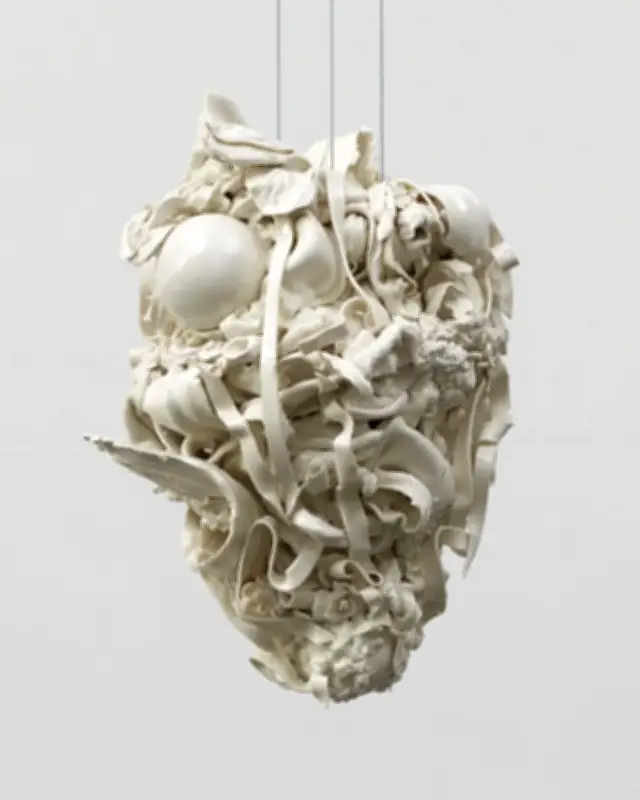
Rachel Kneebone's porcelain sculptures, suspended and ready to pop, are on display at the Wallace Collection in London. The British sculptor's delicate, intimate creations feel right at home among the rococo masterpieces of Hertford House.
A Sense of Peril in Porcelain
Seeing a Rachel Kneebone porcelain sculpture suspended makes one nervous. Can those skinny wires really hold the weight? Emerging from a tangled clump of ribbons and roses are a couple of bone-white bubbles, ready to pop. This is art that quite literally hangs in the balance; a sense of peril is what makes it so marvellous.
Born in 1973, the British sculptor is the latest contemporary artist to be invited to show her work at the Wallace Collection. Following in the footsteps of Damien Hirst, Flora Yukhnovich and Grayson Perry, Kneebone has positioned nine milky sculptures made between 2017 and 2026 throughout Hertford House. The display, titled Metamorphoses, is an intervention, but it feels different, like the contrast has been turned down. There are collisions as well as similarities, but seeing sculpted heaps of human and floral forms alongside the prized masterpieces feels right.
From Royal College of Art to Rococo
Kneebone was studying at the Royal College of Art in 2004 when she started working with porcelain, a medium more commonly associated with the types of cups and saucers safely stowed away behind glass in Manchester Square. Instead, Kneebone gives us strangely intimate pileups that recall art historical sources from the sculptural fragments of Auguste Rodin to the erotic figures of Jake and Dinos Chapman. Among the fleshly folds are glimpses of Ovid and Dante. While distinctly modern, they also nod to classical friezes, baroque fountains and rococo canvases.
One of two works created specially for the show, Temple, is presented on a plinth at the top of the stairs. Sandwiched between Boucher's The Rising of the Sun (1753) and The Setting of the Sun (1752), it's a lustrous, solid take on the churning waves the 18th-century French master conjures in paint. Emerging from the surf are three columns, a jumble of gnarly barnacles and tendrils, plus a gleaming scallop shell containing a pearl – a reference to Boucher's bejewelled water nymphs. Just like those vast mythological scenes, it's a mashup of decoration and high drama, pleasure and peril.
Embracing Instability and Metamorphosis
Challenging preconceived notions of domesticity, Kneebone embraces instability, finding beauty in the blisters and cracks that can emerge when her chosen material is fired in the kiln. Look closely and you'll notice distortions and fissures among her graceful twisting forms. In the billiards room, Dance (2017) is perfectly imperfect, a throng of protruding legs and toes – some pointed, others flexed – sprouting from a hulking mass with deep fractures at the base.
Which is where the metamorphosis part comes in. Like heated clay, Kneebone's figures are undergoing a transformation, their limbs buckling and splaying. They're also playfully sensual. Either side of Boucher's Jupiter and Callisto (1769), Pearl IV (2025) and Pearl II (2025) lunge towards one another like lovers, just as the god disguised as Diana springs towards the nymph. Elsewhere, rounded porcelain forms might resemble bubbles and pearls, but here there's no mistaking the resemblance to Callisto's creamy breasts.
Rewards of Slow Looking
Shape-shifting art rewards slow looking, and at the Wallace you can walk around it (as well as under it), watching it change and morph from different points of view. What makes the pairing of Kneebone's contemporary creations and the treasures in the collection so delightful is that it makes you look at well-known works afresh, too.
It's only seeing Bower (2026) in front of The Swing (c1767-68) that one notices the silvery quality of Fragonard's palette, complemented by the porcelain, a dazzling white. Guided by Kneebone's twisting forms and knots, the eyes aren't drawn to the young woman wearing the frothy pink frock, as is usually the case, but to the knotted rope wound around the bulky branches above. As for the cracks: they may be a fortuitous byproduct of the kiln, but they do provide a nice nod to the fractured relationship between the lady and her elderly husband, who's playing tug of war with a much younger man.
Surrounded by amorous scenes and opulent paintings of fruit and flowers, you might expect porcelain to feel cold and austere. Instead, it's titillating and decadent – just wait until you see the two pieces positioned at either end of the great gallery, seductively pale beside the red damask walls and flashy gilt frames. The beauty of even a single Kneebone sculpture is the way its parts merge and multiply before your eyes. At the Wallace Collection, London, until 25 April.