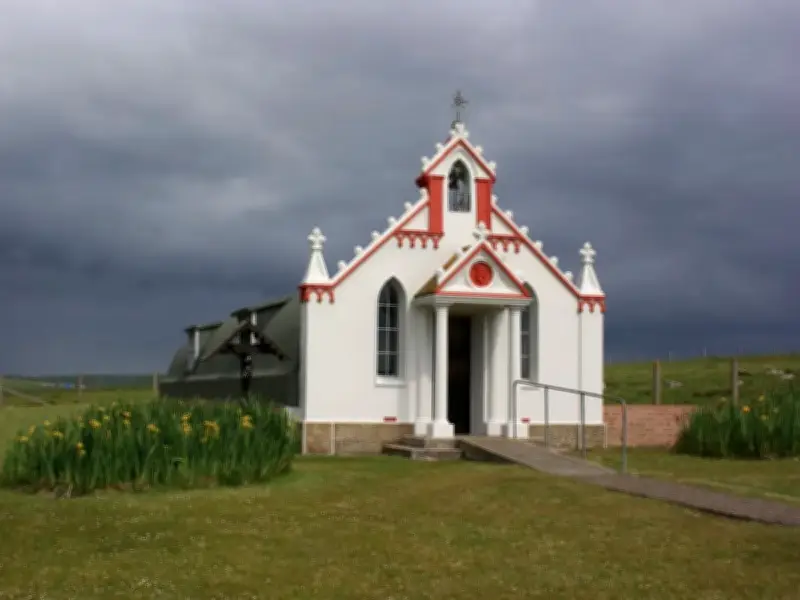
A tiny Scottish island offers a small slice of Italy, complete with sweeping views of the North Sea and Atlantic Ocean. The Italian Chapel, a small and beautifully painted church on the island of Lamb Holm in Orkney, is one of the most moving and unusual heritage sites in Scotland.
Built by Italian Prisoners of War
The shrine was constructed by Italian prisoners of war during WWII, using two corrugated-iron Nissen huts and salvaged scraps of metal and wood. In January and February 1942, around 500 Italians were brought to Lamb Holm and held at Camp 60. They were among the more than 100,000 Italian POWs in the UK, many of whom were put to work on the fields following the Italian surrender in 1943, according to the Imperial War Museum.
Following the sinking of HMS Royal Oak by a German U-boat inside Scapa Flow, the devastating 1939 attack that killed 834 crew, Winston Churchill approved a project to build a series of causeways linking Orkney's Mainland to the smaller southern islands. Called Churchill's Barriers, they were designed to block enemy access to the naval anchorage. With a local labour shortage, Italian POWs captured in North Africa were brought in to help build them.
An Ornate Interior from Scrap Materials
The chapel was largely the work of artist and prisoner Domenico Chiocchetti and his colleagues. Even after being defeated, imprisoned, and viewed as the enemy, some of the Italian POWs were determined to show that Italy's culture and people were still worth celebrating.
The interior is beautifully painted, with lovely ironwork and trompe l'oeil artwork. It offers an extraordinary contrast between its humble scrap-metal construction and its genuinely elegant, ornate finish. The chapel was lined with plasterwork, and an altar was made out of concrete. Chiocchetti painted the sanctuary end of the chapel, which in turn inspired the prisoners to decorate the entire interior and create a front façade out of concrete that concealed the shape of the hut and made the building look like a church.
Outside the chapel is a concrete sculpture of St George, sitting on a horse and slaying a dragon with a lance. This was made by Chiocchetti and other prisoners using spare bits of barbed wire and the same concrete being used to build the Barriers.
Visiting the Chapel on an Uninhabited Island
Following the prisoners' departure at the end of the war, several residents of Camp 60, including Chiocchetti, returned to visit the chapel they created. In 1996, a declaration was jointly signed by officials in Orkney and Chiocchetti's hometown of Moena, reinforcing the ties between the two places.
For war history and Italian architecture enthusiasts, the chapel is a significant place, but it's not easy to visit. There is nothing else on the island, which is completely uninhabited. First of all, head to Orkney. Most visitors arrive via NorthLink Ferries, which run routes to Kirkwall and Stromness, or by flying into Kirkwall Airport. They then travel onward by car, bus, or organised tour.
Lamb Holm sits directly on the A961, the road linking Kirkwall to Burwick, right on the Churchill Barriers causeway route. It's hard to miss, as the chapel is visible on the hillside as you cross. There's a small car park on site. The X1 bus route from Kirkwall Travel Centre toward St Margaret's Hope stops near Lamb Holm, close enough to walk to the chapel.
Entry costs £4 per person, with under-12s and tour guides/drivers going free. It's open all year round, with shorter hours in winter. It's often combined with other nearby WWII sites like Ness Battery, HMS Tern, and the Scapa Flow Museum, plus other Orkney highlights like Skara Brae, the Ring of Brodgar, and the Standing Stones of Stenness if you're making a full day of it.