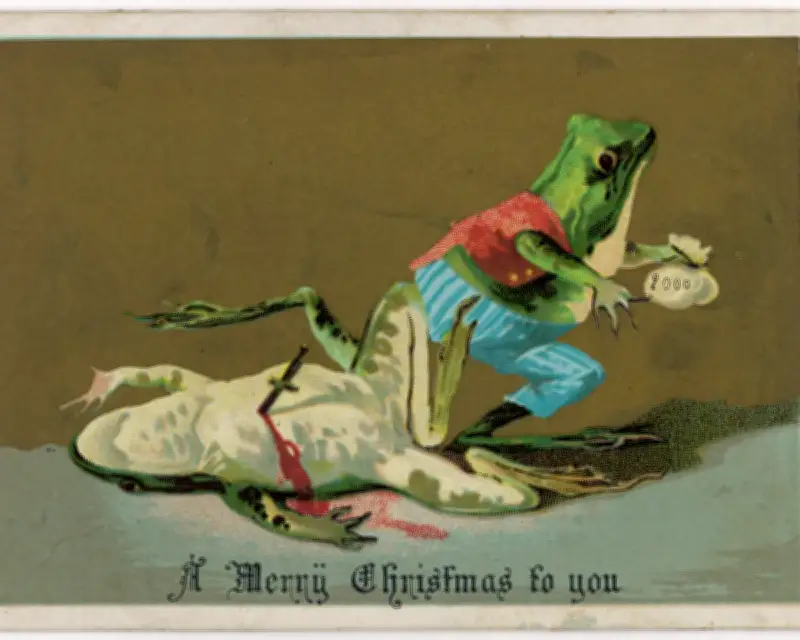
A new set of historic Christmas cards reproduced for sale by English Heritage reveals a darker and more subversive side to Victorian festivities, featuring scenes of killer frogs, dead robins, and rat-murdering fairies.
The cards, described as “absurd and unexpectedly violent,” offer season’s greetings that are far from cosy. One card depicts a dead robin lying on the ground under the slogan “A Joyous Christmas to You.” Another shows a robin triumphantly standing on the breast of a turkey it has just murdered, knife and fork in hand, in a parody of the tale of George and the Dragon, with the motto “Cheerful Good Wishes – Always a knife and fork for you.”
Frog Murder and Rat-Murdering Fairies
Perhaps the oddest image shows a dead frog lying spreadeagled on the ground with a tiny dagger in its chest, while its fellow frog killer, wearing trousers and a waistcoat, escapes with a bag of loot. Another card features a dead rat suspended over a fire by a group of fairies wearing the skins of its murdered family, captioned “With the compliments of the season.”
Peter Moore, a curator of collections and interiors at English Heritage, said the twisted Christmas images emerged during the mid-19th century, when the seasonal card industry was expanding rapidly, driven by advances in print technology and the growth of the postal service.
Dark Traditions and Symbolism
“As sending Christmas cards became increasingly popular, publishers competed for customers with unusual, eye-catching and sometimes downright bizarre designs,” Moore said. “Many of these illustrations play with the uncanny, depicting animals behaving like people in scenes that could be humorous, absurd or unexpectedly violent.”
Moore said the images echo darker and more subversive traditions of the winter festival, from the Roman festival of Saturnalia to the Welsh tradition of Mari Lwyd, where wassailers went door to door with a horse’s head, to the Catalan “caganer,” a figurine posed as if defecating that is placed in nativity scenes. “A lot of the alternative folklore traditions across Europe come from the idea of winter being dark and cold and threatening, a time to think about death and redemption,” he added.
The dead robin, Moore noted, may have made more immediate sense to Victorians. “Robins became associated with Christmas through their connection with Victorian postmen, whose red uniforms earned them the nickname ‘robins’,” he said. “Some historians have also suggested that the bird carried religious symbolism, with a popular Christian tradition holding that the robin’s red breast was stained with Christ’s blood as it sought to comfort him on the cross.”
Unanswered Questions
The rat-murdering fairies, while deeply odd today, would have been less alien in a culture where stories of elves and pixies were wildly popular. Moore said of the image: “It’s so hard to say if there’s any kind of irony there. This is a visual culture and history that isn’t really recorded, so we’ll never really know how people responded. I’d love to be able to go back in time and ask people what they made of it.”
Moore had been unable to find any fable or potential inspiration for the festive frog murder, but said it was probably intended as a pantomime-style scene. “The dagger is very theatrical, don’t you think? It has got the weird air of a froggy version of a Shakespearean tragedy.”
The limited edition cards are available, alongside more traditional festive cards, at English Heritage gift shops.