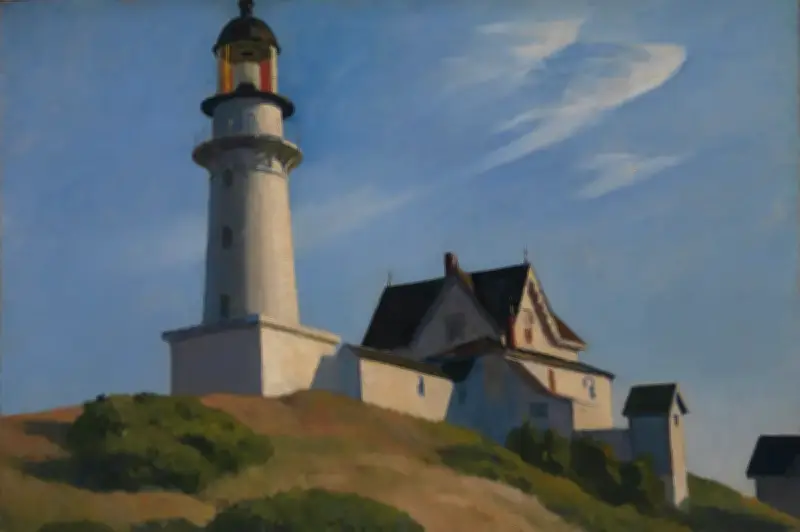
Edward Hopper, the master of American melancholy, painted his lighthouses as anthropomorphic self-portraits, according to a new biography that draws on his wife's unpublished diaries and notebooks. The biography reveals that Jo Nivison Hopper documented domestic abuse, an unsatisfactory sex life, and her husband's deep identification with the tall, awkward structures he painted most.
A Tumultuous Marriage Documented in Diaries
The biography, the first on Hopper in 30 years and only the second ever, is based on a vast material legacy preserved by Jo. As Edward's creative partner, muse, curator, producer and unofficial manager, Jo produced 35 years' worth of daily diaries, almost 100 notebooks, reels of letters, and four ledger books documenting Edward's works. Much of this material is housed at the Whitney Museum of American Art in New York.
Jo once contemplated writing her husband's biography herself, but ultimately decided against it. She explained: "To have to think and weigh and be explicit – this big, tall, lonely, silent man … it would need expert reporting and memory to repeat his exact words for any fairness."
Lighthouses as Self-Portraits
In 1946, Jo wrote: "Those lighthouses are self-portraits." She added: "That ego is impenetrable … It was pitiful to see all the poor dead birds that had run into [the lighthouses] on a dark night. I know just how they felt. That bright light on the top had deceived them."
The Hoppers first drove to Two Lights, a remote Maine village, in the summer of 1927. "We fell in love with the lighthouse," Jo wrote, but when she attempted "a harmless little watercolour", Edward said: "If you're going to paint it – I won't." Jo called her husband a "sadist" and a "prize hog".
Artistic Rivalry and Personal Pain
Jo modelled for Edward's 1941 painting Girlie Show, featuring a nude burlesque performer. On a stray scrap of paper, she documented her experience: "One doesn't exist at all in any personal sense. He isn't painting you. He raves about the wall … Little does he care how you freeze … with scarcely a stitch on of a cold night to see how light falls on your shivering flesh."
Edward's 1959 work Excursion into Philosophy suggests the Hoppers' incompatible sexual relationship. It portrays a woman on a bed, turned away with her naked buttocks on display, a nod to Edward's sexual preferences, which Jo referred to as "attacks from the rear". Jo described the painting as a "book of Plato … resorted to on morning after episode with young woman".
A Final Acknowledgment
Edward's final oil painting, 1966's Two Comedians, acknowledged Jo as an equal partner. It shows Edward and Jo donning ruffs as a smiling Pierrot and Pierrette on a stage, holding hands and bowing out after a life together, with a nod to their favourite film Les Enfants du Paradis. "This marriage has been the one great enterprise – my kingdom come," Jo wrote in 1939. "Our Kingdom … Of all the profoundest gifts of God: fidelity, wisely or not."
The biography, Edward Hopper: A Life, is released via Yale University Press on 24 November.