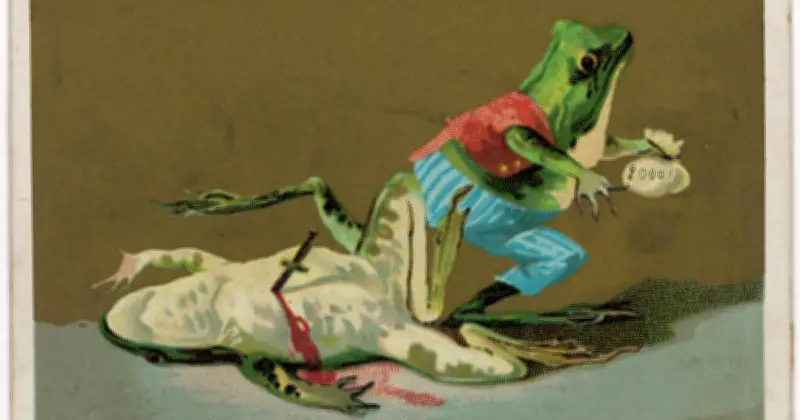
English Heritage has reproduced four limited edition Victorian Christmas cards featuring grisly scenes, including a murderous frog, a dead robin, woodland sprites roasting a rat over an open fire, and a turkey slaughtered with a carving knife. The cards are on sale in aid of the conservation charity.
While many of today's favourite Christmas traditions – from decorated trees to puddings – were popularised by the Victorians and have remained broadly similar over the years, festive greetings could sometimes be as gruesome as they were whimsical. Today's cards tend to feature familiar festive favourites such as snowmen, nativity scenes and wintry landscapes, but Victorian designers were considerably less restricted.
Victorian design trends
In addition to traditional seasonal imagery, the illustrations on many 19th century festive cards featured violent encounters, fantastical scenes and absurd animals. Peter Moore, curator at English Heritage, explained: "The Christmas card industry expanded rapidly in the 19th century, driven by advances in printing technology and the growth of affordable postal services. As sending Christmas cards became increasingly popular, publishers competed for customers with unusual, eye-catching and sometimes downright bizarre designs. While traditional religious and sentimental images remained popular, there was also a market for novelty cards intending to amuse the recipient."
Moore added: "Many of these illustrations play with the uncanny, depicting animals behaving like people in scenes that could be humorous, absurd or unexpectedly violent. This reflected a wider Victorian fascination with interests in the macabre, from anthropomorphic taxidermy which displayed animals engaged in recognisably human activities, to the ghost stories and Gothic fiction that were popular reading, particularly at Christmas."
The dead robin's symbolism
According to Moore, the dead robin is a particularly intriguing example. "Robins became associated with Christmas through their connection with Victorian postmen, whose red uniforms earned them the nickname 'robins'," he continued. "Some historians have also suggested that the bird carried religious symbolism, with a popular Christian tradition holding that the robin's red breast was stained with Christ's blood as it sought to comfort him on the cross. By depicting a dead robin, the image turns a familiar symbol of Christmas into something unexpected and unsettling."
"While it may seem a surprisingly bleak choice, it perhaps appealed to the same enjoyment of dark, surreal and macabre humour that is still embraced by many today. There's a fine line between humour and horror, and these curious Christmas cards sit right on it."
Darker traditions and availability
Throughout history and across Europe, there are many examples of darker, more subversive traditions associated with this time of year. These range from the Roman festival of Saturnalia to the medieval Lord of Misrule. Other examples include the Welsh tradition of Mari Lwyd, where wassailers go door to door with a horse's head; the central European legend of Krampus, a horned half-demon half-goat figure who punishes misbehaving children; and the Catalan 'caganer', a figurine posed as if defecating which is placed in nativity scenes.
For those who prefer their Christmas to be on the brighter side, English Heritage's historic properties are hosting a range of traditional experiences such as snowman trails, wreath-making, crafting tables, carol concerts and Christmas markets. But the four limited edition cards are available to buy while stocks last, alongside the charity's more traditional range of cards featuring snowy illustrations of its historic sites including Stonehenge and Whitby Abbey. Each is priced at a suggested donation of £3 and 100% of the profit goes towards caring for English Heritage's buildings and monuments. The Victorian cards have been reproduced from the collection held by the Mary Evans Picture Library in Blackheath, south east London.