Never-before-seen photographs, film and documents chronicling the 1943 Dambusters raid are to go on display in a world-first exhibition staged by former sworn enemies in a spirit of remembrance and reconciliation.
The trove of black-and-white images, painstakingly amassed from private collections, archives and historians, reveals the scale of destruction wrought by Barnes Wallis's bouncing bomb raid. They form the centrepiece of the exhibition, titled After Me, The Flood, opening next week at the International Bomber Command Centre (IBCC) in Lincoln.
Exhibition reveals devastation and rebuilding
The exhibition brings together hundreds of photographs and rare film recordings captured in the immediate aftermath of the mission to destroy the Mohne, Edersee and Sorpe dams in the Ruhr Valley, Hitler's industrial heartland, on the night of May 16/17 1943. Eight of the 19 Lancasters that took part in Operation Chastise were shot down or lost, with the loss of 53 men. The flooding caused by the breach of the Mohne and Edersee dams killed between 1,300 and 1,650 people.
The exhibition presents a stark visual record of the devastation caused when the Mohne Dam was breached. Photographs taken by Nazi officials, civilians and regional archivists reveal flooded landscapes, shattered communities and the immense scale of destruction downstream. Alongside these are images documenting the rapid rebuilding of the dam, a reconstruction achieved in just 17 weeks, driven by forced labour under the Nazi regime.
Reconciliation between former enemies
The exhibition is staged as a result of a flourishing relationship between Scampton, Lincolnshire, from where the raid led by 24-year-old Wing Cmdr Guy Gibson departed, and the German town of Körbecke on the Möhnesee lake. It also includes correspondence between Barnes Wallis, inventor of the bouncing bomb, and German historian Dr Helmuth Euler, together with excerpts from the diary of Piet Hilkmann, a Dutch prisoner forced to work on the reconstruction, and the only known surviving first-hand account.
Nicky van der Drift, chief executive of the IBCC, said: “Our aim is to deepen understanding of the raid, show the effects and the aftermath from the German perspective, and tell the story of what happened after the 1955 film The Dam Busters ended. Many people’s idea of the Dambusters raid comes from the film, but it is incomplete. The new exhibition shows the harsh reality and shared suffering of war. The dams were a strategic target but the effect on the civilian and POW populations was devastating. To have these archives on display in the UK is very exciting and it’s a great honour. We are telling an important untold story and I’m sure it’s going to create a great deal of interest both here and overseas.”
Tribute to aircrew and victims
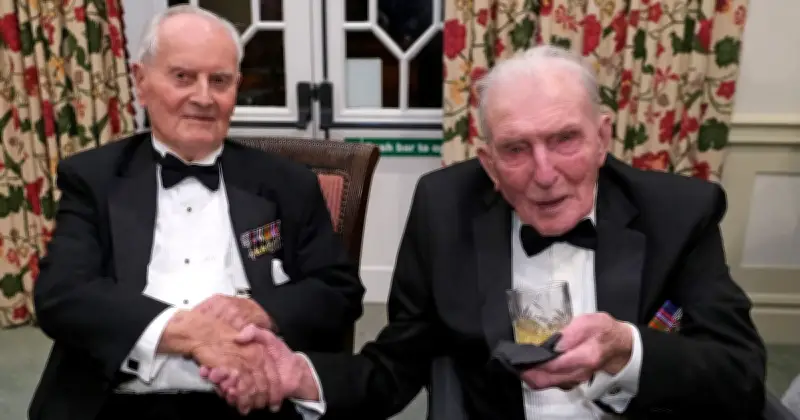
Earlier this month Flt Lt Colin Bell, 105, returned to the skies over Germany for the first time since the end of the Second World War in a flypast that took him over the dams. The RAF Mosquito pilot flew 50 missions with 608 (Pathfinder) Squadron over Germany, including 13 over Berlin, and was pals with Squadron Leader George “Johnny” Johnson, a bomb aimer on one of the Lancasters that targeted the Sorpe Dam, who died in 2022 aged 101.
Colin said: “It was in the spirit of peace and reconciliation that I wanted to pay tribute to the courageous 133 courageous aircrew of 617 Squadron - 53 of them made the ultimate sacrifice in pursuit of freedom and peace. These tragic losses of life equate to a devastating 40% of the crew. Approximately 600 of the victims were German citizens, while around 1,000 were enslaved foreign forced labourers and prisoners of war - many of them Russian, Ukrainian, Polish, and French who were housed in camps near the dams. It is incumbent on us to respect and honour these casualties of war too.”
He added: “I had the privilege on a number of occasions to spend time with Johnny. Not only was he a man of outstanding courage but he also carried humility, resilience and great inner strength. I also deeply admire him for his purposeful impact not only during the war but also during his life after the War. He personified everything that was special about our generation.”
Legacy and tour
The Dambusters Raid was a tactical masterclass and provided a huge morale boost at a pivotal stage of the war, but its long-term strategic impact has been interpreted differently by different post-war historians. The resulting floods destroyed factories, mines and power stations, and temporarily disrupted water and steel production in the Ruhr Valley. The raid also forced Nazi Germany to divert thousands of troops, workers and resources away from other fronts to rebuild the infrastructure. But how long this disruption impaired the Nazi war machine has been questioned for decades.
Wing Cmdr Gibson received the Victoria Cross but died on September 19, 1944, when his de Havilland Mosquito crashed near Steenbergen, the Netherlands, returning from a bombing raid over Germany. He was 26. Of his trip, Colin said: “It inevitably brought back profound memories of dark and dangerous times, especially missions over the ferociously defended night skies of Berlin. Even as I surpass the ripe old age of 105, these memories never grow dim.”
Once the free exhibition closes in February, it will be translated and tour museums, libraries and galleries in Germany, including the Museum of Military History of the Federal Forces in Berlin. The photographs and films will also be added to the IBCC digital archive housed by the University of Lincoln.