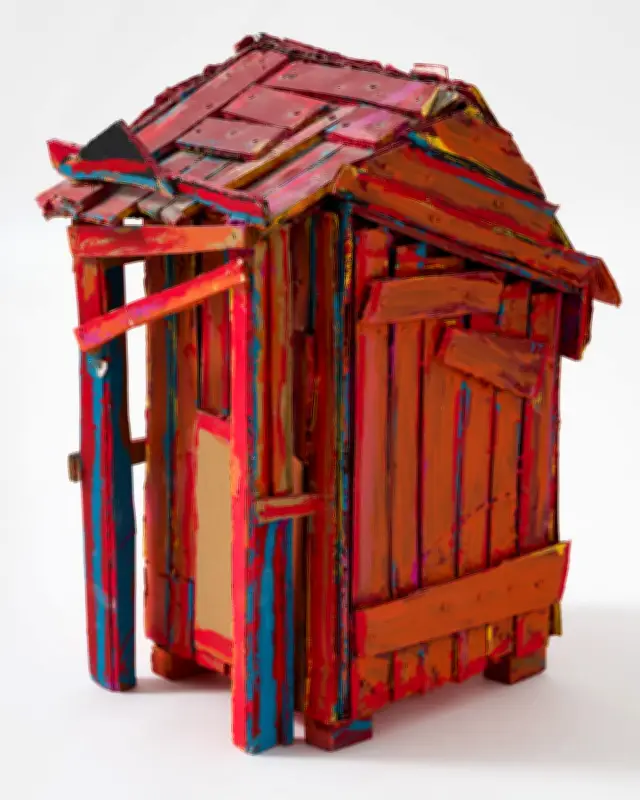
Beverly Buchanan’s sculptures, inspired by the shacks and sheds of the American south, combine folk art and minimalism to memorialise the survival of enslaved people. The show at Spike Island, Bristol, is filled with ramshackle, half-broken, semi-dilapidated little sculptures, each one based on the buildings of the south.
Architecture as a symbol of perseverance
When she was a kid, Buchanan visited tenant farmers and sharecroppers across the American south-east with her dad. There in the fields she saw shacks and sheds, shanties and shotgun houses. More than 100 years after the abolition of slavery, she saw in this rough improvised architecture a symbol of survival and perseverance, of a people making their own way against the odds.
Buchanan spent the rest of her life – a life marked by multiple chronic illnesses before she died in 2015 – translating that architectural heft into art. There are houses made of scrap wood, churches made of cardboard, tiny barns hammered together and splashed with paint or covered with buttons. The one large sculpture here is great, a shed seemingly on the verge of collapse, but Buchanan’s physical condition forced her to work on a smaller scale as she was often stuck at home for long periods.
Folk art and minimalism
They’re improvised sculptures, just like the shacks of the south are improvised buildings. And each one is filled to the brim with history, bursting at the seams with the past. In every shack sculpture you see an echo of slavery, a memorial to the people who survived it, a paean to the endurance of the enslaved.
The sculptures sit neatly between folk art and minimalism. You can see them as modernist geometric forms or slapdash DIY craft; both are true, and that’s what makes them so compelling. Buchanan was keen to reject any idea that her art was nostalgic. She saw her work as an attempt to make sure these symbols of grim history weren’t erased.
Weathering and the Frustulas
Lots of her best stuff remains in the fields and marshes where it was installed, almost as much a part of nature as the trees and tide. She experimented with concrete and tabby, a material made from oyster shells, sand and ash historically formed into bricks by the enslaved people of the deep south. Buchanan made her own tabby bricks – a filthy, dangerous process – then stacked them up and left them outside where they could be eroded slowly by nature.
This idea of weathering is everywhere in Buchanan’s work, symbolising the way people, bodies, could be worn away by injustice. A handful of these works – which she called Frustulas – sit on plinths here, pockmarked and weather-beaten, like someone left a modernist sculpture out in the rain. Each one, again, is a fragment of a violent past, an object weighed down by the history implied in its material, its shape.
Personal touches and curation
Not everything here is that emotionally heavy. A lot of Buchanan’s work is serious and formal and societal, but plenty of it is more personal too. She spent a lot of time in her local pharmacy, a place she could get her meds, but also one where she could meet friends, have some lunch. She made the pharmacy a promo T-shirt, drew out her favourite lunch menu. They’re fun objects that show you a lighter side to Buchanan but they’re not particularly interesting as artworks. The same goes for a lot of her drawings of flowers and chickens and angels, though her self-portraits tell a bit more of a story.
The show is also a bit hamstrung by some overthought curation, which pulls the work into a bunch of barely discernible thematic groupings. And there’s no part of me that understands the inclusion of new work by young English artist Phoebe Collings-James – a sound piece and a film of her cousins playing with a sculpture – which has zero relation to Buchanan or her work.
But the good stuff here – the shacks and Frustulas – is exceptional. It’s not just morose memorialising of brutal history: it’s a joyful celebration of ingenuity and survival in a world of inequality. As rickety as they look, these shacks tell a story that’s built to endure. At Spike Island, Bristol, 26 September-31 January.