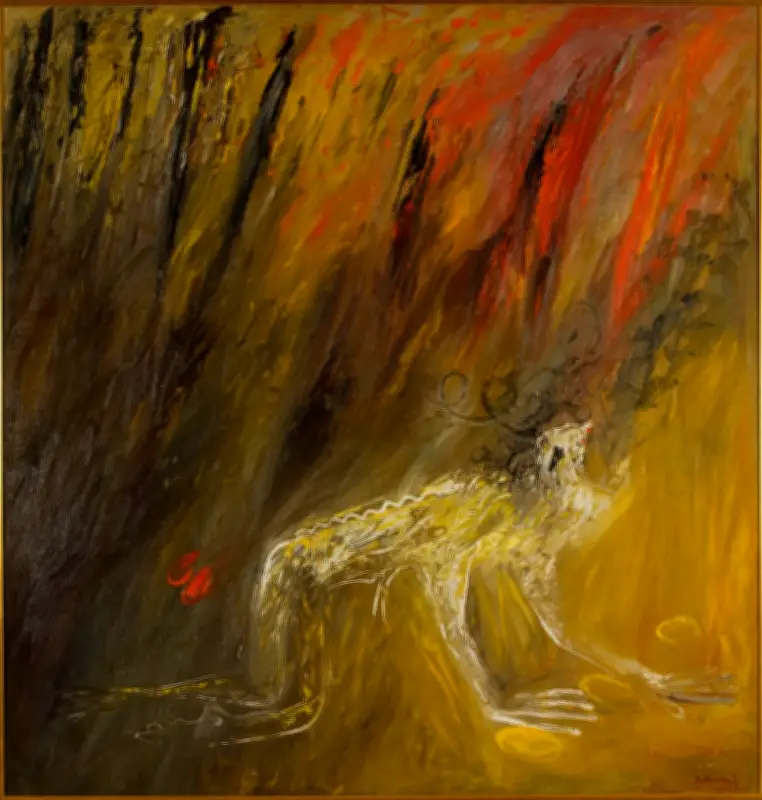
On a fine day, the bushland surrounding Bundanon Art Museum is sunbathed and effortlessly resplendent. Inside the gallery, visitors are confronted with a surreal landscape charged with horror and anguish; nightmarish and fantastical visions of a figure wandering through a wilderness, tortured by fire and transformed into a clawed and feathered beast; crouching, contorted, on all fours.
Background of the Series
The hallucinatory paintings by the Australian artist Arthur Boyd chronicle the downfall of the Babylonian king Nebuchadnezzar: a conqueror punished by God for his hubris, sentenced to seven years’ exile and insanity, living as an animal in the wilderness. Boyd embarked on the extraordinary series while living in London in the late 1960s, drawing on his horror at the Vietnam war and a series of protests involving self-immolation. The myth and modern context proved fertile territory for the artist, spawning about 100 paintings, pastels and drawings, and spanning to the 1990s.
Exhibition Details
Almost 50 of these artworks are presented in the exhibition Man on Fire: Visions of Nebuchadnezzar, which opened at the weekend at the museum established on his former bushland estate on the New South Wales south coast, on Dharawal and Dhurga country. Drawing on Bundanon’s collection as well as that of the National Gallery of Australia and private lenders, Man on Fire is the first large-scale presentation of the Nebuchadnezzar series since its initial exhibitions in London, Edinburgh and Adelaide in the late 1960s.

The first of the exhibition’s three main spaces alone is worth travelling for: 20 paintings, including masterpieces clocking in at close to two square metres, show Nebuchadnezzar alternately struck by lightning, on fire, eating grass, wild and wailing. This vivid imagery is executed with expressionist energy – lines loose and flowing or in wild motion; paint applied in sweeping strokes, frantic slashes, flurries of flicking curls and tight impasto coils. Jewel tones are punctuated by daubs and gashes of bright colour. In the gallery’s judiciously calibrated lighting, the paintings are luminous.
Themes and Interpretation
The works in this space are arranged in a loose narrative – from a depiction of Nebuchadnezzar arched protectively over a pile of gold pieces, through to images of apparent acceptance and release, as he seems to merge with the land and the atmosphere. Presented in this way, the series rivals Sidney Nolan’s Ned Kelly suite and it seems remarkable that a large-scale presentation hasn’t been undertaken sooner.
The series is generally framed as a pacifist’s salvo against the Vietnam war and Boyd himself spoke of being haunted by a series of anti-war self-immolations on Hampstead Heath, a favourite walking spot near his home (his biographer Darleen Bungey could find record of only one such incident, of unknown motivation). But the key themes – man and beast, fire, landscape – had been long present in Boyd’s work, as was the use of biblical narratives, familiar to him from his religious upbringing. An encounter with William Blake’s 18th-century image of Nebuchadnezzar at London’s Tate was a catalyst for his artistic interest in the story, as was an invitation from the medieval art scholar Tom Boase to illustrate a version of it for a 1972 book.
On a more personal level, Boyd was thinking of his father, Merric, whose violent epileptic fits he had witnessed as a child. More than allegory or biblical narrative, his series documents a soul in extremis. And specifically, a man: witness the enlarged and often inflamed testicles in many of the paintings, sometimes detached and trailing behind their owner, other times burning upwards into his body.
“They’re about masculinity in terms of its idea of control and power, and what having that taken away from you feels like,” says the curator, Sophie O’Brien. “It’s not a religious painting, it’s a painting of the human condition … Boyd had great empathy for him [the figure in the paintings], which is a much more complex relationship to the idea of masculine power.”

Additional Works and Commissions
The drawings in the exhibition’s third and final room are more humorous, surreal, sexual. One, titled Fleeing figure with black hair and squatting lion: Nebuchadnezzar, shows an abstracted nude figure with long, flowing dark hair on which a teddy bear-like lion seems to be hitching a ride. “Arthur loved to test ideas through quick form, by drawing,” O’Brien says, “so his thinking process is very much evident in that room.”
Boyd once suggested you’d need a film to do justice to the agony he sought to capture in his paintings. Shaun Gladwell, a former professional skater with familial roots in the Shoalhaven, is more interested in the endurance of his body in the landscape. His 67-minute video A Nebuchadnezzar Cycle is a major new commission created while the artist was in residence at the Bundanon studios, presented on a massive screen in the exhibition’s central gallery. In the work we see Gladwell naked and wild-haired, traversing the surrounding countryside in slow motion – clambering down rocks and running through the bush; wading into the waters of the Bangli (Shoalhaven River) and the surf at Djerrabalay (Shoalhaven Heads) bearing a flaming torch; lighting himself on fire before jumping into a waterhole. Gladwell is incredibly buff – there’s nothing abject about this Neb, and the cinematic imagery is dreamy and poetic rather than apocalyptic.
Bundanon is a “living art space,” dedicated to “fostering artists and soon-to-be artists” through residencies, commissions and exhibitions, O’Brien says. “The idea of connecting the collection to living artists is a really important one for us, and it’s something that was very important for Arthur as well.” Man on Fire: Visions of Nebuchadnezzar is at Bundanon Art Museum in Illaroo until 11 October. Guardian Australia travelled as a guest of Bundanon.