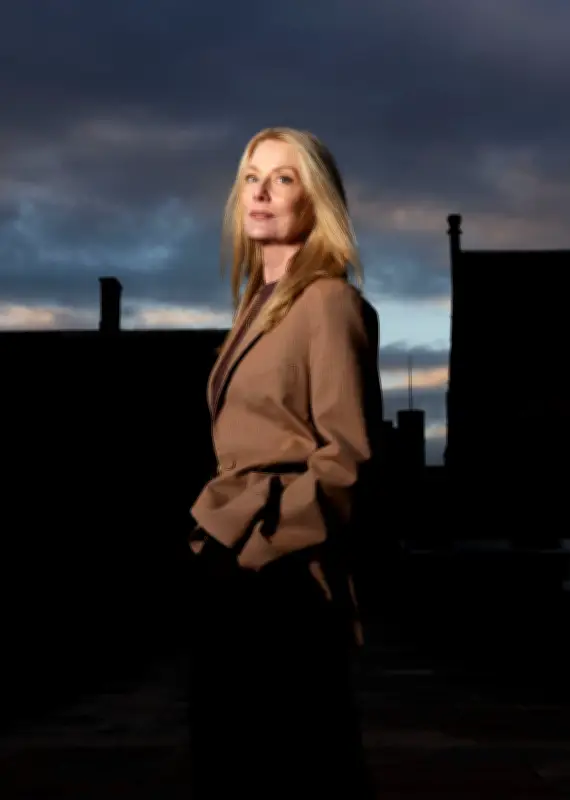
Anna Funder is mere days into her new role as professor of practice in creative writing at the University of Sydney when we meet on an overcast Friday afternoon. She waves vaguely toward her new office and admits she hasn't yet unpacked. With her encouragement, I agree to play tour guide around my alma mater, but halfway through the interview, she begins discussing the architecture, revealing how her easy, self-effacing manner masks a sharp mind.
No Formal Training in Creative Writing
As we walk past fig trees and manicured lawns, past students and graduates posing for photos, I ask Funder about her own creative writing studies. She looks stricken: 'We're starting with a confession. I have good friends who teach creative writing, and I love to talk to them, but I've never actually been taught it.'
Funder had no creative writing practice when she quit her job in international law for the Australian government to write Stasiland, her award-winning examination of East Germany's surveillance state. Published in 2002, it won the UK's Samuel Johnson Prize for nonfiction and has been published in more than 28 countries.

'I clearly didn't know what I was doing. But I did have an honours degree in English literature, and I had been reading my entire life. I always knew that I was going to write,' she says.
From Law to Berlin
Stasiland began in the late 1980s when Funder was a 20-year-old exchange student in West Berlin. Casual conversations with German friends grew into a desire to understand how citizens could turn on each other and how some refused, often at great personal cost. Of three women who became the basis of Stasiland, she says: 'They were living under a bell jar in an enclosed society, under this male tyranny of the Stasi, and they still said no. I just think to do that is incredible.'
She secured fellowships to return to Germany through the 1990s. 'In 1997, I left the law, left my boyfriend, left the country, left my career and said to everyone “I'm going to Berlin to write a book!” I was basically painting myself into this unbelievably difficult corner where I would have no option but to write my way out,' she says. 'I kind of can't believe no one stopped me.'
Career and Family
Funder's books—Stasiland (2002), All That I Am (2012), and Wifedom (2023)—center on women and resistance against totalitarianism, based on deep, labour-intensive research. Stasiland took four years while she was breastfeeding her first child; All That I Am won the Miles Franklin Award; Wifedom explores the invisible life of Eileen O'Shaughnessy, George Orwell's wife.
'I'm always a bit ashamed at how long my books take,' she admits.
AI and the Humanities
Funder sees her new role as a vote of confidence in the humanities. 'The university putting me in here is a vote of confidence in the humanities in an age of technocrats, AI, the rise of the right, book burnings and bannings. It's not just about creative writing... More broadly it says: we think universities are here in general to be a place for creative thought of all kinds, and debate.'
She testified at a Senate inquiry in September about defending authors against AI, an Instagram video that drew a comment from Sharon Stone, who called her a 'bad ass'. Funder laughs: 'I thought that was really funny because she's the OG badass, right?'
Family Background and Writing
Her mother was a psychologist whose studies shaped policies like mandatory child support; her father was an endocrinologist. 'They had this enormous sense of working professionally and personally for two things: searching for truth, firstly, and the purpose of that was social justice – making things better.'
Funder doesn't see her own work as driven by social justice, but concedes her books explore dynamics between power and disenfranchised individuals. 'I think that's the angle that I've taken to explore what it is to be human... You're looking at somebody under a microscope in an extreme situation, and seeing how they behave.'

Current Work
She is working on a new novel that is 'contemporary and quite personal. I would like it to be something that requires no research, but we will see.' She adds: 'I like to write from a place of admiration. So even if the person on the page becomes a character and is not quite like the person in real life, that original sense of awe about who they were or what they did or how they behaved in a certain situation is a very happy place for me to write from.'
Anna Funder is touring Australian capital cities in July and August 2026.