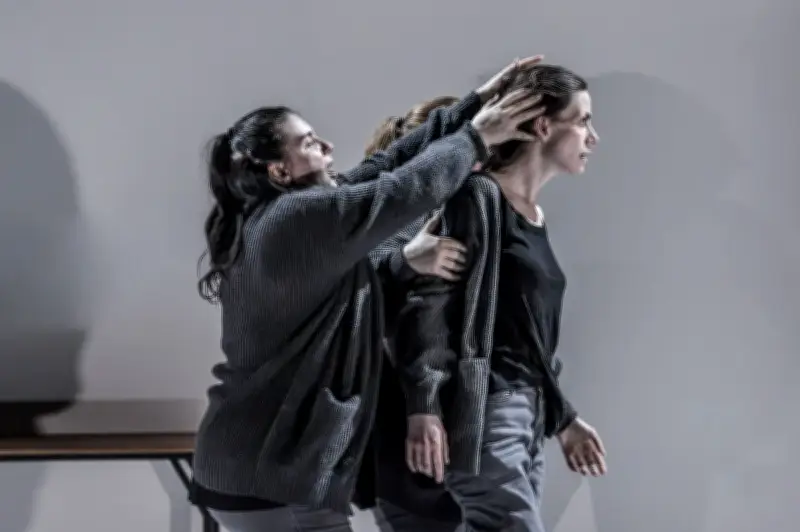
Philip Venables and Ted Huffman’s opera version of Sarah Kane’s final play, 4.48 Psychosis, has opened in the Linbury Theatre at Royal Opera, delivering a devastating triumph that is both beautiful and terribly upsetting. The production, which debuted at the Lyric Hammersmith in 2016 while the Linbury was closed for renovation, is now showing in Covent Garden for the first time.
A Journey Into Despair
Written shortly before Kane’s suicide in 1999 aged 28, 4.48 Psychosis takes a less violent but similarly traumatic path than Cleansed, which recently ran at the Almeida. Kane’s experimental approach—no defined characters or stage directions, long passages of self-coruscating poetry-prose, lists of medications, and snatches of doctor-patient dialogue—makes the piece unusually apt for opera.
Six performers dressed alike sing in complex patterns of overlaying lines to represent a central character at war with herself. Soprano Jacquelyn Stucker, listed as Gwen in the programme, is prostrate on the floor of the institution room set as the audience files in, then rises to be taken on a journey of turmoil and anguish in one of the finest performances currently on stage.
The Text as Star
The text itself is the star: an internal voice locked into an inescapable, fractured doom loop that shifts between forms abruptly and extremely. The stage is lit up with numbers from a Serial 7 test, a cognitive test where a patient subtracts numbers from 100, accompanied by bursts of frenetic passages from chamber ensemble Chroma, who sit above the institution room. Jolting bursts of electronica interrupt calming swathes of clinic muzak, as conductor Naomi Woo rides a knife-edge of tension.
Most affectingly, the dialogue passages are ‘spelt’ out syllable-by-syllable by duelling percussionists, Catherine Ring as the patient and Delia Stevens as the Doctor. With so little characterisation, the pair beating out exchanges using hammers, bare hands, or a saw are as close as it comes to traditional scenes. Dark humour emerges in illustrative arguments: “It is not your fault. You are ill.” “I am not ill, I am angry.”
A Daring Look Into the Abyss
The internal voice is clearly Kane’s, given her own experiences with mental illness and what happened in the wake of the play’s completion. While suicide hangs heavy in the air, the play is not a suicide note but a daring look into the abyss, with a deep, horrifying loathing of bodily existence, shame, guilt, and hatred of the Self, and an unflinching conviction that the act of living is painful.
The production is brilliantly accomplished but has flaws. The six-person ‘split personality’ conceit may water down the trauma, positing the suicide doomloop as an inner battle of warring selves rather than the result of a rejection of the outside world and the brutality of a system that tries to ‘correct’ that. Unlike Cleansed, where pain wrought on protagonists’ bodies is used to control their minds, the lead character is never really seen victimised by the institution.
Nevertheless, in concentrating on internal trauma, the opera grips hard and doesn’t let go. No sentimentality or self-pity is allowed into its suffocating space, with Venables resisting emotional release in favour of discordant avant-noise. When his music does soften late on, it underscores the irony of a fantasy sequence where the voice weakens and passively accepts life. There are suggestions that love, trust, and compassion could be an answer, because of their very absence—just not in this case.
This is an opera that will divide but demands to be seen. The reviewer was emotionally blindsided on the way out when the end section of Radiohead’s Exit Music (For a Film) played, with its closing refrain of ‘we hope, that you choke…’ 4.48 Psychosis is at Royal Opera until 25 October.