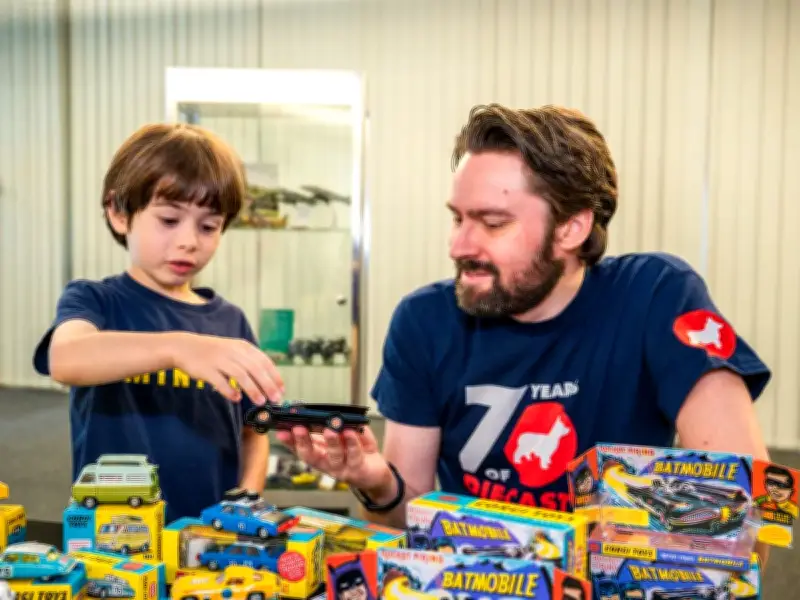
Seventy years ago, a city on the south west coast of Wales became an unlikely mecca for the motorcar. Be it a Rover 90, a Triumph TR2, a Morris Cowley, a Hillman Husky or a host of other great British models, this is where they were made. Only these were Corgi cars – miniature scale models with clear plastic windows, detailed interiors and working mechanical features, like suspension and opening parts.
First off the production line at the Swansea factory back in 1956 was the Ford Consul. It became an instant hit. Victoria & Albert museum assistant curator, Tanaya Basu De Sarkar, says: "In Swansea, they were able to create nearly 6,000 jobs in an area where unemployment had been high due to closure of coal mines."
Early Days and Wartime Production
The Corgi story began even earlier, after Jewish migrants Philip Ullmann and Arthur Katz, fled persecution in Germany for England, after Hitler’s rise to power in 1933. Toymakers, they established a workshop in Northampton, initially producing tinplate toys, similar to those being made in Germany, calling their company Mettoy.

During the Second World War, the factory also manufactured munitions and a cooking stove for troops posted in tropical jungle environments. Within six years, the Northampton factory had 600 employees and needed more room and the company moved to the larger site in Wales, making toys of all shapes and sizes, from boats and trains to dollhouses. Then, in 1956 in Swansea, a line of diecast toy motor vehicles were developed under a new name. The Corgi car was born.
Rise to Fame
Tanaya continues: "They were one of the main toy vehicle producers of the 60s and 70s, alongside their competitors Dinky Toys [made by Hornby] and Matchbox [made by Lesney]." According to toy expert and Corgi collector Lawrence Lambert, the Britishness of the cars boosted their popularity. He says: "It was a homegrown company, which instantly appealed. They did British cars, British trucks, British buses, British lorries. You had the Ford Consul, the Mini Cooper, the ERF lorries – things you used to actually see on the street when you were growing up."
Named after the famous Welsh dog beloved by our late Queen, there are plenty of famous Corgi fans, including James May, Bill Nighy and Gary Oldman, who all collect toy cars.
Collector's Passion
Lawrence, 70, a regular contributor to TV shows Car Booty, Cash in the Attic, and Antiques Roadshow, continues: "I’m the same age as Corgi. I have been collecting Corgi toys since the 1960s. At the top of my road where I grew up in East London was a newsagent called Wrights. My older brother and I would walk there every Saturday morning and marvel at all these wonderful toy cars in the window."
Once my mum got wind of that, she said, 'do some housework’, and each week we had pocket money to choose a car.” His first, the Monte Carlo Rally Mini, was a famous racing car. Northern Irish rally driver Patrick “Paddy” Hopkirk drove the iconic number 37 Tartan Red Mini Cooper S to a victory at the Monte Carlo Rally in 1967.
Lawrence says: "You could own a little piece of history for between three and eight shillings." Aghast after leaving home, when he discovered his mum had given his collection away, he built it up again and now has hundreds of Corgi cars.
Innovation and Iconic Models
Famous for pioneering transparent plastic windows, Corgis were marketed as "the ones with windows", setting them apart from rival Dinky Toys, with empty windows. Lawrence adds: "Part of the Corgi appeal was you could buy your dad’s car or a supercar. You could choose familiarity or reach for the stars." A top seller in the 60s was the Volvo P1800, the car driven by Roger Moore’s character in The Saint.
And they didn’t stop there. Tanaya says: "Their major success came in acquiring the rights to merchandising James Bond’s vehicles. Bond’s Aston Martin DB5 was sold in gold, although in the movie it was silver." Guy Stainthorpe, MD for Corgi Brand and founder of Corgi Model Club, says: "The 1965 James Bond Aston Martin DB5, featuring an ejector seat, rear shield, and machine guns, became the bestselling die-cast toy car ever made. It was one of the oldest toy licensing arrangements. To date it’s sold 11.5 million models."

As the late 1960s and 1970s rolled around, Chitty Chitty Bang Bang and the Daktari Land Rover drove further millions in global sales. Later models featured advanced features like fibre-optic working headlights, Glidematic suspension, and spring-loaded ejector seats.
Legacy and Evolution
Guy says: "It was just fun at its heart. The company evolved lots of different things, like wheel jacks so you could take off the wheels and play with them. You could play with the steering wheel too. Interactive features were especially loved on the cars from the films – like James Bond. It captured people’s imagination. It was innovation, new approaches, new styles, new techniques, all with one aim - to bring joy. There is no more iconic toy motor than a Corgi."
Tanaya adds: "Corgi was the first manufacturer to include a vacuum-formed plastic interior, rather than empty interiors. The Young V&A has several Corgi Toy vehicles in the permanent collection, including the classic Aston Martin DB5, the Beatles’ Yellow Submarine, and a model Routemaster released for the 2012 Olympics." She says of many examples displayed in the museum: "They explore the idea of 'small world play'. Children develop many skills through this kind of early years play, from creativity as they imagine that their toy vehicles are going on adventures, strengthening motor skills from pushing them about, and developing social skills by playing together."
But, just like the rest of British car manufacturing, while the Corgi brand lives on, the Swansea factory closed in 1991, after a buyout by American toy giant Mattel in 1989. Between 1995 and 1996 Corgi became Corgi Classics Ltd, relocating to Leicester and expanding into die-cast aircraft. Then, in 2008, Corgi was acquired by Hornby Hobbies, its current parent company, but production is now in China and new models are still produced each year.
The original Land Rover, released in 1957, sold over 10 million and a brand new Range Rover is being released for 2026 to delight a new generation of fans. Guy says: "We’re renowned for being a heritage brand, but we’re constantly evolving, with recent partnerships including Star Trek for a range of their starships. We’ve worked with Aardman, another great British brand celebrating an anniversary this year – their 50th. We’ve just released Shaun the Sheep on a quad bike."
You can now pick up a new Corgi with change for a tenner, less on resale platforms like eBay. Although some of the rarer models are worth over £100. Lawrence says their worth lies not in the cost but in the nostalgia. He added: "For the grown-ups, they transport them to a time of simplicity and joy. I pick up a Corgi car at 70 and I am that small boy again, looking through the shop window. And for the children picking them up for the first time, what joys are yet to unfold."