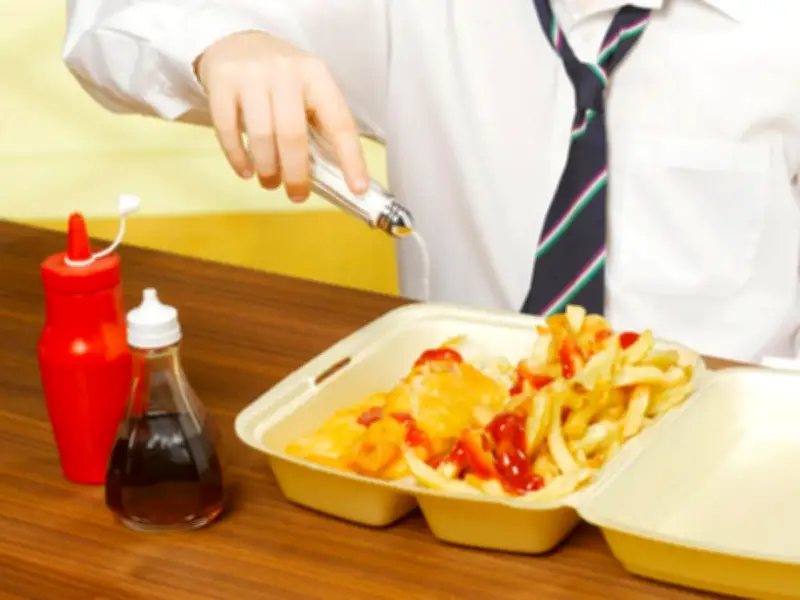
Three-quarters of secondary schools in England are serving junk food, like burgers and chips, too often – breaking the rules on meals offered to pupils. A study of almost 400 state secondaries by Bite Back, a food charity set up by chef Jamie Oliver, found schools were offering unhealthy foods more often than allowed.
Jamie famously first declared war on Turkey Twizzlers and other junk food back in 2005, as he campaigned for healthier school dinners. But now the analysis of nearly 400 school menus found 76% weren’t sticking to the rules.
Caterers struggling with rising costs
A report by LACA (Lead Association for Caterers in Education) last year found children were getting less meat, cheaper ingredients and smaller portions in their lunches as caterers battled rising costs. It revealed caterers, who were part of LACA and provided about three million school dinners a day, were having to make “really difficult decisions” over portion sizes, and the quality of ingredients they could afford. It said it was becoming an "ever increasing challenge" to meet the government’s school food standards.
Banned snacks and more frequent meat
The government’s proposed School Food Standards aimed to increase the availability of nutritious and healthy food including fruit, vegetables, and wholegrains. But the research found 53% of schools were selling snacks high in fat, sugar or salt – such as crisps, biscuits, Mini Cheddars, chocolate bars and pastries – which were meant to be banned. Some 224 schools were providing meat products, such as burgers, nuggets, sausages and goujons, more often than the twice a week permitted. And 123 schools were using chocolate chips or chocolate coating as an ingredient in desserts or bakes, despite being banned.
D’Arcy Williams, chief executive of Bite Back, said: “At a time when the health of one in three English children is at risk, parents are sending the government a clear message: stronger school food standards must come with teeth. Schools need the support to deliver, but the companies making money from feeding children must also be held accountable.”
He added: “These findings are very alarming and expose a system that is fundamentally failing our children. It is shocking to find crisps and chocolate being pushed at breakfast time or processed meats like sausage rolls and bacon baps being served far more frequently than the rules allow.”
New standards and public support
The government was rolling out improved School Food Standards in the coming months to accompany the expansion of Free School Meals to all children on Universal Credit. Separate polling of parents across England by the agency Public First, on behalf of the School Food Review, found 72% supported greater enforcement of these new standards.
The menu analysis found repeated violation examples of unhealthy options being offered during breakfast and break times, including crisps and branded confectionery. Many menus also advertised processed meat such as sausage rolls and bacon baps, or starchy foods cooked in oil such as hash browns and chips – all more frequently than the current standards permit.
Bite Back campaigner Carrera, 19, said: “Young students have been saying for years that what appears on school menus often doesn’t give us the fuel we need to concentrate, learn and get through the school day. If you’re not in a canteen every day, you might not realise that.”
Stephanie Slater, the founder and chief executive of the charity School Food Matters, said: “With these incoming improved standards we have a once in a generation opportunity to raise the quality of school food for every child. But the data and the public demand is clear: standards without a robust compliance framework will miss this opportunity.”
Parents also expressed overwhelming support for the government to go further on expanding access to Free School Meals. Around 80% supported extending provision to every primary-school child, while a similar number (or 78%) supported extending it to all children across primary and secondary schools.