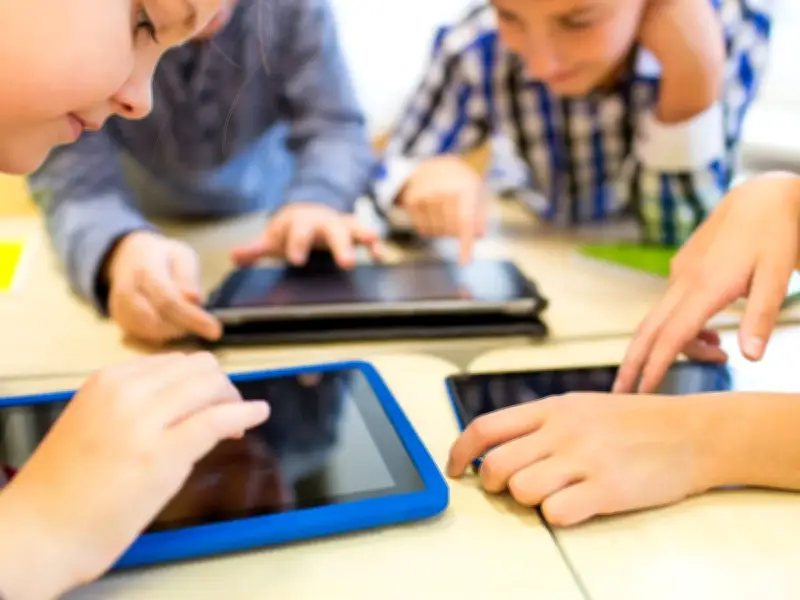
Teaching school pupils using tablets and screen devices is making them short-sighted, experts have warned.
A letter to government signed by 150 leading clinicians warned the proportion of short-sighted children in the UK has more than doubled since the 1960s. It says screen time in classrooms could be permanently harming a generation of children's language and development.
The experts say they are witnessing a "crisis unfold with children presenting earlier and more severely" with language and eyesight problems. They highlight use of tablets, laptops, interactive whiteboards and headphones - which they say "exploded" during the era of remote learning during the pandemic and have "never been rolled back".
Letter sent to health and education secretaries
The letter, also sent to Health Secretary Yvette Cooper and Education Secretary Lucy Powell, said: "No drug, food product, or toy is given to millions of children without a single safety check. Yet, astonishingly, education technology devices and platforms currently used by millions of pupils in schools and for homework every day of the week face no equivalent child-focused health scrutiny."
"As a country, we need to wake up to this now, and start rolling back screen use in schools before the damage compounds further."
Research and medical groups show a strong link between increased screen time and a rise in childhood short-sightedness - known as myopia. Previous research suggested every extra hour of daily digital screen time raises the odds of developing myopia by about 21%. The Korean study involving 335,524 participants found four hours of screen exposure daily nearly doubles the risk.
Impact on eye development and language
Heavy screen use can replace time spent outdoors, either during break times or after school. Natural outdoor daylight plays a protective role in eye development, so lacking it can speed up short-sightedness.
Dr Becky Foljambe, a GP and the founder of Health Professionals for Safer Screens, said: "We can't keep prescribing glasses and speech therapy for a problem schools are making worse."
Myopia is caused by having an over elongated eyeball and is a growing problem, with research suggesting about 40% of children and adolescents worldwide could have the condition by 2050.
The open letter has been signed by GPs, ophthalmologists, audiologists, paediatricians, physiotherapists and speech and language therapists. The letter continued: "Language acquisition depends on rich, responsive, face-to-face interaction that screens, however well designed, cannot replicate."
"Many pupils now spend longer on screens in the classroom than they are recommended to spend across an entire day."
Widespread use in schools
Data suggests one million pupils are now using device-learning in every lesson at school, while 2.6 million more kids use screens every day as part of the curriculum.
The experts wrote: "A generation is being taught on devices and platforms that have never been subject to systematic, child-focused testing for their cumulative impact on children's eyes, ears or speech, and we are the clinicians who will spend the rest of our careers treating the consequences."
The letter also warns that a three-year-old spending three hours a day on screens misses an estimated 194 conversational turns and 1,139 adult words daily. More than two million UK children are now struggling with speech and language, and around a third of children start school not ready to learn, according to the clinicians.
A Government spokesperson said: "Used well, technology can be a powerful tool to support learners who need it and free up teachers to deliver the excellent education every child deserves."
"Evidence gathering is vital to getting this right, and we're committed to working with teachers, leaders and parents to help them use technology most effectively as the evidence evolves."