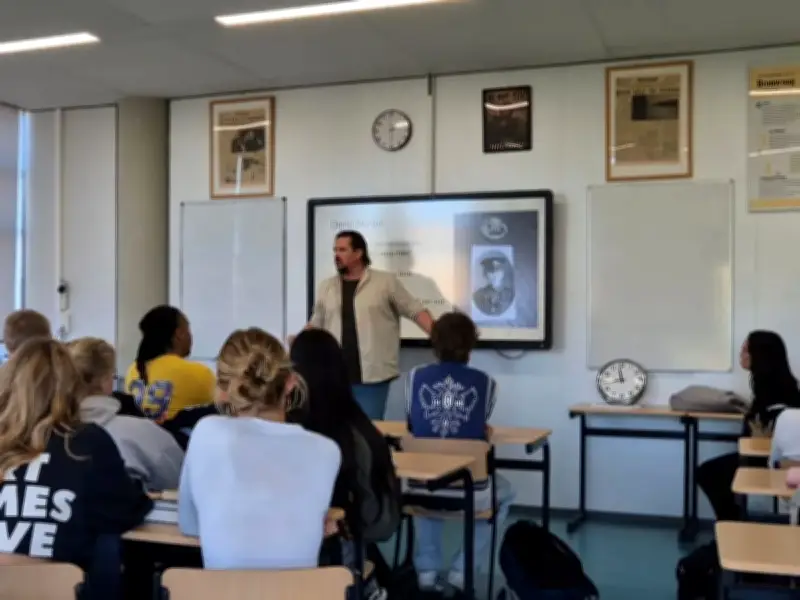
A 22-year-old British soldier killed on the Somme has been adopted by a school in Holland to teach pupils about the horrors of World War One. Devon-born Private David Morton died on the battlefield in October 1916. His great niece, Caroline Hatheson, said: “he was an ordinary man doing extraordinary things.”
A Soldier Remembered
Caroline has spent years researching Morton’s life. She and her husband Ferris visited the Somme last month to see the precise spot where he died, exactly 110 years ago. Now a school in Holland is using Private Morton’s story to teach students about the sacrifices made during the Great War. A group of Dutch history teachers met the couple and were so moved by the story that they added it to their curriculum.
Retired police officer Caroline Hatheson, 68, said: “It feels very special that children in Holland are learning about World War One through the eyes of my great uncle. He was a young 22-year-old man who volunteered to serve King and Country and ended up paying the ultimate price. I’m so proud that his memory is being kept alive through these teachers in Holland. David Morton is representing that entire generation who gave their lives.”
Serendipity on the Somme
Caroline added: “I hadn’t realised the Dutch were neutral in World War One until I was talking to the group of history teachers who were visiting the Somme to learn about what soldiers of both sides went through. It really was serendipity that they were visiting the same small hotel - No Fifty6 on the Somme - that we were staying in. It felt like it was meant to be.”
Caroline, from Tavistock, Devon, has carried out research on Morton’s final days. She said: “By the end of August 1916, British losses had already been devastated. The Duke of Cornwall’s Light Infantry. Battalion War Diary described their positions as ‘recently dug and having suffered from tremendous shelling, the trenches were knee deep in mud and water, and only only one dugout existed, with decaying bodies lying all around, and the occasional cry for help from wounded soldiers lying helplessly out in no man's land.’”
The Final Days
“By September, it went on. ‘The dreadful pall of winter was gradually falling over the Somme battlefields. Most of the trenches hastily dug became water channels, and broken ground now assumed a terrible, spongy condition, first inches and later feet deep, in filthy clinging mud of the consistency of porridge.’”
Caroline added: “David's death is recorded as 2nd October, which was a ‘quiet day’ according to the regimental diary. The best guess is that even though no action was recorded for C Company on either first or second of October, he was involved with a D Company action on the first of October, and was actually killed that day, but not recorded as missing dead, until failing to attend the second of October roll call.”
“On the day he died, his mother was at home sleeping in her chair, when she suddenly woke up, crying for no apparent reason, it was it was as if she knew that something terrible had happened to her son. During his service, David was never lucky enough to have been allowed to go back home on leave to see his family, but his mother did send out food parcels to him every week, and while he was in France, he sent his sister Agnes a small ivory jewellery box, which she talked about, but which has sadly not survived.”
A Family's Loss
“Back home in England, just a day after receiving their last letter from Dave, the family received official notification to say that it had been killed in action three days before. The letter was written on the fifth October. On the 11th of October, a Sergeant Towner, told the family that Dave had been killed by shrapnel whilst asleep in the trench, but was Towner being kind? Was every family told a similar story? We'll never know.”
“The censor has blacked out the location where Dave died, but from what we know, this matches official diary records somewhere near Rainbow Trench, so the location is almost certainly Gueudecourt. There is no mention of his name in the official war diary. At this time, only officers were individually named, not ordinary soldiers like Dave. There were just too many of them.”
David, a trained motor mechanic born in Plymouth, was just 20 when he joined up on August 31st 1914. He joined the Duke of Cornwall’s Light Infantry. Despite the family moving to Birmingham, he has strong connections with Cornwall.