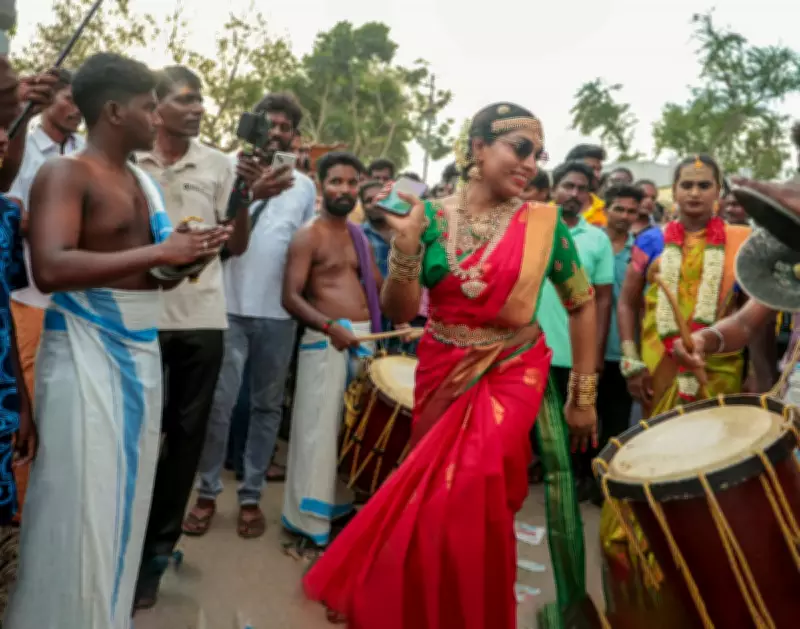
The summer air is thick with dust, sweat and the scent of jasmine. In Koovagam, in southern Tamil Nadu, more than 100,000 people have gathered for one of India's most distinctive festivals. Transgender women from across India arrive in bright silk saris and gold temple jewellery, their hair oiled and braided with flowers.
For nearly 18 days, the little town swells into a city of devotion, culminating in rituals that blur the boundaries between myth and reality.
The Myth of Aravan
The annual festival centres on the Koothandavar Temple and the story of Aravan, a figure from the Mahabharata, one of India's most revered epic poems. According to the story, Aravan agrees to be sacrificed before a decisive battle, but asks for one final wish: to be married before he dies. When no woman is willing to wed a man fated to die the next day, the god Krishna assumes the female form of Mohini to fulfil his desire. By morning, Aravan is sacrificed, and Mohini, now widowed, mourns him – her grief forming the core of the festival.

This retelling has come to hold deep significance for trans women, who come to Koovagam to marry Aravan on the penultimate day of the festival. The next morning, the mourning is re-enacted: bangles are broken; vermilion powder wiped from hair partings; and white saris donned as they grieve his death.
Legal Backdrop
This year, the festival took place against the background of a shifting legal landscape in India. An amendment to the Transgender Persons (Protection of Rights) Act 2019, passed in March, has scrapped the right to self-identify gender and introduced medical scrutiny into the legal recognition process. It also narrows the scope of who qualifies as transgender, privileging more fixed, state-recognisable categories while pushing trans men and many non-binary identities into a grey zone. Critics have called the new law regressive and an affront to human rights and dignity.
For the trans women who gathered in Koovagam, the festival offered a temporary escape from that scrutiny. The Guardian spoke to some of the attendees about their lives and what the festival meant to them.
Prazzi, 26: ‘Without documents, you don’t exist’
Prazzi, a fashion designer and university tutor in Chennai, says this is her second time at the festival. She describes it as a trans-Barbie world where she is not a minority. Most of the year, she navigates spaces where she feels her presence does not matter. In Koovagam, that isolation disappears. She had more than 50 rejections before securing her teaching position, noting that discrimination is built into paperwork. She is concerned about the new Transgender Act, which gives the state power to decide whether to issue documents, making life even harder for trans women.
Akshaya, 29: ‘Our bodies are treated as illegal’
Akshaya, who has been doing sex work for nearly a decade, says the festival offers a space where sex work is not surveilled like in the outside world. Outside Koovagam, she faces police harassment and exploitation. The new legislation, she feels, adds another layer of scrutiny without providing protection. She says it deepens vulnerability, as trans bodies are already treated as illegal.
Kareena, 21: ‘I just want to live fully in my body’
Kareena comes to Koovagam to make a wish for courage. She underwent surgery three years ago and is now preparing for further surgery. Accessing such care in India is difficult, and the new trans law has created confusion among doctors, who are scared to provide surgical care. She worries about finding a doctor and being allowed to proceed.
Yashoda, 30: ‘We come here and can just be’
Yashoda, married to Zamir for seven years, says her family has accepted them, but his has not. Their relationship sits uneasily within broader social scrutiny. At Koovagam, they do not need to explain themselves. They continue to choose each other within the limits around them.

Karpakama, 51: ‘When families abandon us, we create our own’
Karpakama has spent years sheltering trans women in Tirupur district, creating chosen families. She fears the new legislation could be misused to criminalise those who offer shelter or help during transition. She has been coming to Koovagam for 20 years, and this time, arriving with her daughters, is a show of protest. The mourning of Aravan allows them to release the weight of societal and state control.