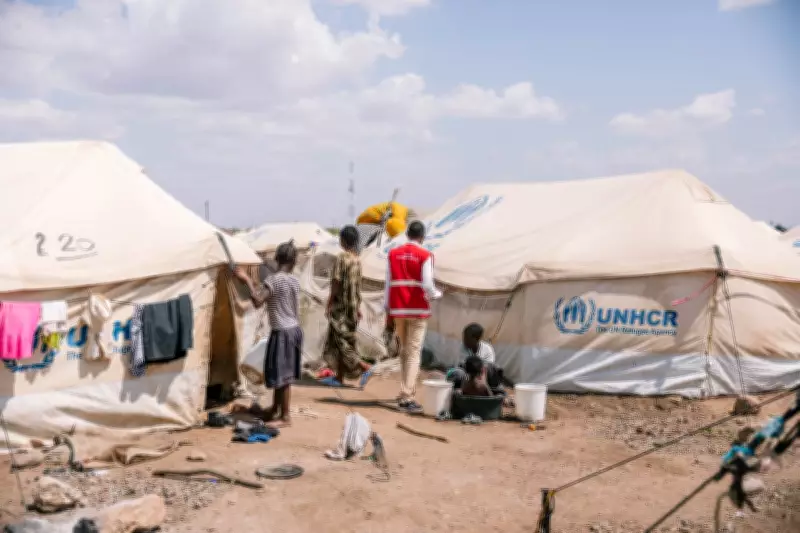
Sudan's War Refugees Face Catastrophe as International Aid Cuts Deepen
In the arid landscapes of Turkana, Kenya, Samar* recounts her desperate flight from Sudan. "It is like being on fire," she tells The Independent from a refugee camp. "You just run without realising it, until you reach a place you never even planned to get to. In Sudan, there was nothing but death." Her journey, stricken with cholera and accompanied by children not all her own, mirrors the plight of millions displaced by one of the world's most catastrophic humanitarian disasters.
Escalating Crisis in Kenya
Three years after rival military factions opened fire in Khartoum, nearly one-in-three Sudanese have been driven from their homes. Kenya, a stable nation in the Horn of Africa, is bearing an extraordinary burden. In Turkana County alone, there are 311,491 registered refugees, with 200 new arrivals each week and 400 births recorded monthly in the camps. Daniel, a health operations overseer for the Kenya Red Cross, notes that while needs increase, resources decline sharply.
"The needs are increasing, but the resources are declining," says Daniel, who has worked across multiple refugee crises for nearly two decades. He recalls that during the 2010-2011 humanitarian crisis, international support surged, but now the equation has reversed. "It is like the budget is almost half, but we are serving a bigger population." Funding to Kenya Red Cross operations has fallen by 54 per cent, leading to staff losses and overwhelmed clinics.

Overwhelmed Health Services and Dire Consequences
Clinicians now see between 110 and 200 patients daily, far exceeding the World Health Organisation's recommendation of 50. "We are supposed to close the clinic at around four, but we have to extend to clear the queue. The clinicians are burnt out because they are seeing too many patients… more than double, more than triple," Daniel explains. Critical supplies, such as iron supplements for pregnant women, have dried up, increasing risks of fatal outcomes during delivery.
"When women are anaemic, the chances of losing either the mother or the child become higher. Even a slight haemorrhage is riskier," Daniel adds. Agencies often borrow from each other when supplies run out, hoping for timely deliveries. The first stop for many refugees is Kitale, a transit centre near Kenya's western border, where Ruth has worked since 2019. She deals with complex cases, including cancer and urgent surgeries, requiring referrals to facilities nearly 400 kilometres away.
Trauma and Resilience Among Refugees
Ruth highlights the psychological toll on arrivals: "When they arrive, there's always a lot of pain and anxiety. Sometimes we have children who cannot express themselves. They are not able to speak, they don’t sleep for days and weeks. They have undergone traumatic experiences." Stories from refugees like Idris, who lost everything to robbers, and Malik, who witnessed violence and his wife's assault, underscore the unbearable accumulation of suffering.
Malik, from El Fasher in North Darfur, says, "I want to study and educate my children, at least try to give them a better future." The crisis extends beyond Sudan, with new arrivals from South Sudan and the Great Lakes region, including Rwanda, the Democratic Republic of the Congo, and Burundi. Recently, a woman from Burundi arrived at Kitale with four children after her husband was killed and she was sexually assaulted, discovering she was HIV-positive upon arrival.
Hope Amidst Growing Challenges
Ruth finds motivation in stories of resilience, such as a boy sponsored through school now pursuing a degree and another scouted in a camp playing football professionally in Asia. "There is a story behind every refugee and it could happen to anyone. It could happen to me," she reflects. However, as Sudan enters its fourth year of war, supporting such outcomes becomes harder. A Red Cross assessment warns, "Without further support, the situation will be catastrophic."
*Names have been changed to protect identities.