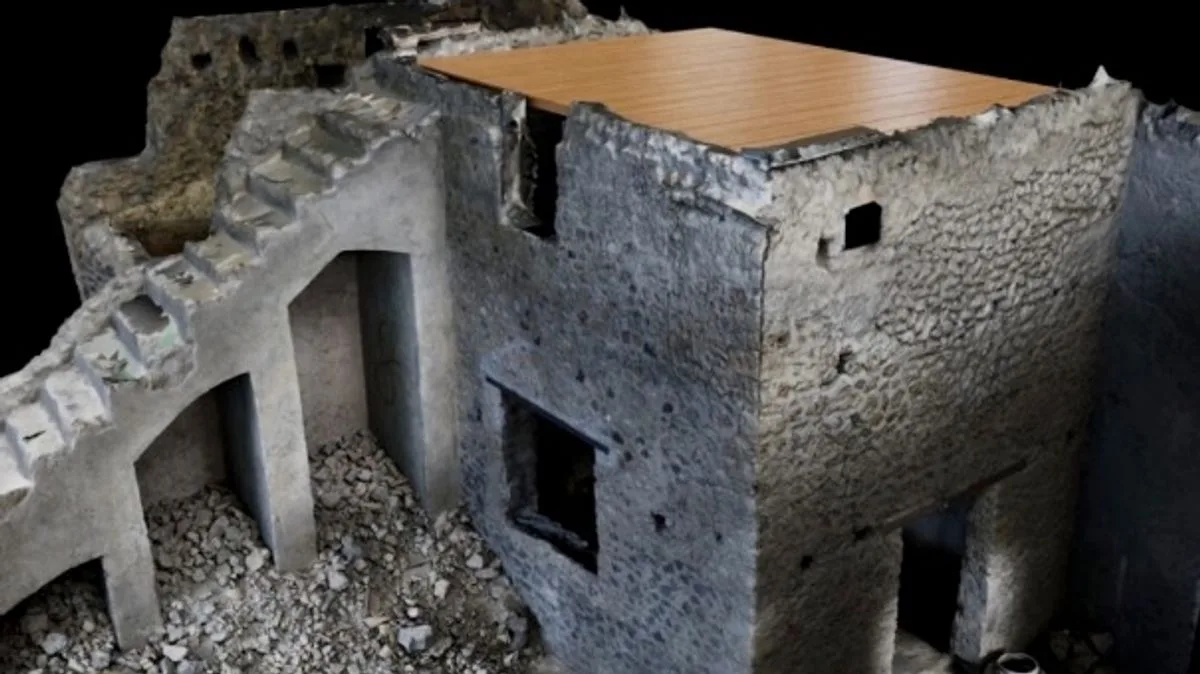
Archaeologists have uncovered a grand staircase in Pompeii that leads to a 'lost Pompeii', revealing that the ancient city may have had tower blocks housing the Roman elite. The staircase, found inside the House of Thiasus villa, was previously thought to lead nowhere, but new research suggests it was the entrance to an urban metropolis that foreshadowed modern luxury apartments.
Gabriel Zuchtriegel, director of the Archaeological Park of Pompeii, explained: 'Lost Pompeii consists of the upper floors of buildings which are essential to understanding life in the ancient city.' The research team used digital archaeology to create models of the villas of the super-rich, showing that Pompeii's largest villas likely once had towers, symbols of power and wealth.
The researchers from Berlin's Humboldt University reconstructed the tower of the House of Thiasus, which they believe could have been up to 40 feet high. The villa was a multi-storey building, with the lower part simply furnished, contrasting with a monumental external staircase leading to more elegant upper floors. The team used clues such as unconnected staircases and cut-off support beams to digitally reconstruct the city.
Zuchtriegel added: 'Archaeological research at Pompeii is highly complex. In addition to fieldwork, there is also non-invasive research, consisting of study and reconstructive hypotheses of what has not been preserved.' The findings were published in the E-journal Scavi di Pompei, offering new insights into life before Mount Vesuvius erupted in 79 AD, destroying the city.