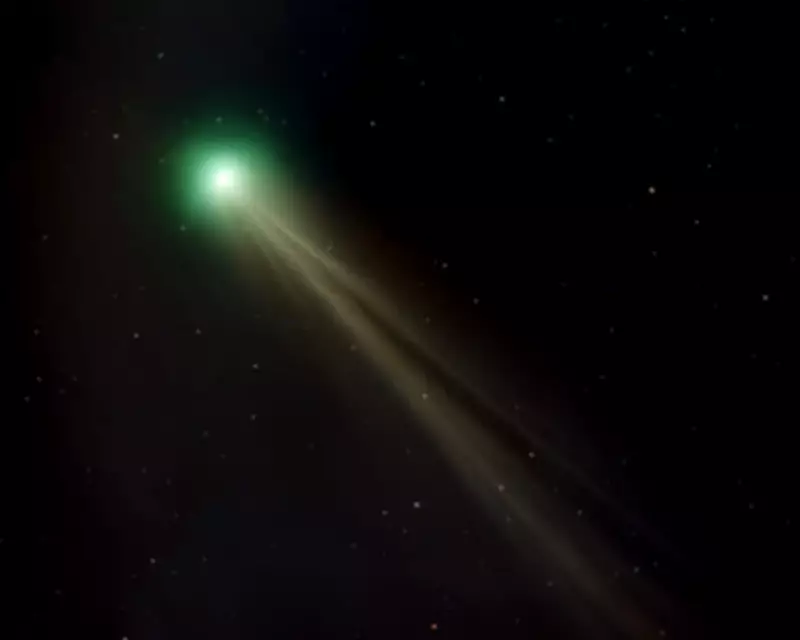
Stargazers in New Zealand have a rare opportunity to witness the comet C/2025 R3 PanSTARRS, which will be visible in southern skies over the next fortnight before it disappears for approximately 170,000 years. The blue-green orb and its smudgy tail were captured from the Wellington Astronomical Society Cretney Observatory on 2 May, as photographed by Matt Balkham, Curator of Instruments at the society.
Comet's Journey and Visibility
The comet, formed on the edges of the solar system, has travelled through the northern hemisphere and recently swung around the sun, making it now visible in the south. Josh Aoraki, an astronomer at Te Whatu Stardome in Auckland, New Zealand, explained that while the comet is fairly bright, it is not visible to the naked eye. Observers will require binoculars, a telescope, or a camera to see it. Aoraki noted, "It's not naked-eye brightness ... but this one is a decently easy one to photograph, which is always nice."
Best Viewing Tips
The comet will gradually diminish in brightness over the next two weeks. Interested viewers in New Zealand, Australia, South Africa, and the Pacific are encouraged to capture it as soon as possible. To spot the comet, find a clear, unobstructed view of the western horizon just after sunset, when the comet is still low in the sky. It will be most visible in the hour following sunset. Those who manage to see it can expect a blue-green orb—a temporary gas around the nucleus called a coma—and a smudgy tail. Aoraki described the sight as "a little fuzzy meteor in the sky."

Origin and Trajectory
C/2025 R3 PanSTARRS originates from the Oort Cloud, a vast shell of icy comet-like objects surrounding the distant edges of our solar system. Discovered in 2025, it is a long-period comet that takes roughly 170,000 years to orbit the sun, provided it does not break apart first. Aoraki cautioned, "It's really hard to predict the trajectory of them, because as they do go around the sun, they're losing mass, and that can change the path. So it could be back in that amount of time, but it also could be ejected from the solar system entirely."