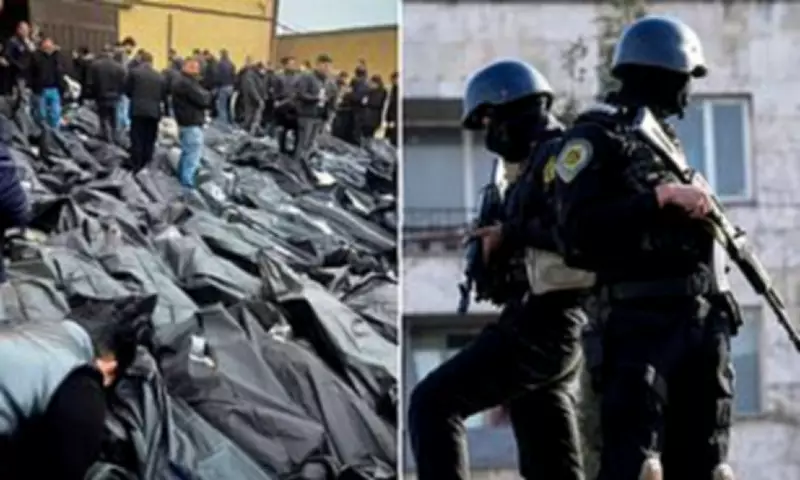
Iran's Regime Executes Four Dissidents in Warning to Political Opponents
Iran's authoritarian regime has launched a brutal killing spree this week, executing four political prisoners in what appears to be a desperate attempt to clamp down on dissent and prevent another popular uprising. The National Council of Resistance of Iran (NCRI), a coalition of exiled dissidents, has issued urgent warnings that scores more political prisoners face imminent execution as Tehran intensifies its crackdown.
Executions Send Chilling Message to Population
During a briefing on Wednesday, Mohammad Mohaddessin, Chair of the NCRI's Foreign Affairs Committee, declared that the executions of Pouya Ghobadi, Babak Alipour, Mohammad Taghavi Sangdehi, and Ali Akbar Daneshvarkar represented more than just four deaths. "These executions were not only the taking of four lives, but they were also a message from the regime," Mohaddessin stated. "The regime wants these executions to intimidate, to send a warning."
All four victims were members of the People's Mojahedin Organisation of Iran (PMOI), a major opposition group. According to Mohaddessin, their killings demonstrate the regime's attempt to "exert control" during a period of external conflict with Israel and the United States. "Why were they executed now? During a very hard external war? Because the regime leadership is extremely concerned about the domestic situation and the possibility of another uprising," he explained.

Fears of 1988-Style Massacre Resurface
The NCRI has raised alarming concerns that these executions might represent a "prelude to a massacre of political prisoners, similar to 1988." During that dark chapter in Iranian history, the regime executed approximately 30,000 political prisoners following its defeat in the war with Iraq. Mohaddessin warned that a court in Iran has already confirmed death sentences for 15 additional PMOI members, with many more prisoners at risk.
Citing exiled opposition leader Maryam Rajavi, Mohaddessin characterized Tehran's actions as reflecting the regime's "fear and desperation" in the face of growing public anger and expanding support for resistance movements. "Carrying out such executions amid an external war is a clear admission that the regime's principal enemy is the Iranian people and their Resistance," he asserted.
Secret Executions and Prisoner Backgrounds
According to the NGO Iran Human Rights, all four executions were conducted secretly without prior notification to the prisoners' families. The victims had been sentenced to death over two years ago and endured harsh imprisonment conditions:
- Babak Alipour, a 34-year-old law graduate, suffered from untreated intestinal infections and prostate disease during previous incarcerations. Arrested again in December 2023, he endured four months of interrogation in Tehran's notorious Evin Prison.
- Pouya Ghobadi, a 32-year-old electrical engineer, came from a family targeted by the regime in the 1980s when five relatives were executed. After multiple arrests and a ten-year sentence, he was briefly released before being detained again in February 2024.
- Mohammad Taghavi Sangdehi and Ali Akbar Daneshvarkar, both 60 years old, were held in Evin Prison. Daneshvarkar, an engineer, faced charges including PMOI membership and "assembly and collusion against national security."
Teenage Patrols and Intrusive Checkpoints
Amid the security crackdown, Iranian authorities have deployed armed teenagers as young as 12 to patrol Tehran's streets and man checkpoints. Residents report increasingly intrusive encounters with these young paramilitaries.
"I came across two checkpoints in the north of Tehran, with teenagers aged 13 or 14, weapons in their hands, who were stopping vehicles," described a 28-year-old woman who spoke to AFP on condition of anonymity. "He asked for my mobile phone and checked everything, even my photographs. It was extremely intrusive."
Another Tehran resident reported similar experiences: "Just 100 metres ahead, there are several private cars with teenagers stopping vehicles. They open car doors without permission, open dashboards and check phones."

International Community Urged to Act
The NCRI has called upon global powers to intervene and prevent further executions. "The UN, US, and all defenders of human rights must condemn the executions of PMOI members," Mohaddessin urged. "The international community must uphold its obligation."
Despite the regime's attempts to exploit external conflicts to mask internal crises, Mohaddessin remained defiant: "Although the regime seeks to exploit external war to mask its deep and unresolved internal crises, it cannot escape its inevitable overthrow by the people and the Resistance."
As checkpoints continue to dot Tehran's landscape and political prisoners face execution, Iran's population remains under intense surveillance and repression, with the regime apparently preparing for even more severe measures against dissent.