Jürgen Habermas's Enduring Influence on Social Democracy and Critical Thought
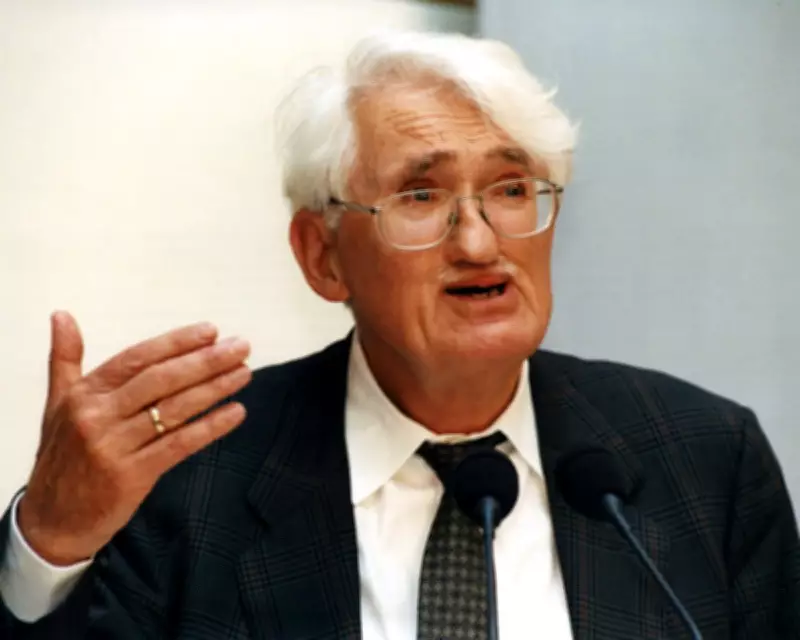
In 1998, Jürgen Habermas addressed a cultural forum on social democracy in Berlin, a moment captured in a photograph that symbolises his lifelong engagement with public discourse. The philosopher, who passed away on 14 March 2026 at the age of 96, remains a pivotal figure in modern philosophy, often mischaracterised as a mere consensus-seeking liberal. His profound belief in the necessity of shared understanding, however, was rooted in radical principles that continue to resonate in our current age of communication breakdown.
The Frankfurt School: A Constellation of Critical Thinkers
Contrary to its name, the Frankfurt School is not a formal institution but a dynamic constellation of scholars dedicated to the project of critique. As described by critical theorist Rahel Jaeggi, this intellectual pursuit aims not at superficial judgment but at transforming reality through deep analysis. Habermas emerged as a fixed star within this constellation, guiding generations of thinkers across Germany and North America with his prolific output of over 40 books and charismatic presence.
His early career was marked by controversy; Max Horkheimer, then director of the Frankfurt Institute for Social Research, deemed him too radically leftwing. Only Theodor Adorno's intervention secured his place, allowing Habermas to become the first notable non-Jewish proponent of the Frankfurt School. This beginning underscores the radical underpinnings of his work, which often challenged mainstream perceptions.

From Productive Labour to Communicative Reason
Habermas diverged from traditional Marxist thought by shifting focus from productive labour to communication as a source of progressive potential. Influenced subtly by Hannah Arendt's ideas on public speech, he proposed the concept of "communicative reason." This notion, which may seem alien in a world marred by colonial violence and gender oppression, finds validation in historical movements like democratic clubs and free press that fought for emancipation.
Extensions of his public sphere theory, such as Nancy Fraser's feminist counter-publics and Alexander Kluge's proletarian traditions, further bolster its relevance. Habermas's materialism insisted that redemption must be found within history itself, a perspective gaining new urgency amid contemporary nihilism, disinformation, and the rise of AI-generated content.
The Theory of Communicative Action and Lifeworld Dynamics
In his seminal 1981 work, Theory of Communicative Action, Habermas meticulously analysed how systems like markets and bureaucracy can override the communicative negotiations of the "lifeworld"—domains such as family, civil society, and education. He argued that only the lifeworld, in principle, operates communicatively and can respond to moral demands.
This framework also traced a continuity in critical theory from György Lukács through Adorno and Horkheimer to contemporary thinkers like Axel Honneth, Judith Butler, and Rahel Jaeggi. All engage in critiques of reification, protesting the reduction of living beings to mere objects—a theme echoing throughout the Frankfurt constellation.
Formal Pragmatics and the Aspiration for Understanding
Later in his career, Habermas adopted a more formalist approach through "formal pragmatics," seeking to ground arguments against objectification in actual communicative exchanges. He maintained that communication inherently aims for shared understanding and non-coercive consensus, even if most utterances fall short. The moral test, he proposed, is whether an idea could gain approval from all concerned parties.
In today's world, where communication often seems to break down, Habermas's insights remind us that without this aspiration, discourse devolves into proto-fascist dynamics of "might is right." Yet, as we engage in dialogue, his work suggests that the potential for genuine understanding persists, buried within our interactions.

Controversies and the Future of Critical Theory
Habermas's legacy is not without contention. His stance on geopolitical issues, such as refusing to label Israel's actions in Gaza as genocide, has sparked dismay among scholars. Some question whether critical theory can recover from such perceived failures of judgment. However, the resources for renewal lie within the tradition itself, including Habermas's own contributions.
As we navigate an era of communication collapse, his message remains vital: the pursuit of shared understanding is not a liberal complacency but a radical endeavour essential for societal transformation. Eva von Redecker, a German philosopher, highlights this enduring relevance, urging us to reconsider Habermas's work beyond caricatures.