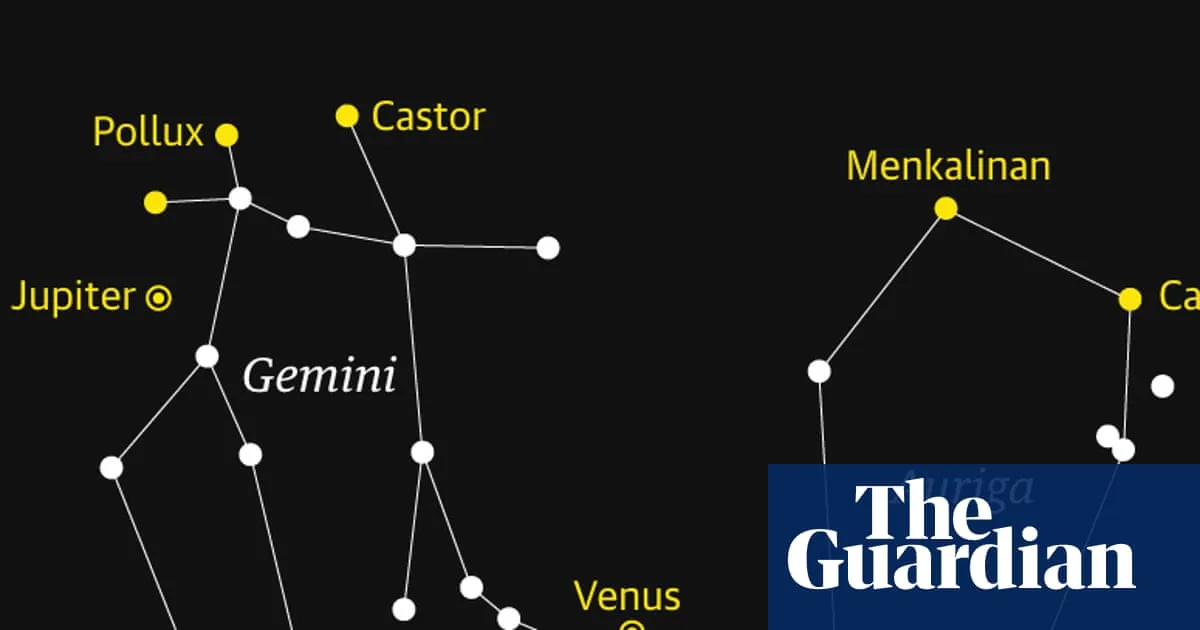
Stargazers are in for a treat this week as a young crescent moon moves past Venus and Jupiter in the western sky after sunset. The slim arc of a two-day-old moon will first pass Venus, shining brightly, then move towards Jupiter over several nights.
On 18 May, looking west from London at 22.00, the moon will be just 2.4 days old with only 6.2% of its visible surface illuminated. Venus will be unmistakable even in twilight, while Jupiter sits a little higher and dimmer but still prominent. The stars of Gemini, Castor and Pollux, will be the faintest.
Over the following nights, the moon moves eastward towards Jupiter, growing in illumination as its angle to the sun changes. For the best view, choose a location with an unobstructed western horizon.
In the southern hemisphere, the view may be easier as the ecliptic is tilted more steeply from the horizon, placing the conjunction higher in the sky at sunset.