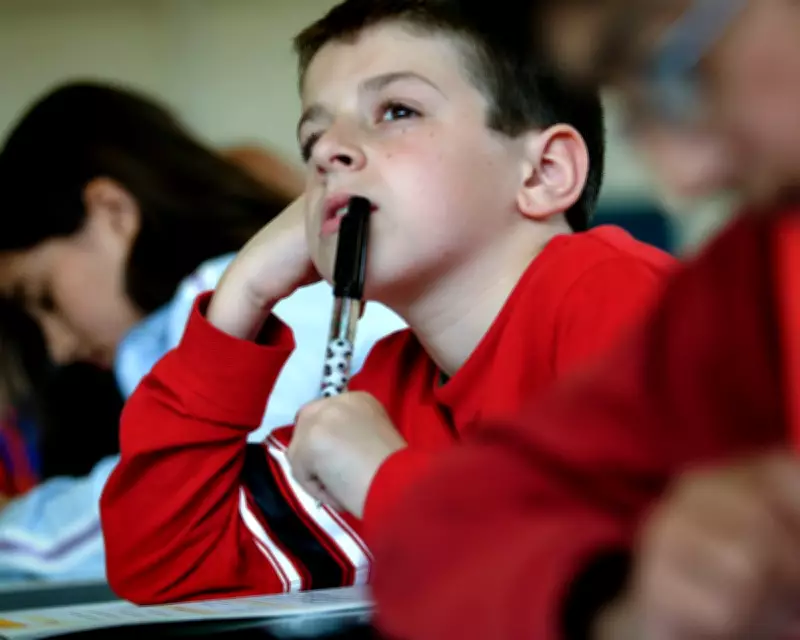
Children sitting their year 6 Sats exams at a primary school in Wales are not the only ones feeling the pressure. Their parents, too, are grappling with anxieties about long division and the role of artificial intelligence in a rapidly changing world. Emma Brockes reflects on the challenges of revisiting multi-stage maths problems and the broader implications for education.
The Real Victims of Sats
As parents of 11-year-olds offer sympathy and support for their children ahead of year 6 Sats exams next week, let us not lose sight of the real victims here: the parents who have been forced to revisit multi-stage maths problems when they had made large and deliberate life choices to avoid them. Called on to do long division, many adults find themselves ill-prepared, with AI offering little help.
Of course, Sats "don't matter," or if you are a more liberal parent, exams as a whole don't matter. This statement, once a consoling lie, seems to be becoming ever more true. Arguments around the value of testing have been ongoing, but as AI eviscerates the entry-level job market and university degrees become increasingly expensive and at odds with the skills young people may actually need, one must wonder whether the old systems of education are still fit for purpose.

What Do Tests Really Test?
It is a question that joins all existing doubts about what tests actually measure, and whether being exam-smart, with its narrow definition of intelligence, should be the singular determinant of a child's future success. The pendulum on this swings back and forth; when Brockes was at school, coursework was a big thing, then Michael Gove came along and wrenched education back to the 1950s, and now she finds herself helping her child with a test prep question about the "past progressive tense," crying, "I'm literally a writer and I don't know what this means!"
Alternative systems of assessment always seem to fall short. Brockes's children did most of their primary school education in New York during the final years of enthusiasm for gentle parenting and "prizes for all," so that, despite being in one of the most competitive cities in the world, they sat two consecutive years of state tests with no upper time limit. One child took this rule at face value, returning to her exam paper after a leisurely lunch, only relinquishing it when her fourth-grade teacher howled, "You're killing me here."
The Value of Pressure
Irrespective of what is being tested, meeting a deadline under pressure seems a useful skill to learn early. So too is learning to move on if you do not get the grade you need, and that adrenaline, correctly channelled, has uses. While Brockes is too lazy to be a tiger mom, she has never loved the approach that seeks entirely to neutralise pressure around children. Now, gentle parenting is on the wane, and we are back to a more usefully robust assessment of what children can and cannot stand. If nothing else, Sats serve a ritualistic purpose that marks the end of something and the start of something new.
This makes a case for exams more as life experience than learning tool, in the same way that a university education these days offers best value as a very expensive developmental stage. Brockes recalls the quote by novelist Don DeLillo, who when he left advertising argued that what he needed most in life was a moment "to smoke cigarettes, drink coffee and look at the world." Financially, if it makes more sense for children to eschew training systems built for a world becoming rapidly obsolete, what else will afford them the time to grow and think and look at the world?
None of which helps with the KS2 maths sheet where, oh god, multi-stage questions about sweets in bags await. Brockes tries to set a good example by concentrating and holding on to her temper, but soon finds herself crying, "This literally doesn't make sense." Looking on the bright side, this may provide a life lesson of its own: in the limitations of the adult emotional range relative to the occasionally bottomless maturity of children. Her child pats her arm: "It's OK."