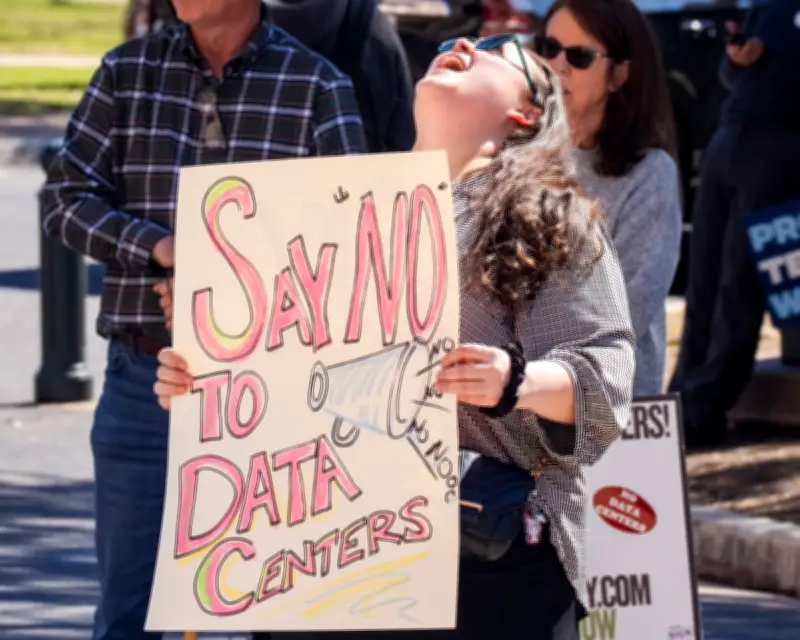
Residents across the United States are increasingly pushing for moratoriums on new datacenters and attempting to oust elected officials who approve such projects, reflecting a rare bipartisan unity against the industry. In Lenox Township, Michigan, a proposed datacenter shrouded in secrecy prompted packed public meetings and a recall petition against four board members. The website Lenoxdatacenter.com, which promoted the project, did not disclose the developer, and township officials initially denied any application. Emails obtained via open records requests revealed developers had contacted the township supervisor and deputy supervisor for support.
Secrecy Sparks Outrage in Michigan
Residents expressed anger over the lack of transparency. “The community still has questions that aren’t being answered and the public deserves to have transparency,” a resident said at a June board meeting after trustees declined to extend a four-month moratorium on datacenter development. The perceived secrecy led to a petition seeking to recall four members of the Lenox board of trustees, which oversees township administration, zoning, and ordinances.
Bipartisan Opposition Grows Nationwide
Evan Sutton, a Seattle resident who has helped datacenter opponents in 10 states, said the movement “reflects the growing anxiety about AI writ large. People feel like this technology is being shoved down our throats.” The US has over 4,400 datacenters, according to Data Center Map. A University of Michigan report notes one center can consume as much electricity as 2,000 homes. Datacenters also require water for cooling; a typical facility uses 300,000 gallons daily, equivalent to about 1,000 households, while large ones can use 5 million gallons daily, matching a town of 10,000–50,000 residents, per the Environmental and Energy Study Institute.

This consumption strains local water supplies and electric grids, leading to infrastructure upgrades and higher consumer costs. Nearby residents often complain about constant humming from cooling systems and air pollution. Industry analysts note that companies frequently build datacenters clandestinely without revealing the tech firm that will use them. The Virginia Mercury reported that among 31 Virginia localities with datacenters, 80% had non-disclosure agreements with developers.
75 Projects Blocked in Early 2026
During the first quarter of 2026, at least 75 datacenter projects worth about $130 billion were blocked or delayed, roughly the same as all of 2025, according to Data Center Watch. In May and June alone, voters in states including California, Florida, Michigan, Missouri, Oklahoma, Oregon, and Texas launched efforts to recall officials over datacenter proposals.
Anthony Leiserowitz, director of the Yale Program on Climate Change Communication, said, “Many Democrats are deeply concerned about energy use and polluting electricity, like the re-invigoration of coal-fired power plants, whereas Republicans and many Democrats are concerned about economic consequences, especially on their electricity bills.”
Missouri Recall Effort Faces Legal Challenge
In Festus, Missouri, residents filed a recall petition against the mayor and three council members after they approved a $6 billion datacenter agreement with CRG Clayco. The developer had shifted focus from St Charles, where strong opposition led to a datacenter ban. In both cases, the developer refused to reveal the operating tech company. Michael Bommarito, author of How to Fight a Data Center, said, “The company usually goes public only after the decisive votes have been taken.” The Festus city council approved a five-year personal property tax abatement for the developer. Though a judge validated the recall signatures, the council rejected the petition. Resident Dennis McDonald has filed a legal challenge. “If the community says we want to be involved and you just don’t involve them, it builds into where we are now,” McDonald said.

Oklahoma and Other States See Action
In Yukon, Oklahoma, Republican bank vice-president Joe Horn filed a recall petition against the mayor and vice-mayor over a proposed $1 billion datacenter, citing lack of transparency and water usage. “We already ration water here in Yukon. At what cost are we going to have this huge industrial building right across the street from one of our most beautiful neighborhoods?” Horn said. The city manager signed a non-disclosure agreement with Beltline Energy. Following the recall petition, Vice-Mayor Jeff Wootton resigned. In nearby Luther, the city council passed a six-month moratorium on datacenter development after seeing the Yukon backlash. Wootton said he believed the datacenter could bring economic benefits but acknowledged public trust is critical.
Trump Administration Pushes Fast Construction
Despite some Republican opposition, the Trump administration has pushed for fast datacenter construction. Investors and Republicans have claimed Chinese Communist party propaganda is driving resistance. Kevin O’Leary, a Shark Tank star, claimed opponents of his Utah project were fueled by China, but later admitted no evidence. Fox News hosts issued on-air apologies for airing his claims. Meanwhile, the Lenox Township effort appears to have stalled; the campaign website now states: “This campaign has ended and is no longer taking action.”