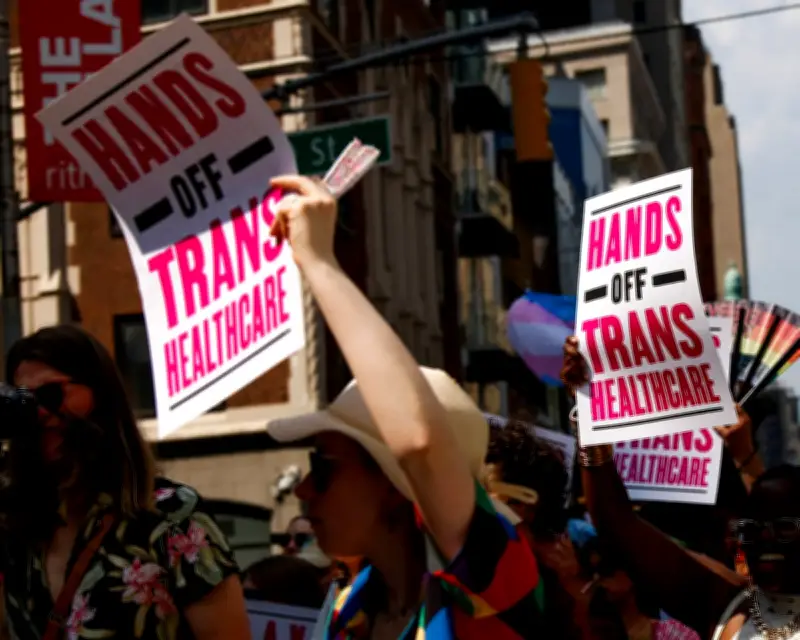
US federal employees and their families are joining a class-action lawsuit against the Trump administration for blocking insurance coverage of gender-affirming healthcare.
Lawsuit filed against federal office
The Human Rights Campaign Foundation (HRCF) and the DC-based law firm Correia & Puth filed the lawsuit on Monday morning against the federal office of personnel management (OPM), arguing that the prohibition violates Title VII, which protects against sex discrimination.
The Trump administration had been “fixated” on ending gender-affirming care, said Cynthia Cheng-Wun Weaver, HRCF’s senior director of litigation. “A lot of the criticism and attack on this care is for treating minors, but this exclusion is for all ages,” she said.
Scope of the ban
Federal insurance plans cover about 8.3 million people in America – not just employees and retirees themselves but also their partners and other family members.
Health insurance coverage for gender-affirming care is no longer covered by federal insurance plans as of January, with the exception of mental health counseling, including faith-based counseling. There was also an exception for those who are in “mid-treatment”, though it didn’t detail which treatments exactly qualified. A subsequent letter in March eliminated this exception beginning in 2027.
At least 39,400 enrollees will be affected by the prohibition on gender-affirming care coverage, according to a recent estimate from the UCLA School of Law Williams Institute.
Impact on workers and families
“Healthcare access should never be weaponized to advance discrimination – and the denial of coverage for critical healthcare based simply on who you are blatantly violates the rights of all of us,” said Kelley Robinson, the HRCF president, in a statement.
Federal workers and their families have been forced to pay out of pocket for gender-affirming care, including routine doctor’s visits, while others have foregone the care entirely. Some employees have left their jobs.
The pseudonymous plaintiffs detailed the exorbitant costs of care that they are now forced to pay out of pocket or forgo entirely. Trans employees have begun receiving bills for hundreds of dollars for annual exams, bloodwork, follow-up appointments, and hormone replacement therapy. Costs for surgery, deemed by their doctors as medically necessary, run in the thousands of dollars. A US Postal Service employee had to turn to his savings to cover his daughter’s gender-affirming care.
One of the plaintiffs previously had a surgery that was covered, and they now require post-surgical care that is not covered. “This person is now stuck in this untenable, very unsafe situation, having to decide whether they can actually pay untold amounts of money or risk having serious complications,” Cheng-Wun Weaver said.
Financial burden as prohibition
Even though the ban is on insurance coverage, not on the care itself, the financial burdens amount to prohibition for some individuals, Cheng-Wun Weaver said.
Gender-affirming care can be life-saving, and major medical organizations support it as medically necessary. The complaint likened the move to denying coverage of other life-saving care like insulin. “If you have diabetes and you need to receive insulin for treatment that is ongoing – to have it taken away from you, it’s a devastating situation because your health is at stake, and now you have to budget for this care that adds up as you live on,” Cheng-Wun Weaver said.
Confusion and precedent
The temporary exception for “mid-treatment” coverage has been “very confusing”, Cheng-Wun Weaver said. The vague language in the letter to carriers means that insurers are left to interpret what is covered on their own, and “it’s really a crapshoot”, she said. Patients are calling their doctors and insurers before every visit and blood draw to see what will be covered.
To have coverage of medically necessary care prohibited based on no medical or scientific reason is “cruelty”, Cheng-Wun Weaver said. And it set the precedent of politically motivated coverage bans for any population, she added: “If this can happen to a very small population of a country, it can happen to anyone else.”