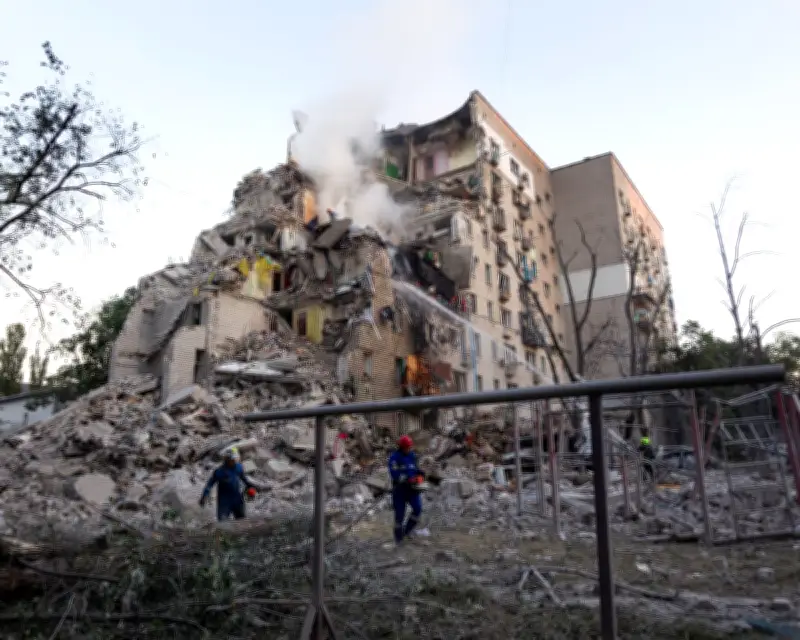
At least 28 people were killed and more than 100 wounded in a Russian missile barrage on Kyiv on Friday, prompting both Ukraine and Russia to vow further escalation of the war. The attack, which struck residential buildings and a children's hospital, was one of the deadliest on the capital in months.
Details of the Attack
Ukrainian officials reported that Russia launched a combination of cruise and ballistic missiles, with air defenses intercepting some but not all. Among the dead were three children. The strikes hit a busy residential area and a medical facility, causing widespread destruction.
Ukrainian President Volodymyr Zelenskyy condemned the attack, stating, "This is a deliberate act of terror against civilians. We will respond with force." He called on Western allies to provide more advanced air defense systems and longer-range weapons to strike Russian launch sites.

Russia's Response
Russian officials defended the strike, claiming it targeted military infrastructure. Defense Ministry spokesman Igor Konashenkov said, "The strikes were aimed at command centers and weapons depots. Any civilian casualties are the result of Ukrainian air defense missiles falling on residential areas." He warned that attacks would intensify unless Ukraine ceases operations in contested regions.
Russian President Vladimir Putin, in a televised address, said, "The military campaign will continue until all objectives are met. We are prepared for a long conflict." He accused Ukraine of using civilians as human shields.
International Reaction
United Nations Secretary-General António Guterres condemned the strike, calling for an immediate de-escalation. The European Union announced additional sanctions against Russia, targeting its energy sector and military supply chains. The United States pledged a new $400 million military aid package, including air defense interceptors.
Ukraine's allies have expressed outrage but remain divided on providing long-range missiles that could strike deep inside Russia. Some NATO members fear escalation beyond Ukraine's borders.
Impact on Civilian Life
The attack has deepened the humanitarian crisis in Kyiv, where power and water supplies were disrupted in several districts. Emergency services worked through the night to rescue survivors from rubble. Hospitals reported being overwhelmed with casualties.
Residents described scenes of panic and devastation. "We heard explosions and then the building shook. There was dust and blood everywhere," said a survivor, Olena Kravchenko. "We need this to stop."
Military Implications
Analysts say the strike demonstrates Russia's ability to penetrate Ukrainian defenses despite Western-supplied systems. Ukraine has received Patriot and NASAMS batteries but lacks enough interceptors to cover all cities.
Ukraine's military chief, General Valerii Zaluzhnyi, said, "We need more air defense and the ability to strike back at the launch points. Without that, these attacks will continue." He indicated that Ukrainian forces are planning counteroffensives in the south and east.
Escalation Risks
Both sides appear committed to intensifying the conflict. Russia has been building up forces near the border and increasing production of missiles. Ukraine is mobilizing additional troops and pressing for faster Western deliveries.
The International Committee of the Red Cross warned that the escalation could lead to further civilian suffering. "International humanitarian law must be respected. Attacks on civilians are prohibited," said ICRC spokesperson Sarah Alzawqari.
As the war enters its third year, prospects for a diplomatic resolution remain dim. Peace talks have been suspended since early 2023, with both sides demanding maximalist positions.