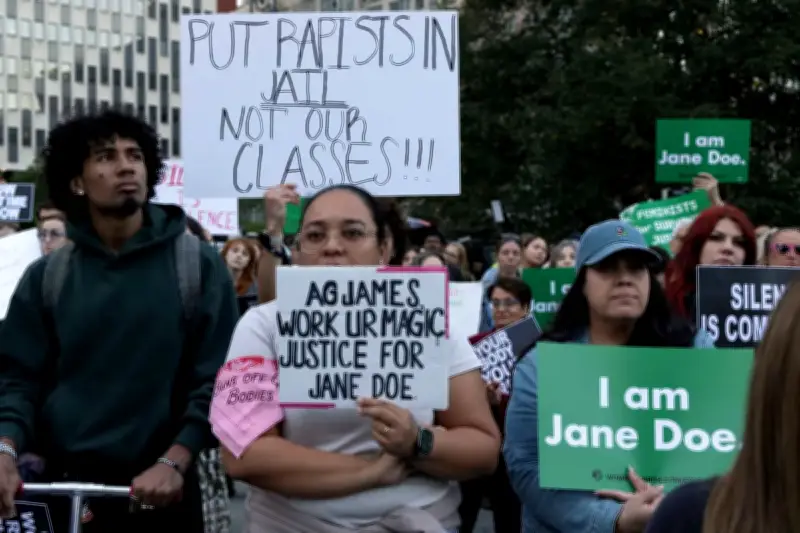
Tens of thousands of protesters gathered at city halls and college campuses across the US on Thursday to demand an end to sexual violence. The nationwide rallies followed weeks of public outcry over the mishandling of campus sexual assault cases at Cornell University and Louisiana State University.
The protest organizers – including Women’s March, Feminist Generation and Me Too International – demanded justice for Jane Doe, who said she was drugged and gang-raped by seven students at a Cornell frat party; Kendall Francis, who said she was raped by an LSU football player; and all survivors harmed “from the frat house to the White House”. They also called for reform of Title IX, a set of protections for sexual misconduct victims and LGBTQ+ students that the Trump administration has slowly stripped away.
Rally draws men of all ages
The latest cases have outraged college students and their families over the pervasiveness of rape culture; 81% of women and 43% of men in the US said they have experienced sexual harassment or assault, according to the National Sexual Violence Resource Center. Parents online are questioning how to raise sons who will stand up to sexual violence instead of being bystanders. Women, survivors and longtime advocates say the onus has often been on them to use the momentum in moments like these to educate others and demand concrete change.
While the demographic makeup of the crowd at the Stop Sexual Violence rally in New York City was majority women, men of all ages were there, too, holding “I Am Jane Doe” signs and yelling to end rape culture. We asked six of them how they are personally taking a stand against rape culture.
Men share their personal commitments
Kaif Gilani, 29, said: “Too often, we see that after a big uproar and high-profile news, that the only people standing up and attending protests are women or female-identifying folks. It’s really important for men to step up and say: ‘Hey, I need to put an end to this in any way that I can in my day-to-day life.’ We need to try to make a difference in our own communities, whether that’s speaking up against frat brothers who say something toxic or misogynistic in the chat, or going out and attending events like the Women’s March.”
Ben Tee, 42, highlighted legislation: “There’s some really important legislation in the New York state legislature to make consent education a mandatory part of the school curriculum. I’m in Democratic party leadership, and we just passed a resolution last week supporting a framework for teaching consent. I actually think that’s the most important thing that we can do. People are talking about increasing penalties and closing the voluntary intoxication loophole, which is super important. But the reality is that we don’t get [sexual assault] convictions, the police don’t take [sexual assault] seriously and DAs do not prosecute. We need to be doing a lot more in prevention. After the assault is just too late. There have been really good studies that show that consent education can have a huge impact on reducing the rate of victimization and perpetration, and nobody talks about it at all. It’s a real, real shame.”
Teaching and awareness as tools
Peter Walsh, 64, said: “I know from my own experiences as a man that many boys need to be taught what is appropriate, and when consent means consent. Men need to do more teaching.”
Nicola Francia, 21, said: “It really starts with reconsidering your own position and understanding where it is near you, and in you. I’m from Italy, and there was a girl from my high school who was killed by her ex. In my home country, there has been a lot of mobilizing around this issue. It’s very evident that [rape culture] is near us, all across the country, in our society. There were cases in my social life where I wish I had been more present for the women I know. They have felt uncomfortable in social situations with guys being creepy when they were intoxicated. We all have to be very aware of whether someone is feeling uncomfortable or whether you are making someone uncomfortable.”
Shalin Upadhyay, 27, said: “I see rape culture as something that starts from little moments – how people talk, how women are treated. The language that we use when we talk to women or talk about them is objectifying. Those things are normalized, and then that’s what turns into something bigger, like rape. And when rape happens, it’s also not seriously considered. It always turns into victim-blaming. I’ve seen that, and I want to stand against that.”
Daniel Olivier, 37, said: “I grew up in the punk rock scene, and when things happened, we took action. You got your head kicked in if you did something bad. I wish that would happen more often. I know that’s not the right thing to say, and I don’t stand for violence. But the violence that [abusers] are doing to us is so much worse. In my current life, just being in New York, it’s constant. You can’t sit at a bar without overhearing people saying disgusting things about women. I worked in the music industry and the alcohol industry, and I’ve been surrounded by it my entire life. I’ve spent my whole life fighting against this stuff.”